
Question-led guide · how-to
How do I build an ontology from workflow evidence?
Derive a small ontology from decisions, records, exceptions, and competency questions rather than from a large noun inventory.
Direct answer
Begin with a business decision and the records people inspect to make it. Identify entities, relations, states, and exceptions that change the answer. Write competency questions and sample cases before choosing RDF, OWL, or another storage form. Validate the resulting definitions with domain owners and counterexamples. A useful ontology earns its scope through a workflow it can explain, not through the number of classes it contains.
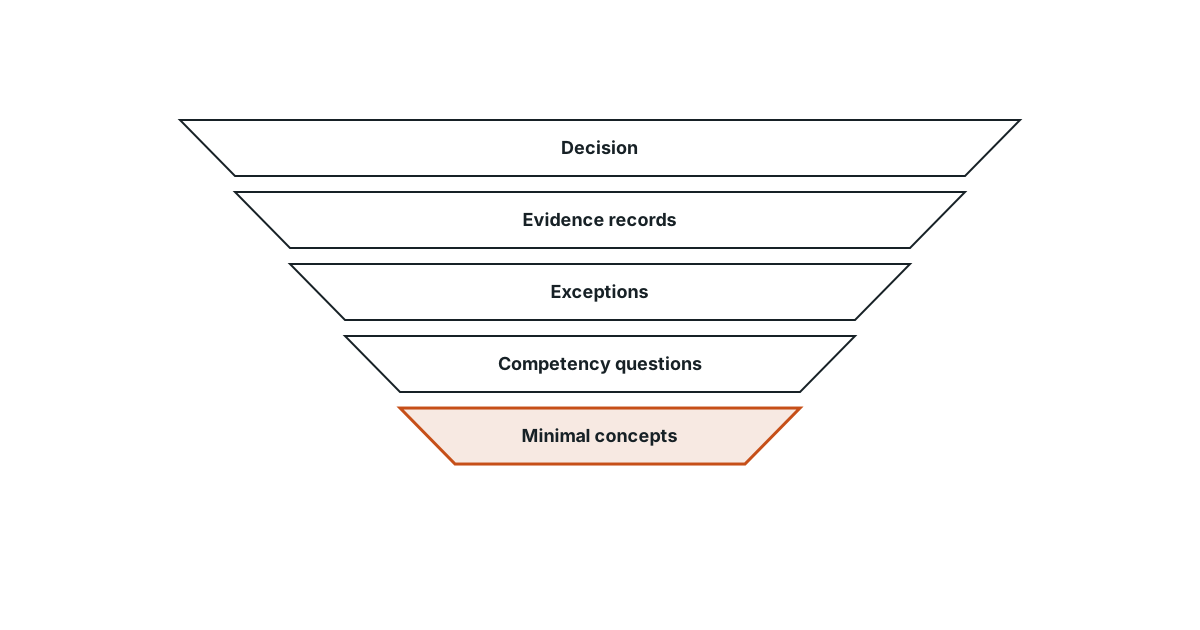
Start where a wrong answer changes work
Ask what the analyst, agent, or operator is deciding. Collect examples of the records used, including cases that were rejected or escalated. A noun list often contains broad labels such as customer and product but omits the state or exception that determines the actual decision. Make the smallest decision boundary the unit of discovery.
Use competency questions as acceptance tests
Write questions the ontology must answer, such as which accounts were eligible at a particular time and why. For each question, identify required entities, relations, provenance, and missing-data behavior. Include a counterexample that resembles an eligible case but must be excluded. These tests constrain modeling choices more effectively than an abstract preference for a graph technology.
An eligibility exception changes the model
In a fictional subscription service, an account appears active and owns the right plan, but its contract excludes a trial offer in one region. A generic Account–Plan link cannot explain the refusal. The workflow evidence reveals contract scope, effective date, region, and exception authority. The ontology adds only the relationships needed to answer the eligibility question with a reviewable reason.
Map each concept to evidence
A mapping sheet keeps semantic commitments tied to inspected records.
| Question element | Candidate concept | Evidence and owner |
|---|---|---|
| Active account | State with effective interval | Billing record and finance owner |
| Eligible plan | Contract relation | Product catalog owner |
| Regional exception | Scoped exclusion | Contract policy owner |
| Decision reason | Provenance of applied rule | Eligibility service |
Validate shapes and examples together
Use constraints to catch missing identifiers, impossible state combinations, and wrong relation targets. A passing shape check only proves a data graph satisfies the written shape, not that the shape captures the right business rule. Review the positive and negative examples with domain owners. Record which questions remain outside the first slice and how an agent should respond to them.
Choose representation after the commitment is clear
RDF and OWL offer standardized graph and inference machinery; relational tables or a property graph may also represent a bounded contract. Pick the form that supports the required identity, validation, update, and query work. Do not expand into open-ended inference when the workflow needs a small explicit decision. Version the concepts and mappings so a later exception can be tested without silently changing historical answers.
Evidence boundary for workflow ontologies
- W3C RDF concepts: W3C defines RDF graphs and datasets as a representation framework. The data model does not choose the business concepts for this workflow.
- W3C SHACL: SHACL specifies constraint validation against data graphs. Passing constraints does not establish business-rule correctness.
The eligibility case is constructed. A real ontology needs domain-owner examples and inspected source evidence.
Evidence
RDF provides a graph data model of subject-predicate-object statements.
W3C defines RDF graphs and datasets as a representation framework.
Primary source · standard · checked Oct 7, 2026
Limit: The data model does not choose the business concepts for this workflow.
Shapes can validate constraints on RDF data graphs.
SHACL specifies constraint validation against data graphs.
Primary source · standard · checked Oct 7, 2026
Limit: Passing constraints does not establish business-rule correctness.
Limitations
The mapping sheet is a discovery tool and does not constitute a complete enterprise ontology or implementation recommendation.
FAQ
- Should I model every noun in the business glossary first?
- No. Start with the concepts needed to answer a consequential workflow question, then expand through tested needs.
- Does SHACL validation mean the ontology is right?
- No. It checks the written constraints; domain examples and decision outcomes test whether those constraints are the right ones.
Related guides
Continue within Evolving semantic layers for data agents, or use one of these adjacent diagnostics:
Editorial QA: automated native-English, structure, source-presence, and link checks completed . This record is not an independent expert endorsement. Review boundary.