
Question-led guide · decision
When should an alert use an adaptive threshold?
Choose between a fixed rule and an adaptive threshold by measuring incident detection, noise, reset behavior, and change sensitivity.
Direct answer
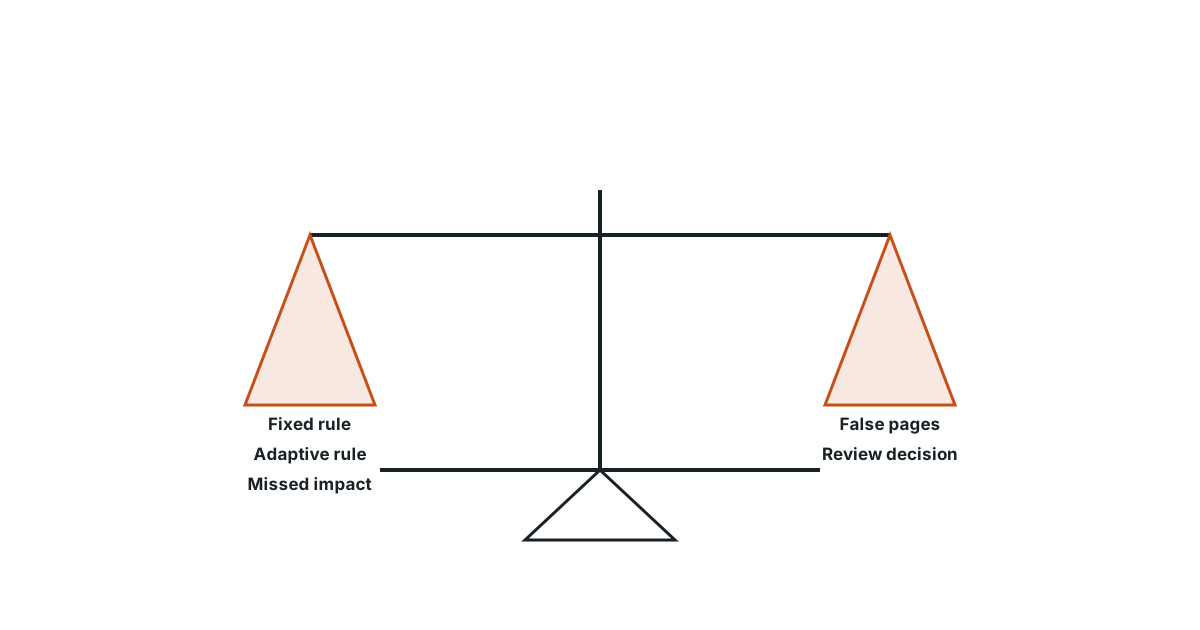
Use an adaptive threshold only when a stable fixed rule cannot represent the service’s predictable variation and the new method improves an explicitly named pager decision. Compare both rules on the same incident history, including quiet periods, deployments, missing data, and high-impact failures. Keep a fixed safety signal for cases the model may normalize away, and review detection delay and false pages separately.
Start from the page that would change an action
Name the condition for which a person should interrupt other work. A rising latency curve may be interesting without being actionable; an error-budget burn or a failed checkout path can justify a page. Specify the owner, expected response, and maximum useful detection delay before selecting a threshold method. The alert is a decision interface, not a classifier accuracy contest.
Seasonality can hide both noise and damage
A learned baseline may account for predictable daily traffic, but it can also absorb a slowly growing fault. A fixed threshold can be transparent yet page repeatedly at every legitimate peak. Compare the rules on identical windows and separate data missingness from healthy low traffic. If a model needs a week of history, say what happens during a new service launch or after a major release.
A Friday promotion distorts the baseline
In a constructed shop scenario, ordinary checkout traffic peaks at 2,000 requests per minute. A promotion doubles volume while the failure ratio rises from 0.2% to 3%. A volume-sensitive latency baseline may treat the increase as expected and stay silent. The operator retains a simple failure-ratio safety rule, then tests whether the adaptive latency rule adds useful warning without repeating the same page.
Record the competing alert policies
Use one decision card for both candidates. It keeps threshold settings beside the operational outcome they are meant to protect.
| Field | Fixed candidate | Adaptive candidate |
|---|---|---|
| Trigger | Explicit impact ratio and window | Baseline deviation with versioned training window |
| Cold start | Works immediately | Falls back to named safety rule |
| Review | Misses and noisy periods | Misses, noisy periods, and drift |
Replay the same hard windows
Include confirmed incidents, maintenance, deployment rollouts, quiet hours, and missing telemetry. Count significant events detected, pages without useful action, time to page, and time to clear. A low page count is ambiguous: it may indicate improved precision or suppressed important failures. Record incident labels and disputed cases so a reviewer can inspect the denominator rather than only a dashboard score.
Retire a rule only with an escape path
Keep the fixed safety signal until the adaptive rule has survived representative operating conditions and the team can disable it quickly. A changed traffic mix, instrumentation revision, or missing feature should put the adaptive result into an unknown state. Make the fallback visible to on-call staff and compare behavior after release; a model that stopped paging is not evidence that impact disappeared.
Evidence boundary for adaptive alert thresholds
- Google SRE alerting on SLOs: Google SRE evaluates alert strategies using precision, recall, detection time, and reset time. It does not prescribe an adaptive model for this fictional shop.
- Prometheus alerting practices: Prometheus documents alerting practices and the need for meaningful notification behavior. The page does not validate the invented thresholds or traffic pattern.
The example rates are invented. Local incident labels and pager consequences are required before any threshold can be accepted.
Evidence
Actionable alerting must consider precision, recall, detection time, and reset time.
Google SRE evaluates alert strategies using precision, recall, detection time, and reset time.
Primary source · official-doc · checked Oct 7, 2026
Limit: It does not prescribe an adaptive model for this fictional shop.
Alert rules should be actionable and avoid unnecessary pages.
Prometheus documents alerting practices and the need for meaningful notification behavior.
Primary source · official-doc · checked Oct 7, 2026
Limit: The page does not validate the invented thresholds or traffic pattern.
Limitations
The decision card describes a review method, not an approved threshold. It requires representative local incidents, labeled non-incidents, and a tested fallback.
FAQ
- Should every noisy alert become adaptive?
- No. First remove duplicate or non-actionable pages and inspect whether a simple service-level rule already solves the problem.
- Can a quiet model prove the service is healthy?
- No. A missing input or a model that learned a slow failure can also produce quiet output; retain independent impact checks.
Related guides
Continue within AIOps alerting and operations, or use one of these adjacent diagnostics:
Editorial QA: automated native-English, structure, source-presence, and link checks completed . This record is not an independent expert endorsement. Review boundary.