
Question-led guide · governance
What provenance should a semantic-layer claim retain?
Attach source, transformation, owner, validity, and confidence to definitions so agents can inspect how a business claim was formed.
Direct answer
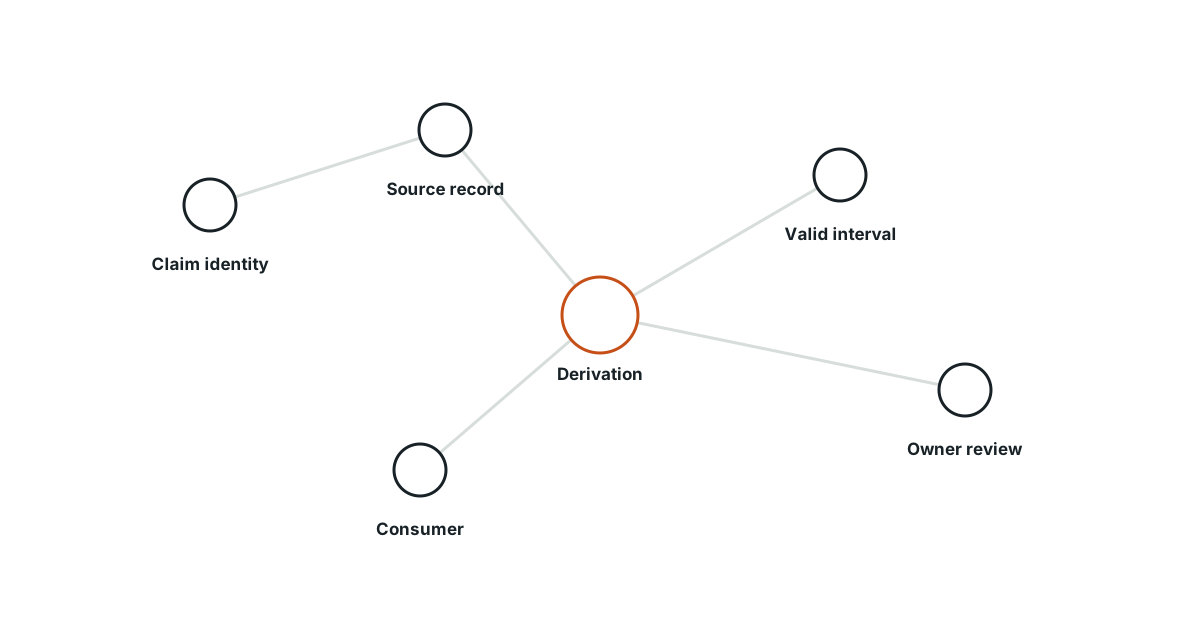
A semantic claim should carry its subject and rule together with source evidence, transformation or derivation, owner, valid-time interval, and the time it was observed or approved. Keep declared rules separate from measured facts and inferred links. This record lets an agent cite the correct revision and lets reviewers challenge stale or conflicting assertions. Provenance describes lineage; it does not by itself prove that the business rule is right.
A definition is a claim with a history
A field called active_customer can hide a policy decision about activity window, account state, and excluded test tenants. Record the exact assertion rather than only a name. Give it an identifier and revision so a data agent can say which rule it used. If the definition changes, preserve the old claim for historical interpretation instead of overwriting it in place.
Keep source, derivation, and approval distinct
The data source may show transactions, a transformation may derive customer activity, and a policy owner may approve the threshold. These are separate authorities. A lineage graph explains how a dataset came to be; it does not certify the business choice embedded in a transformation. The semantic record should point to both the technical derivation and the accountable decision that made the rule official.
A report crosses the validity boundary
In a fictional analytics team, “active” meant one purchase in 90 days until July, then one in 60 days. An agent preparing a June comparison retrieves only the current 60-day rule and describes historical numbers as if they were computed under it. The provenance record exposes the valid interval. The agent either retrieves the earlier rule or explains that the report has been restated under a new definition.
Use a provenance record per assertion
Store the minimum fields required to reopen the claim.
| Field | Purpose |
|---|---|
| Claim and revision | Stable reference for consumers |
| Source and transformation | How underlying observations were produced |
| Owner and approval | Who accepted the business rule |
| Valid interval | When the rule applied |
| Recorded time | When the system learned of it |
| Status | Supported, contested, or retired |
Check a claim against its source path
Trace a sample answer to its metric revision, transformed table, input dataset, and approval note. Verify that the source timestamps and valid interval fit the user question. If a lineage event is missing, show that gap rather than substituting a plausible adjacent source. A claim can remain contested even when every technical job in its lineage ran successfully.
Give consumers an honest uncertainty state
An agent should be able to return “definition conflict” or “source unavailable” with identifiers. Never promote a model-generated explanation into an approved business definition merely because it is fluent. Reconciliation may require a finance or product owner, and the final resolution should create a new provenance event. Historical answers retain references to the rule that actually governed them.
Evidence boundary for semantic claim provenance
- W3C PROV-O: PROV-O defines reusable terms for source and derivation relationships. Its vocabulary does not decide whether a business metric rule is correct.
- OpenLineage object model: OpenLineage documents dataset and job metadata alongside runtime events. A lineage event does not replace semantic-rule approval.
The 90-day and 60-day policies are invented. Real claims need exact effective dates and approved source records.
Evidence
Provenance can represent entities, activities, agents, and their relationships.
PROV-O defines reusable terms for source and derivation relationships.
Primary source · standard · checked Oct 7, 2026
Limit: Its vocabulary does not decide whether a business metric rule is correct.
Lineage events distinguish job runs, jobs, and datasets.
OpenLineage documents dataset and job metadata alongside runtime events.
Primary source · official-doc · checked Oct 7, 2026
Limit: A lineage event does not replace semantic-rule approval.
Limitations
The record format supports inspection but cannot resolve conflicting policy or missing source evidence on its own.
FAQ
- Is a data-lineage graph enough for semantic provenance?
- No. It traces technical production; the business rule and its approving owner must also be recorded.
- Should old definitions be deleted after a change?
- Preserve them for historical interpretation and mark their validity, unless a separate retention policy requires lawful deletion.
Related guides
Continue within Evolving semantic layers for data agents, or use one of these adjacent diagnostics:
Editorial QA: automated native-English, structure, source-presence, and link checks completed . This record is not an independent expert endorsement. Review boundary.