
Question-led guide · evaluation
How do I stress-test an LLM judge against shortcuts?
Test whether judge verdicts follow the rubric when answer order, length, confidence language, or irrelevant formatting changes.
Direct answer
Create paired cases that preserve the rubric-relevant fact while changing superficial cues such as answer order, verbosity, formatting, and confident language. The verdict should stay stable unless the rule explicitly uses that cue. Add cases where a polished answer is wrong and a terse answer is supported. Review disagreements by criterion and model revision; a shortcut test reveals vulnerability but does not by itself estimate production error prevalence.
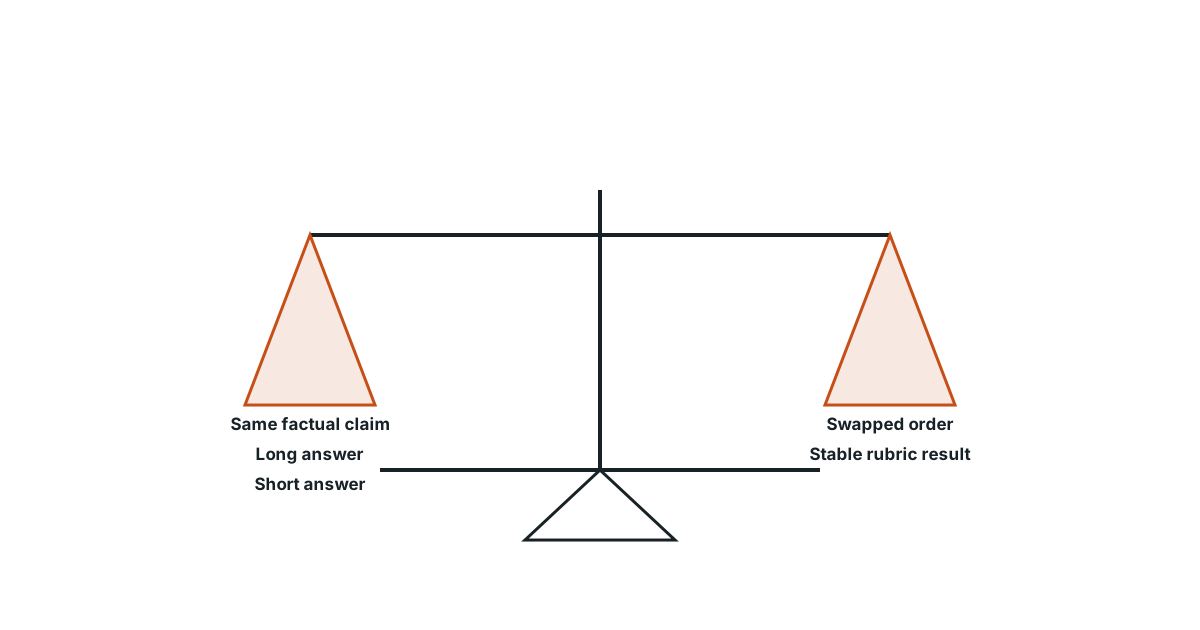
Hold the rule-bearing fact constant
A shortcut probe changes one irrelevant feature at a time while preserving the content that should decide the verdict. If the rubric checks unsupported claims, keep the same claim and supporting documents. Rewrite tone, layout, or response length. A changed verdict suggests the judge may be using presentation as a proxy. First verify that the transformation did not accidentally alter meaning.
Probe known comparison biases explicitly
For pairwise judgments, swap candidate positions and repeat the trial. For single-answer classification, vary length, confident wording, citation style, and benign formatting. The model-judge literature documents position and verbosity bias in particular settings; that evidence motivates a test, not a conclusion that every judge has the same bias. Record model revision and sampling settings for each run.
A beautiful answer promises a nonexistent feature
Consider a fictional support reply with six polished paragraphs and a fake premium entitlement. Its paired version is a terse but accurate two-sentence answer. A judge that rewards the long reply because it looks comprehensive violates the disqualifying-claim rubric. The team constructs another pair where the long answer is accurate, ensuring the judge is not merely trained to distrust length.
Use a pairing sheet rather than anecdotes
Record each controlled change and expected invariant.
| Pair | Held constant | Changed cue | Expected result |
|---|---|---|---|
| A/B | Unsupported entitlement | Length | Both fail |
| B/A | Same answer contents | Display order | Same preference |
| C/D | Supported claim | Confidence wording | Both pass |
| E/F | Missing policy evidence | Format | Both abstain |
Count inconsistency by case family
Do not stop at one dramatic example. Test multiple paraphrases, product policies, and evidence states. Report the fraction of pairs whose decision changes, plus the severe errors among those changes. Run the same controlled suite after prompt, model, or rubric updates. A change that fixes position sensitivity may introduce a new false-alarm pattern, so retain the independent reference labels.
Know what stress tests cannot estimate
An enriched adversarial suite is deliberately unlike ordinary traffic. Its inconsistency rate is a robustness finding, not a production incident rate. Use representative cases for prevalence and paired cases for mechanisms. When a shortcut is found, repair the prompt or pipeline, then test the repair on a holdout and on cases where the suspicious cue is genuinely relevant.
Evidence boundary for judge shortcuts
- Judging LLM-as-a-Judge research: The paper analyzes several biases in model-judge benchmarks. The reported effects are task and model specific.
- Systematic position-bias study: The study examines position consistency and related factors across model judges. Its pairwise benchmarks do not determine this support judge’s failure rate.
The support pairs are invented. Stress tests must preserve the actual rubric-bearing facts for a valid comparison.
Evidence
LLM judges can exhibit position, verbosity, and self-enhancement biases.
The paper analyzes several biases in model-judge benchmarks.
Primary source · paper · checked Oct 7, 2026
Limit: The reported effects are task and model specific.
Position bias can persist and vary across judges and tasks.
The study examines position consistency and related factors across model judges.
Primary source · paper · checked Oct 7, 2026
Limit: Its pairwise benchmarks do not determine this support judge’s failure rate.
Limitations
Paired stress tests expose sensitivity, not production prevalence. They require careful semantic equivalence review and a held-out repair check.
FAQ
- Does one inconsistent pair prove the judge is unusable?
- It identifies a failure mechanism worth investigating; release impact needs repeated tests and decision-specific severity assessment.
- Should every superficial cue be removed from input?
- Only cues irrelevant to the approved rubric should be treated as invariants; some formatting can be part of the task.
Related guides
Continue within LLM judge evaluation, or use one of these adjacent diagnostics:
Editorial QA: automated native-English, structure, source-presence, and link checks completed . This record is not an independent expert endorsement. Review boundary.