
Question-led guide · governance
What must an audit trail record after an AI agent changes something?
An audit-and-effect envelope connecting request, proposal, evidence, authorization, identity, parameters, target versions, attempts, and verified outcome.
Direct answer
After an agent changes something, the audit trail must connect the original request, agent and software identity, typed proposal and parameter digest, evidence used, policy and approval decision, delegated credential reference, target identity and pre-change version, each attempt, idempotency key, actual effect or unknown outcome, verification, compensation, and human handoff. Protect log integrity and secrets; model rationale is context, not proof.
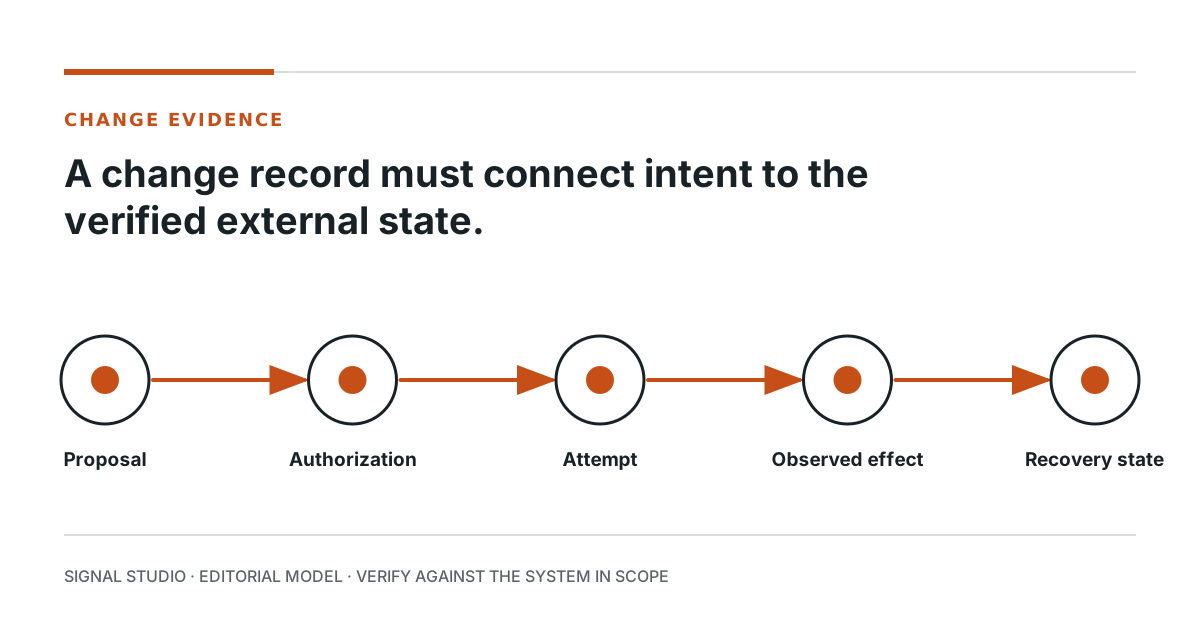
Audit starts with the effect to reconstruct
Use this envelope for agent-initiated changes to data, configuration, access, infrastructure, communications, purchases, or other durable state. Read-only access logging may use a reduced form. The audit store is separate from conversational memory and ordinary application logging.
Why model transcripts leave causal gaps
Agent systems produce many partial records. The chat has the request, the orchestrator has a plan, the gateway has a tool call, identity has a token event, the target has a change, and observability has spans. None alone explains who authorized which exact proposal or whether the intended effect occurred.
Teams often save the model’s final statement as the summary. It may say “deployment succeeded” even though the gateway only accepted a job. Conversely, logging every prompt and argument creates secrets and personal-data exposure without guaranteed audit integrity.
A firewall rule with an unknown response
The network API times out after receiving a rule change. The audit record retains the proposal digest, approver, capability, attempt ID, and target; a read-back later records whether the rule exists before the system retries or compensates.
Rebuild one change from evidence
Select one production change and perform a bidirectional trace. Starting from the user request, reach the exact target version after the change. Starting from the target effect, identify actor, agent version, task, proposal, policy, approval, credential, attempt, and evidence.
Check these failure cases:
- request timed out after target commit;
- a retry used the same or a different idempotency key;
- approval expired before execution;
- target state changed after approval;
- compensation ran partially;
- a log sink was unavailable.
The audit system should represent unknown and audit_degraded, not manufacture a clean story.
Join intent, authority, attempt, and observation
Create an audit event schema and append events at authoritative boundaries: proposal creation, policy decision, approval, credential issuance reference, tool attempt, target receipt, effect verification, compensation, denial, and handoff. Use stable task, action, proposal, target, and effect identities.
Canonicalize and hash sensitive parameters where reviewers need integrity but not routine visibility; retain protected originals only under defined access and retention. Never log bearer tokens or secrets. Send audit events through a protected path with access logging, clock discipline, integrity controls, retention, and outage behavior.
Cross-reference traces for timing and diagnosis. Build human-readable incident views from audit facts rather than storing only prose summaries.
Audit-and-effect envelope
The audit-and-effect envelope includes:
request: {id: ..., actor: ..., tenant: ..., purpose: ..., received_at: ...}
agent: {workload: ..., software: ..., model: ..., prompt_policy: ...}
proposal: {id: ..., operation: ..., target: ..., parameters_digest: ..., evidence_refs: [...]}
authorization: {decision: ..., policy: ..., approval: ..., expires_at: ...}
credential_ref: {issuer: ..., audience: ..., scope: ..., token_ref: ...}
attempt: {id: ..., tool: ..., schema: ..., idempotency_key: ..., trace_ref: ...}
target: {canonical_id: ..., version_before: ..., version_after: ...}
effect: {state: committed|failed|unknown, receipt: ..., verified_at: ..., verifier: ...}
recovery: {compensation: ..., residual_effects: ..., handoff: ...}
integrity: {event_ids: [...], sink: ..., retention_class: ..., access_class: ...}
Records that look complete but cannot answer an incident
- Treating the final agent message as effect evidence.
- Logging raw credentials or sensitive payloads into general traces.
- Recording allowed actions but omitting denials and expired approvals.
- Using display names instead of canonical target IDs and versions.
- Storing records without integrity, access, retention, or sink-failure policy.
Evidence
Security log management requires planning for generation, transmission, storage, analysis, protection, retention, and operational responsibilities.
NIST SP 800-92 provides guidance for enterprise computer-security log management and lifecycle practices.
Primary source · standard · checked Aug 26, 2026
Limit: The 2006 guide predates modern agent systems and does not specify tool proposals, model versions, or delegated agent effects.
MCP tool invocation has distinct protocol requests, results, errors, and security responsibilities that can be represented in audit records.
The MCP tools specification defines discovery and invocation messages and discusses validation, access control, confirmation, and result handling.
Primary source · standard · checked Aug 26, 2026
Limit: The protocol record does not establish the business effect, current authorization, or integrity of a particular tool server.
Agent audit should join decision evidence to target-side effect evidence with stable identities and immutable version references.
The envelope below makes post-change investigation possible without treating the agent transcript as the system of record.
Signal Studio author framework · reviewed Aug 26, 2026
Limit: Tamper resistance, retention, access, and admissibility requirements depend on system risk, regulation, and organizational policy.
Limitations
Audit records can be incomplete, delayed, tampered with, or too sensitive to centralize. External targets may not provide receipts, and log retention can conflict with data minimization. Design controls with security, privacy, legal, and operations stakeholders.
FAQ
- Should the audit log store the agent's chain of thought?
- No. Preserve task inputs, proposals, evidence references, tool calls, policy decisions, outputs, and effects. Free-form rationale can be useful but is neither necessary nor reliable proof and may expose sensitive content.
- Is an OpenTelemetry trace an audit trail?
- It can supply timing and correlation evidence, but audit often needs stronger completeness, integrity, access, retention, denial, and effect semantics. Link the systems rather than assuming one replaces the other.
Related guides
Continue within AI agent security, or use one of these adjacent diagnostics:
Editorial QA: automated native-English, structure, source-presence, and link checks completed . This record is not an independent expert endorsement. Review boundary.