
Question-led guide · diagnostic
AI helps me code faster—why am I learning less?
A judgment-loop diagnosis for developers who are shipping faster with AI but retaining less understanding, transfer, debugging skill, and design confidence.
Direct answer
Speed removes some of the mental work that used to create learning: predicting behavior, choosing among constraints, retrieving concepts, explaining failures, and correcting a model of the system. If AI supplies both the implementation and the explanation, you may complete the task without practicing those decisions. Keep the speed, but add deliberate checkpoints: predict before running, explain without the assistant, test a failure, change a constraint, and record what transferred.
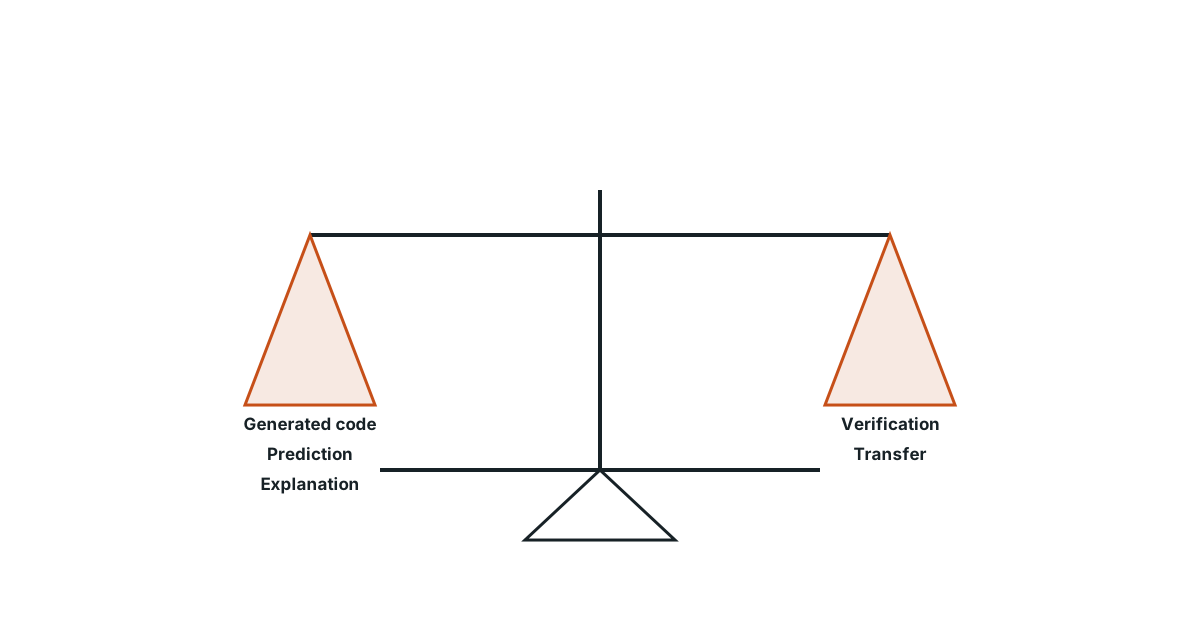
Separate delivery from capability
This is for developers who can complete AI-assisted tasks but struggle to explain behavior, debug without the assistant, or reuse the idea later. It addresses practice design, not clinical cognition, employee surveillance, or a universal ban on generated code.
How generated fluency hides weak models
Completion and learning are different outcomes. A generated change can pass tests while the developer skips retrieval, prediction, option comparison, and error correction. Explanations generated after the fact can also create recognition without recall: the text feels familiar, but the developer cannot reconstruct the reasoning when the interface is gone or the constraints change.
The cache fix nobody can explain
A developer accepts an AI-generated cache invalidation patch because tests pass. When asked to predict behavior after a concurrent write, the explanation collapses; the task is reopened with a state model and a failure test before merge.
Audit what you predicted and verified
Choose a recently completed change and answer without the assistant:
- What user and system outcome was required?
- Why did this design fit the constraints better than two alternatives?
- What state transition or invariant makes it correct?
- Which failure did the tests not cover?
- What would break if latency, concurrency, data volume, or trust changed?
- Can you locate and fix a seeded defect using runtime evidence?
- Can you apply the same concept in a different codebase or language?
Difficulty answering identifies the missing practice; it does not mean the delivered code has no value.
Turn fast output into a judgment loop
Use AI in stages. First write a prediction and decision sketch. Ask the model for alternatives or implementation only after you have named constraints. Before running generated code, predict output and failure behavior. After tests, explain the mechanism in your own words, then inspect evidence that could falsify the explanation. Finally, change one constraint and adapt the solution without replaying the same prompt.
Reserve regular no-assistant intervals for retrieval and debugging. The purpose is not purity; it is to measure whether the skill remains available when the tool is absent or wrong.
Judgment-loop worksheet
| Step | Your evidence |
|---|---|
| Frame | User, outcome, constraints, and unacceptable failure |
| Predict | Expected behavior and one predicted failure before execution |
| Choose | Two alternatives and the tradeoff that selected this design |
| Inspect | Runtime, test, or code evidence that supports or weakens the prediction |
| Explain | Mechanism stated without assistant text |
| Transfer | Changed constraint and adapted solution |
| Remember | One corrected assumption added to an engineering note |
Signals that speed is consuming learning
- Equating a passing test suite with understanding.
- Asking the model to explain its own code and treating fluency as your recall.
- Practicing only greenfield generation while avoiding debugging and maintenance.
- Measuring learning by prompt sophistication instead of transfer and independent reasoning.
- Rejecting all AI assistance instead of designing where judgment practice occurs.
Evidence
Higher confidence in generative AI was associated with lower self-reported critical-thinking effort in a survey of knowledge workers.
The CHI 2025 publication reports survey-based relationships among confidence, perceived effort, and critical-thinking practices during knowledge work.
Primary source · paper · checked Aug 25, 2026
Limit: The study is self-reported, covers knowledge work rather than this specific coding protocol, and does not prove that AI use causes skill loss.
Human roles, oversight, and risk responsibilities should be defined across an AI system's lifecycle.
The NIST AI RMF Core includes outcomes for defining human-AI roles, responsibilities, context, measurement, and ongoing risk management.
Primary source · official-doc · checked Aug 25, 2026
Limit: The AI RMF is a risk-management framework, not an educational study or a prescription for individual learning.
Learning can be made observable through prediction, explanation, transfer, and failure drills.
The judgment loop creates evidence that a developer can reason beyond the generated artifact and adapt the concept to a changed condition.
Signal Studio author framework · reviewed Aug 25, 2026
Limit: The worksheet is a practice framework, not a validated psychometric instrument.
Limitations
This guide does not claim that AI-assisted coding inherently reduces learning or that one routine works for every person. It offers an observable practice loop. Formal education, accessibility needs, prior experience, task difficulty, and tool design can change the outcome.
FAQ
- Should I stop using AI while learning?
- Not necessarily. Change how you use it: ask for alternatives and counterexamples, make your own prediction first, and reserve some tasks for independent retrieval and debugging.
- Does understanding every generated line prove mastery?
- It is necessary for accepting the change, but transfer is stronger evidence. Change a constraint or reproduce the mechanism in a new problem without copying the original solution.
Related guides
Continue within Engineering judgment with AI, or use one of these adjacent diagnostics:
Editorial QA: automated native-English, structure, source-presence, and link checks completed . This record is not an independent expert endorsement. Review boundary.