
Question-led guide · how-to
How do I build a task portfolio instead of a benchmark shrine?
A versioned portfolio method that represents task families, users, frequency, risk, difficulty, tools, environments, and changing production failures.
Direct answer
Build the portfolio from product decisions and failure exposure, not from a pile of convenient examples. Define task families, user and environment segments, frequency, risk, tool requirements, difficulty, and serious failures. Give every task a versioned card and expected decision meaning. Sample production failures into a review queue, but protect calibration and release sets from tuning. Retire, split, or add tasks when the operating distribution changes.
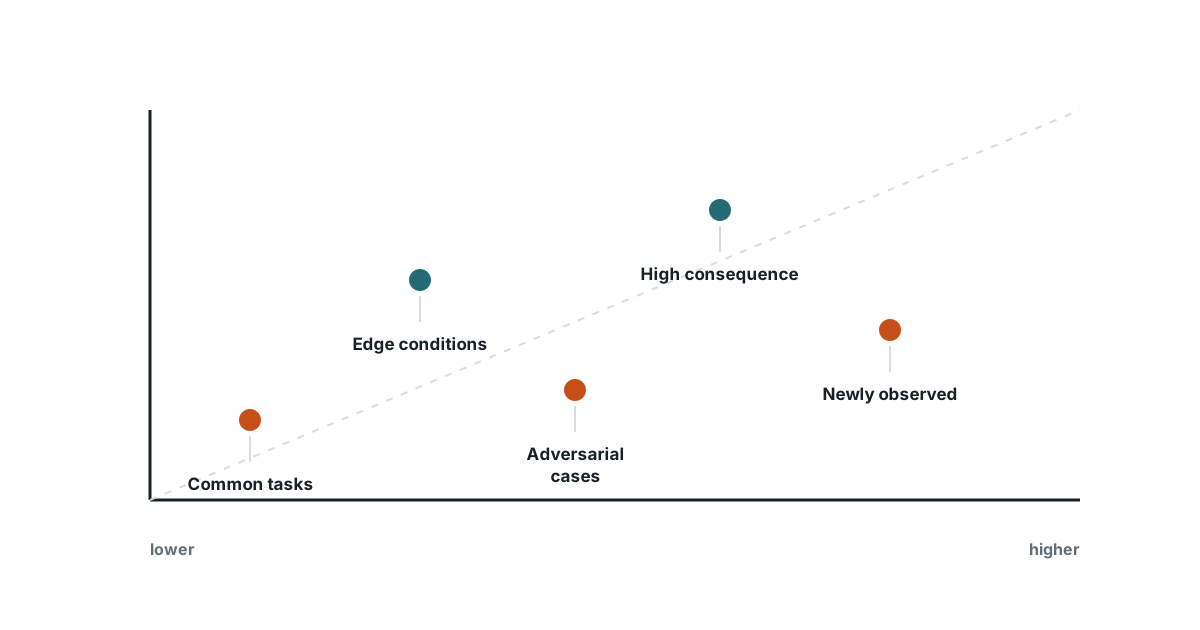
Represent the work distribution
This method is for product teams maintaining an evaluation program across releases. It assumes task examples can be governed, versioned, and connected to environments. It does not require all production data to be copied into an evaluation set.
Why favorite prompts create a shrine
Benchmarks accumulate prestige and technical debt. Teams tune toward what is scored, preserve old cases because trend lines look stable, and add examples without removing obsolete tasks. The result is a high score on a world the product no longer inhabits.
Support automation beyond happy-path tickets
The portfolio weights common password resets, ambiguous billing cases, adversarial attachments, cross-tenant risks, and rare account closures. Each card includes environment state, tools, budgets, reset rules, and serious-failure labels.
Sample frequency, variation, and consequence
Create a coverage matrix and look for empty cells across:
- task family and user segment;
- common, uncommon, and rare-but-serious frequency bands;
- low, medium, high, and prohibited risk;
- normal, degraded, ambiguous, and adversarial environments;
- read-only, proposed effect, approved effect, and human-review paths;
- easy, boundary, compositional, and long-horizon difficulty;
- supported and accessibility-critical locales or modalities.
Then trace every portfolio weight to demand evidence, risk ownership, or an explicit conservative assumption.
Maintain a living task portfolio
Maintain separate sets: development for iteration, calibration for grader and threshold work, and decision sets protected from routine tuning. Store task cards in version control and bind each run to task, environment, model, prompt, tool, policy, and grader versions.
Use two result views. The prevalence view estimates common product behavior with frequency-aware weights. The risk view applies hard gates and deliberate sampling to serious failures. Add production failures through a review process that removes private data, confirms the failure family, and prevents near-duplicate inflation.
Agent task card
Download the agent evaluation task card. It contains synthetic data and fields for initial state, outcomes, tools, budgets, fault injection, resets, deterministic checks, rubric checks, trace checks, and serious failures.
At the portfolio level, record:
| Field | Purpose |
|---|---|
| task_family | Stable product or workflow grouping |
| segment | User, environment, locale, or risk slice |
| frequency_evidence | Source and date for prevalence assumptions |
| risk_owner | Person or function accepting the serious-failure boundary |
| set_role | development, calibration, or decision |
| weight | Prevalence or deliberate risk weight, clearly labeled |
| introduced_by | Product requirement, incident, red team, support, or research |
| review_or_retire | Date and condition for maintenance |
Coverage numbers that omit serious work
- Treating one benchmark as the product definition.
- Copying production traffic weights into a safety gate without rare-event sampling.
- Tuning on the protected decision set.
- Adding every failure as a new task without clustering the underlying mechanism.
- Deleting retired tasks and making historical results impossible to reproduce.
Evidence
Holistic evaluation requires multiple scenarios and metrics and should make underrepresented areas visible.
The HELM paper organizes evaluation across many scenarios and metrics and explicitly discusses coverage, feasibility, and missing or underrepresented areas.
Primary source · paper · checked Aug 25, 2026
Limit: HELM evaluates language models and is not a direct task-portfolio standard for tool-using production agents.
Evaluation examples should represent real conditions, rare costly cases, and evolving failure modes.
OpenAI's primer recommends real-world examples, edge cases that are rare but costly, expert review, log sampling, and continuous updates as new errors appear.
Primary source · official-doc · checked Aug 25, 2026
Limit: The guidance does not prescribe portfolio weights or local risk thresholds.
Portfolio weights and release slices should be governed by product frequency and risk rather than benchmark prestige.
The portfolio matrix exposes which product populations and serious failures influence a release decision.
Signal Studio author framework · reviewed Aug 25, 2026
Limit: Frequency and risk estimates can be incomplete or contested and must include owner and date.
Limitations
A task portfolio is a governed sample, not the full production distribution. Logging gaps, privacy constraints, user adaptation, and rare events limit coverage. Portfolio weights express an evaluation decision and should not be presented as objective prevalence without evidence.
FAQ
- Should portfolio weights match production traffic exactly?
- Use production frequency for common-outcome estimates, then deliberately overweight rare serious failures for safety gates. Report both views instead of hiding the distinction.
- When should I retire a task?
- Retire or archive it when the workflow, policy, environment, or decision no longer exists. Preserve historical versions so past release claims remain interpretable.
Related guides
Continue within AI agent evaluation, or use one of these adjacent diagnostics:
Editorial QA: automated native-English, structure, source-presence, and link checks completed . This record is not an independent expert endorsement. Review boundary.