
Question-led guide · how-to
How do I calculate cost per AI outcome?
A fully loaded outcome-ledger method that includes accepted, rejected, reversed, and reviewed AI work instead of dividing one provider invoice by request count.
Direct answer
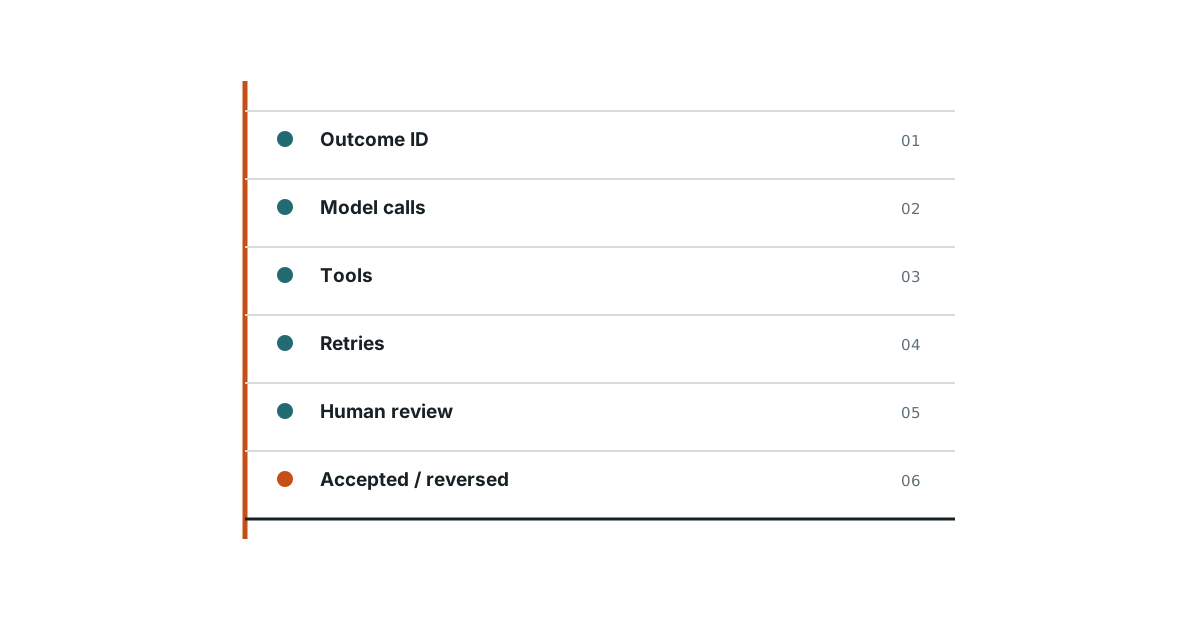
Define the outcome before calculating the rate. Specify acceptance, attribution window, failed and reversed states, then assign every model call, retrieval, tool call, retry, guardrail, review, and allocated platform cost to an outcome record. Divide fully loaded cost by accepted outcomes, while reporting rejected and reversed outcomes separately. Never drop failed attempts from the numerator or let a model request stand in for business value.
Define the denominator before the rate
Use this method for a workflow with an observable outcome, such as a case resolved, document accepted, incident triaged, or approved action completed. Do not use “model response,” “token,” or “session” as the business outcome unless that is truly what the user buys or values.
How request accounting hides failed work
Provider invoices and token counters are easy to collect, while outcome data lives in product systems. Teams therefore divide spend by requests and call the result unit economics. That hides repeated calls, failed tool execution, escalations, review labor, rejected output, and reversals. It also rewards designs that emit fewer expensive requests even when they deliver fewer acceptable outcomes.
Cheaper summaries, more rejected cases
A small model cuts per-request cost by 45% but requires more retries and human correction. The ledger assigns every attempt to the case and shows that cost per accepted summary rose from $0.42 to $0.57.
Build the request-to-outcome join
- Write the outcome in past tense: “case resolved and accepted,” not “answer generated.”
- Define the attribution window and the event that closes it.
- Name
accepted,rejected,abandoned,reversed, andunknownstates. - Trace every request and effect to a stable outcome ID.
- Reconcile model and tool costs with invoices or governed usage exports.
- Choose and document shared platform and labor allocation rules.
- Count records that lack outcome identity or cost identity; report them as coverage gaps.
Calculate fully loaded accepted-outcome cost
Maintain a request-to-outcome ledger at the finest governed level needed for attribution. Aggregate only after reconciliation. For a period and scope:
cost per accepted outcome = fully loaded cost of all attributed attempts / accepted outcomes
Publish companion measures: acceptance rate, reversal rate, unknown-attribution rate, human-review share, retry share, and serious-failure count. Segment by task family or user cohort before comparing routing or model policies. A global average can hide the workflow that consumes the most retries or produces the most expensive reversals.
Cost-per-outcome ledger
Download the cost-per-outcome ledger. Its rows are synthetic and include metadata, accepted, rejected, and reversed examples. Replace the example outcome type, cost sources, quality gate, and allocation notes with approved local definitions.
Minimum fields are outcome ID and type, status, request count, model cost, tool cost, retry cost, human-review cost, allocated platform cost, total cost, quality gate, period, and attribution note.
Unit-economics shortcuts that reward failure
- Dividing total tokens by successful requests while dropping failed and retried work.
- Comparing two models before holding task mix and acceptance criteria constant.
- Treating an outcome proxy as revenue or causal business value.
- Allocating all shared cost by request count when workload intensity differs materially.
- Rewriting historical outcomes after a reversal without preserving the original record and timing.
Evidence
Unit economics connects technology spend to the value or outcome that spending creates.
The FinOps Foundation defines unit economics as bringing technology spend together with value and distinguishes resource-efficiency units from business outcome units.
Primary source · official-doc · checked Aug 25, 2026
Limit: The framework does not prescribe one universal AI outcome, attribution window, or allocation rule.
Provider usage records can supply model-consumption dimensions that must be joined to application outcome identity and other cost sources.
The OpenAI Usage API reference documents usage and cost endpoints with time buckets, grouping, filtering, and provider-side usage records.
Primary source · official-doc · checked Aug 26, 2026
Limit: The API is provider-specific and does not contain complete tool, infrastructure, human-review, reversal, or business-outcome data.
A cost-per-outcome ledger should retain the cost of unsuccessful and reversed work.
Including all attempts prevents a policy from appearing cheaper merely because failures were excluded from the denominator and numerator relationship.
Signal Studio author framework · reviewed Aug 25, 2026
Limit: Allocation choices remain managerial decisions and should be reconciled with finance rather than presented as objective truth.
Limitations
The ledger does not prove causal return on investment and cannot assign value that the organization has not defined. Shared-cost allocation, labor rates, delayed reversals, and incomplete outcome tracking can materially change the result, so publish assumptions and reconciliation status with every metric.
FAQ
- Should human review cost be included?
- Yes when review is required to deliver or validate the outcome. Report the assumption and keep optional research or unrelated management time outside the boundary.
- Can I compare cost per outcome across products?
- Only when the outcome definitions, quality thresholds, attribution windows, and cost boundaries are genuinely comparable. Trends within one controlled scope are usually safer.
Related guides
Continue within AI cost engineering, or use one of these adjacent diagnostics:
Editorial QA: automated native-English, structure, source-presence, and link checks completed . This record is not an independent expert endorsement. Review boundary.