
Question-led guide · how-to
How do I group alerts without hiding separate incidents?
Design alert groups around a shared operational cause and preserve split evidence, ownership, and a path to reopen a merged incident.
Direct answer
Group alerts only when they plausibly describe one response effort, with shared scope, time, and a testable dependency relationship. Retain each original alert and its provenance inside the group. Evaluate over-merging and under-merging separately: one broad incident can conceal a second fault, while many narrow incidents can overload responders. Give the incident commander a visible split and merge decision with an audit trail.
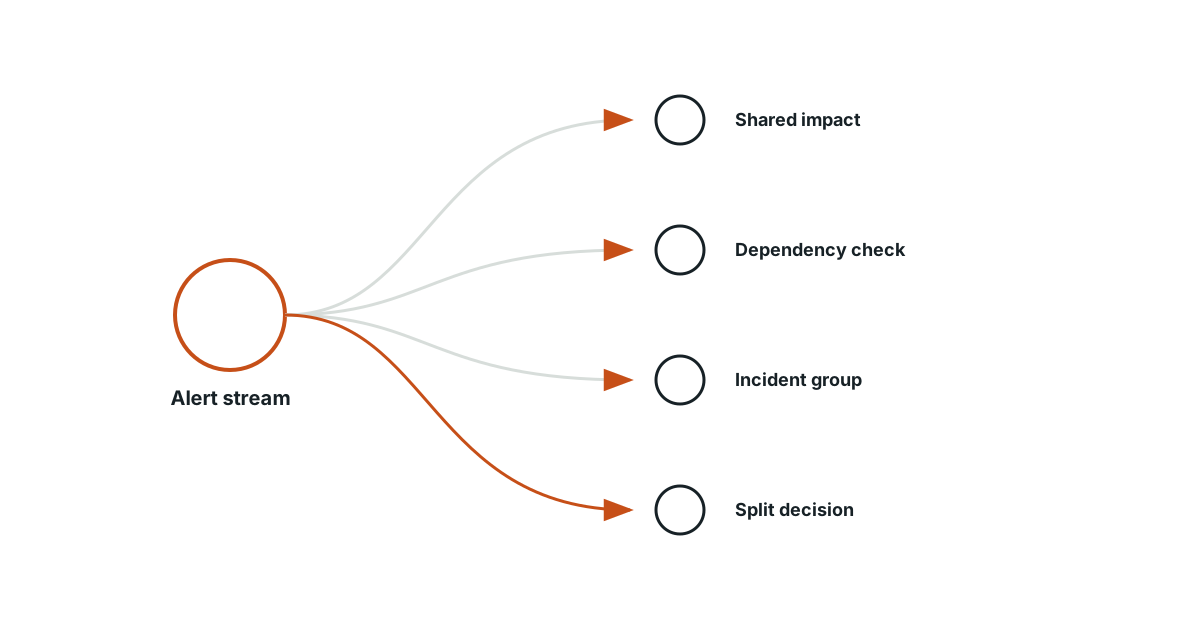
Define the response unit before a clustering key
An incident is a coordinated response to an impact, not merely a bucket of messages. Begin with the customer symptom, affected scope, first observed time, and responsible responders. These fields can be incomplete at declaration, but they must remain distinguishable from an algorithmic similarity score. A service name or region is useful context and too weak to establish one cause on its own.
Similarity is a candidate relationship
Two alerts may fire together because both depend on one database, because one causes the other, or because unrelated faults share a busy minute. Correlation rules should retain the exact alerts, transformation version, and join evidence. An unknown topology edge must not silently become a confirmed dependency. The grouping model can recommend a cluster while a responder still controls incident identity.
Two failures during the same change window
Imagine a release at 14:05 that breaks payment authorization in one region. At 14:07, search latency rises from a separate cache eviction. Both alerts carry the same region and deployment window. A naive group gives the payment incident one owner and buries search. The review finds different user journeys and no tested dependency; the commander splits the group and records why.
Make the grouping record reversible
A compact review table gives operators the evidence and action needed to undo a mistaken grouping.
| Decision input | Retain | Review question |
|---|---|---|
| Impact | User journey and affected population | Same response objective? |
| Relationship | Dependency and source revision | Observed or inferred? |
| Time | First and last event times | One failure window or overlap? |
| Override | Split or merge actor and reason | Can the original alerts be restored? |
Grade the two directions of error
Replay incidents with known response records and ask whether the proposed groups map to the same mitigation effort. Measure over-merging separately from under-merging; their costs differ. Include multi-fault windows, shared infrastructure failures, and duplicated alerts. A single cluster score cannot tell the on-call team whether the system is hiding an independent outage or merely creating extra tickets.
Keep the commander in control of incident shape
Show every constituent alert after grouping and allow a split without losing notes, timestamps, or ownership. A new alert may change the grouping hypothesis, but should not silently rewrite an active incident’s history. When source identity or topology is missing, show a candidate association with explicit uncertainty. The response record remains the source of truth for the active coordination boundary.
Evidence boundary for alert grouping
- Google SRE incident response: Google SRE describes explicit incident roles, coordination, and working records. Its practices do not define a universal clustering algorithm.
- OpenTelemetry resource conventions: OpenTelemetry defines resource attributes for telemetry entity identity. A shared attribute does not establish shared cause or response ownership.
The promotion scenario is constructed. Group quality must be assessed against an organization’s incidents and response costs.
Evidence
Incident response depends on clear coordination, roles, and a working record.
Google SRE describes explicit incident roles, coordination, and working records.
Primary source · official-doc · checked Oct 7, 2026
Limit: Its practices do not define a universal clustering algorithm.
Resource attributes identify telemetry-producing entities and require consistent interpretation.
OpenTelemetry defines resource attributes for telemetry entity identity.
Primary source · official-doc · checked Oct 7, 2026
Limit: A shared attribute does not establish shared cause or response ownership.
Limitations
Grouping recommendations cannot prove causal relationships. Real response records and manual split authority remain necessary, especially during concurrent failures.
FAQ
- Should alerts with the same service label always merge?
- No. A shared label is a candidate join key; impact, timing, dependencies, and response ownership still need review.
- Can an operator undo an automatic group?
- The system should retain source alerts and make split decisions auditable, including the notes and ownership created while grouped.
Related guides
Continue within AIOps alerting and operations, or use one of these adjacent diagnostics:
Editorial QA: automated native-English, structure, source-presence, and link checks completed . This record is not an independent expert endorsement. Review boundary.