
Question-led guide · diagnostic
How do I test an AIOps diagnosis against counterevidence?
Turn an AIOps root-cause suggestion into competing hypotheses, discriminating checks, and a claim whose strength matches the observations.
Direct answer
Treat a diagnosis as a hypothesis with predicted observations and plausible alternatives. Ask which check would distinguish the suggested mechanism from a coincident event, then seek evidence that could disconfirm it. Keep missing telemetry and time uncertainty visible. An AIOps system may prioritize queries and summarize results, but the incident record should state separately what was observed, inferred, and still unknown before any remediation decision.
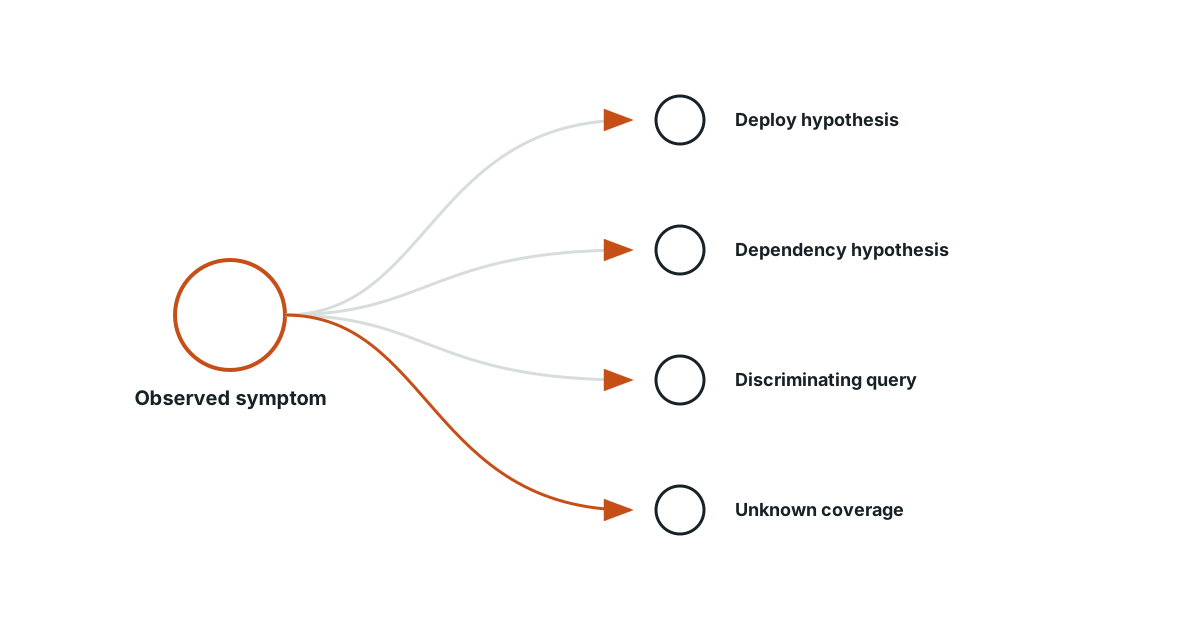
Write the claim at the level evidence supports
A spike in errors is an observation. A changed dependency is context. A statement that one caused the other is a mechanism claim. Keep those levels distinct in the incident record. Ask what the proposed cause predicts that a competing explanation would not. If the answer is only that two events happened near each other, the system has a lead, not a diagnosis.
Prefer discriminating checks over more summary
A model can collect many similar graphs without reducing uncertainty. Select one query that changes the relative credibility of two explanations: compare affected and unaffected cohorts, inspect dependency errors before deployment, or identify the first failing hop. Preserve query scope and timestamps. If telemetry sampling hides the needed population, label the check inconclusive instead of filling the gap with a fluent narrative.
The last rollout is an attractive distraction
In a fictional shop, version 42 was deployed at 11:02. Checkout failures rose at 11:05. The payment provider’s timeout rate, however, began climbing at 10:58, while an unchanged region also failed. The deployment remains relevant because it may change retry behavior, but it is not yet the initiating fault. A region comparison and provider timeline narrow the next check.
Keep a contrast ledger during the incident
Write down the prediction before running each query so the result cannot be reinterpreted after the fact.
| Candidate | Predicted observation | Contrary observation | Next check |
|---|---|---|---|
| Version 42 | Only updated cohort fails | Unchanged region fails | Compare retry paths |
| Provider outage | Timeout precedes rollout | Healthy provider path | Provider status and traces |
| Data gap | Errors absent because traces dropped | Collector healthy | Coverage counters |
Choose a safe stopping point
The team may need to mitigate before it knows a final cause. Record a bounded action and the evidence that supports it, along with the uncertainty left open. Keep diagnosis confidence separate from authority to modify production. After impact is controlled, test the remaining alternatives and update the incident account without rewriting the earlier decision state.
Review where the reasoning could fail
Check clock alignment, sample coverage, deployment cohort mapping, and whether a dependency status page describes the same region and time. An operator should be able to reopen the source trace or metric rather than trusting a generated summary. The ledger is most useful when it captures a contradicted attractive story; a system that never records counterevidence is not performing diagnosis.
Evidence boundary for AIOps diagnosis
- Google SRE incident response: Google SRE explains structured response, roles, working records, and learning from incidents. Its incident examples do not validate the invented checkout timeline.
- OpenTelemetry signals: OpenTelemetry defines distinct trace, metric, and log signals. The signal definitions do not infer causality from temporal order.
All shop identities and times are invented. The ledger shows a method for questioning a claim, not the actual cause of a real outage.
Evidence
Incident teams separate mitigation and coordination from later understanding of cause.
Google SRE explains structured response, roles, working records, and learning from incidents.
Primary source · official-doc · checked Oct 7, 2026
Limit: Its incident examples do not validate the invented checkout timeline.
Telemetry provides several observation types that may cover different populations.
OpenTelemetry defines distinct trace, metric, and log signals.
Primary source · official-doc · checked Oct 7, 2026
Limit: The signal definitions do not infer causality from temporal order.
Limitations
The investigation depends on real telemetry coverage and clock quality. The example demonstrates claim discipline, not a universal diagnostic algorithm.
FAQ
- Must the team know root cause before mitigating?
- No. It can take a bounded mitigation with a clear evidence and authority record while continuing the causal investigation.
- Can a model confidence score replace counterevidence?
- No. A score is meaningful only for a tested population and cannot supply missing observations or establish a mechanism.
Related guides
Continue within AIOps alerting and operations, or use one of these adjacent diagnostics:
Editorial QA: automated native-English, structure, source-presence, and link checks completed . This record is not an independent expert endorsement. Review boundary.