
Question-led guide · how-to
Which service-level indicators should an MCP tool expose?
Define MCP outcome denominators that distinguish transport responses, eligible tool operations, expected denial, freshness, and unknown results.
Direct answer
Measure MCP service levels with separate indicators for protocol responses and eligible logical tool outcomes. Define acceptable terminal results, freshness and latency requirements, expected denials, and unknown outcomes before calculating a rate. Attribute failures to an actionable owner, preserve excluded populations in companion reports, and sample semantic usefulness separately. A healthy transport response rate cannot establish that the tool delivered its promised service.
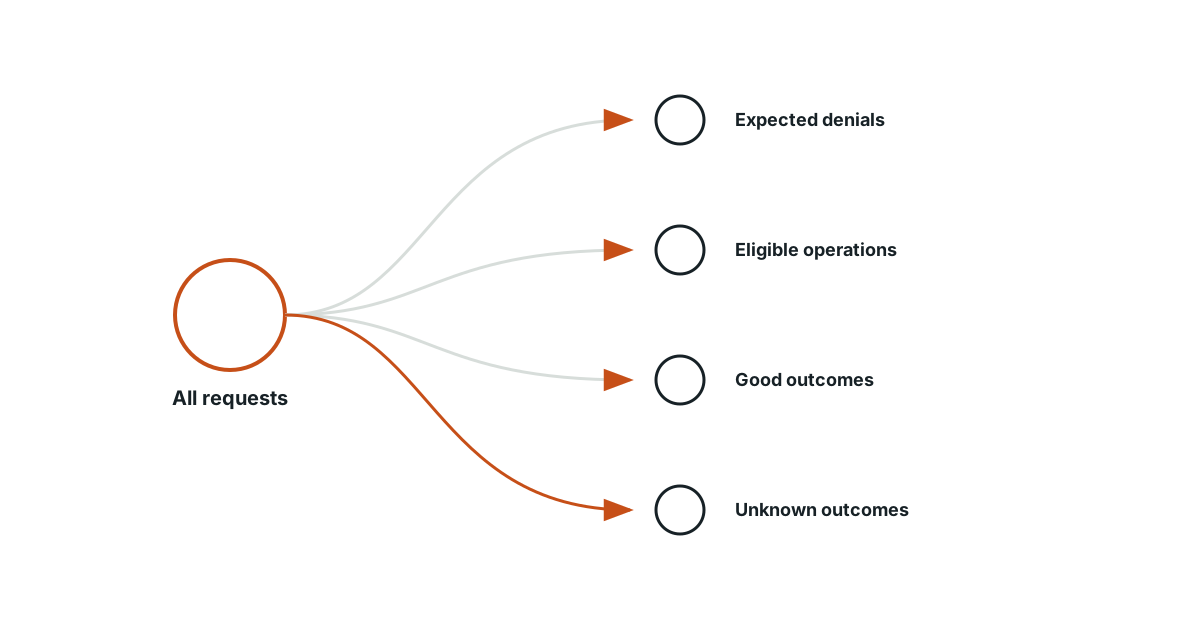
Start with the operation the caller needed
A host asks a tool for the current service owner’s contact. Receiving valid JSON proves that a response arrived; it does not establish that the contact is current, belongs to the requested service, or reached the host in time. Define the usable result before selecting a dashboard metric.
For a directory lookup, a good outcome could be a source-identified owner record within two seconds, or an explicit authoritative not_found. Those are local product choices. A fabricated contact, an unmarked stale record, and an unexplained timeout would not satisfy that promise.
Give each response layer its own classification
The MCP error model distinguishes protocol errors from execution errors within tool results. Preserve that distinction in instrumentation, then add the domain outcome rather than overloading a single success flag.
Use bounded categories: protocol response, expected denial, eligible completion, unavailable dependency, stale result, malformed result, and unknown terminal outcome. A valid policy-denied result may be healthy protocol behavior while lying outside eligible lookup availability. Conversely, a policy service outage for an otherwise eligible caller belongs inside the failure population.
Ten thousand requests produce three different rates
Consider a hypothetical one-hour review with 10,000 logical lookup requests. Of these, 300 correctly fail eligibility because their callers lack access. Of the remaining 9,700, 9,450 deliver fresh acceptable records, 120 deliver results marked too stale, 80 exceed the deadline, and 50 remain unclassified.
Suppose 9,900 of all 10,000 requests receive valid protocol responses. Protocol responsiveness is 99%. Eligible service success is 9,450 / 9,700, about 97.42%. Outcome classification coverage is 9,650 / 9,700, about 99.48%. These calculations describe different facts; none can replace the others.
Keeping the 50 unknowns in the eligible denominator prevents missing evidence from improving availability. Investigating them may later change the result, so the report also states when the measurement window was closed.
Make the denominator dictionary reviewable
The following author-designed dictionary is the artifact to adapt. Store definitions with a revision so policy or classification changes cannot silently rewrite the meaning of a trend.
| Indicator | Numerator | Denominator | Primary owner |
|---|---|---|---|
| Protocol responsiveness | Valid protocol responses within deadline | All observed protocol requests | MCP runtime team |
| Eligible lookup success | Acceptable terminal records or authoritative absence | Eligible logical lookups, including unknowns | Directory service owner |
| Freshness adherence | Successful records meeting source-age requirement | Successful records requiring freshness | Data pipeline owner |
| Outcome coverage | Eligible operations with terminal classification | Eligible operations due for classification | Instrumentation owner |
| Expected-denial accuracy | Reviewed denials confirmed correct | Reviewed denial sample | Policy owner |
Google’s SLO guidance provides the good-events/total-events foundation. The specific populations above are a local design proposal, not a protocol requirement or recommended target.
Avoid a latency win caused by fast refusals
If a broken policy update rejects useful work in twenty milliseconds, aggregate latency may improve. Calculate tool latency for comparable eligible outcome classes and retain the denial distribution beside it. Also distinguish machine service time from time spent waiting for a user decision.
For tools that return pending work, publish time to acceptance separately from time to the promised terminal result. That does not require this guide to define their state machine; it requires the metric to name which milestone it measures.
Connect a breach to an owner’s decision
Before adopting an objective, decide what happens when it is missed. Stale directory records may stop a data-pipeline release. Missing classifications may pause expansion because responders cannot explain failures. Expected denials may trigger policy review without being counted as runtime downtime.
Thresholds should reflect a supported workflow and observed baseline. A target copied from another API can make a dashboard precise while leaving its operational purpose vague. Keep severe boundary violations outside averages so a large number of ordinary successes cannot offset them.
Sample usefulness without hiding the sample
Freshness and schema checks still do not prove that the result answered the user’s question. Review a defined sample of requests against authoritative records, report the selection method and sample size, and retain corrections. Do not label that estimate as complete production correctness.
For the telemetry needed to join these records, use MCP calls across a gateway. For confirming external changes, use verification after HTTP 200.
Evidence
MCP distinguishes protocol errors from tool execution errors reported inside a tool result.
The error-handling section uses JSON-RPC errors for protocol failures and isError for execution failures.
Primary source · standard · checked Sep 8, 2026
Limit: Neither error mechanism defines the business outcome or freshness requirement for a specific tool.
An SLI can express good events divided by a defined total population.
Google's SRE guidance separates the intended service outcome from the measurement implementation.
Primary source · official-doc · checked Sep 8, 2026
Limit: Its examples are general service guidance and do not prescribe MCP-specific eligibility or numeric targets.
Limitations
The outcome taxonomy and numbers are illustrative. Local telemetry can miss requests before instrumentation, semantic correctness is usually sampled, and delayed confirmation can leave recent operations unresolved. These gaps need their own coverage indicators.
FAQ
- Should a policy denial count as MCP downtime?
- An expected denial can be correct control behavior and excluded from eligible tool availability. Report denial volume and reasons separately, and do not exclude a valid caller denied by a service misconfiguration.
- Should retries be counted as separate outcomes?
- Count attempts when diagnosing protocol behavior and logical operations when evaluating the user's tool request. Publish both denominators so repeated attempts cannot inflate the apparent volume of successful work.
Related guides
Continue within MCP in production, or use one of these adjacent diagnostics:
Editorial QA: automated native-English, structure, source-presence, and link checks completed . This record is not an independent expert endorsement. Review boundary.