
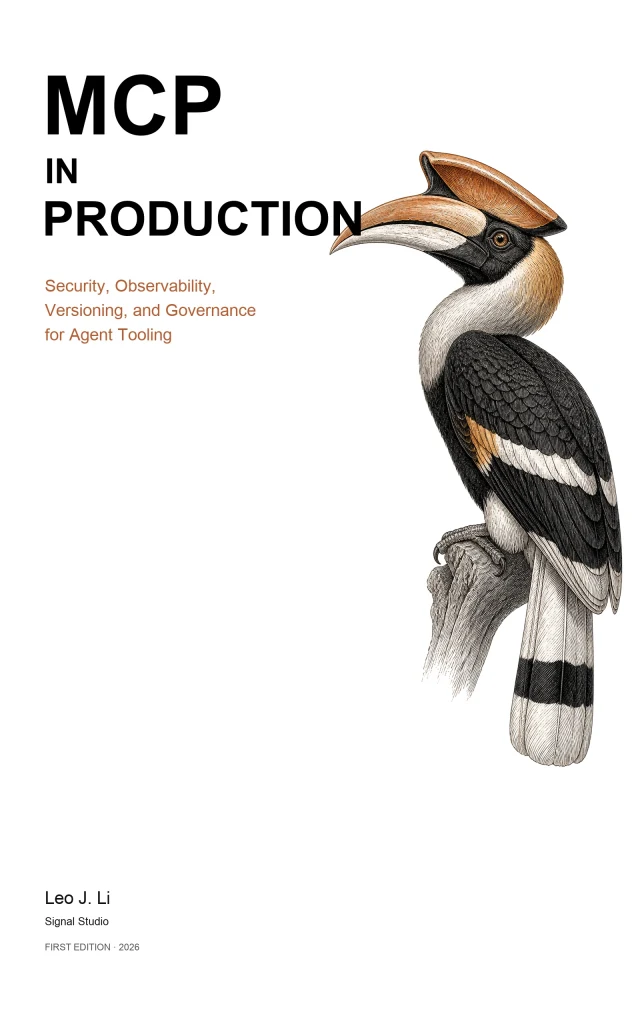
Signal Studio field guide
MCP in Production
Security, Observability, Versioning, and Governance for Agent Tooling
Operate production MCP tools with catalog identity, authorization, service objectives, compatibility, releases, admission, and remote-provider controls.
For: MCP service owners, agent platform engineers, security and reliability leads
What this book helps you do
MCP makes tools easier to connect, but a shared tool service still needs accountable owners, bounded authority, dependable outcomes, and controlled change. This book follows a fictional system as it acquires those obligations, connecting catalog admission, behavioral contracts, evidence, service objectives, compatibility, releases, incident response, and supplier assurance into one operating method.
Problems this book helps you solve
- A successful tool demonstration has become a shared service without a production owner.
- Two servers expose the same tool name and the host cannot identify which definition it selected.
- HTTP availability looks healthy while users receive stale or incomplete tool results.
- An SDK upgrade, catalog edit, and backend change are described as one MCP version bump.
- Hosts keep old tool definitions after a new server release.
- A registry listing is accepted as sufficient evidence to enable a third-party server.
- A remote provider cannot be removed without breaking workflows or losing operating history.
Start with a practical question
Use a focused guide for the immediate problem, then return here when you need the complete operating method.
- What belongs in an MCP production contract?
- How should an MCP host distinguish tools with the same name?
- Which service-level indicators should an MCP tool expose?
- What must be versioned in an MCP client-server contract?
- How do I release MCP tool changes while hosts cache old catalogs?
- What should I verify before admitting a registry-listed MCP server?
- How do I prepare an exit from a remote MCP provider?
Decisions you will be able to make
- Which user promise and operating boundaries must exist before a tool becomes a shared service.
- How to distinguish publisher, endpoint, server instance, tool name, and catalog revision.
- Which authority, data, failure, and evidence rules surround each consequential invocation.
- How to measure eligible tool outcomes separately from protocol response rates.
- Which client, server, schema, policy, and backend combinations receive compatibility support.
- What evidence permits a release, admission, renewal, suspension, or retirement.
- How to preserve a tested exit from remote and third-party dependencies.
Who this book is for
- Teams moving an MCP integration from a developer machine into a shared production environment.
- Platform owners responsible for several independently released hosts and tool servers.
- Security and SRE reviewers who need a common operational record for agent tooling.
Who this book is not for
- Readers seeking only an introductory SDK tutorial or a directory of available servers.
- Teams looking for a protocol-conformance badge that guarantees tool safety or business correctness.
Reading path
- Establish the production boundaryDefine the service promise, catalog identity, authority, failure behavior, and evidence obligations.
- Operate measurable tool outcomesTurn correlated evidence into service indicators with honest eligibility and unknown-result handling.
- Control compatibility and releasesTrack independent contract versions and migrate hosts, catalogs, and endpoints with retirement evidence.
- Admit and contain dependenciesReview server provenance, permissions, data flows, incident controls, and expiring exceptions.
- Extend the operating systemAdd data governance, combined agent-tool evaluation, capacity limits, and federated ownership.
- Prove controls and retain an exitJoin assurance claims to runtime evidence and rehearse adoption, supplier suspension, and recovery.
A protocol boundary needs an operating agreement
The first production question is who depends on a tool result and what happens when that result is unavailable, stale, unauthorized, or ambiguous. A standard message format helps components communicate. The service agreement establishes who must act when communication alone does not deliver the promised result.
Follow one evolving system
The eighteen chapters develop one fictional MCP deployment through successive pressures. Early chapters establish its controls; later chapters test those controls against data handling, combined agent-tool evaluation, resource limits, federated ownership, remote suppliers, and assurance. This structure lets readers see which earlier decisions make a later response possible.
Start with the boundary that is failing
Use the public production-contract worksheet before exposing an internal tool to additional teams. Use the compatibility matrix when a release works for one host and fails for another. Use the remote-provider exit drill when an external endpoint has become operationally essential. Each web guide is independently written and remains useful without the book.
Evidence and method
The book distinguishes normative protocol requirements, official implementation guidance, research findings, and author-designed controls. Harbor and Meridian Support are fictional teaching settings. Their thresholds and incidents are illustrative, while protocol claims name their revision. Deployment safety, semantic correctness, and supplier behavior still need evidence from the reader's own system.
Continue with the Kindle edition
Open the Amazon listing to review the current edition and use Read Sample or Kindle Instant Preview before deciding.
Read a sample
Signal Studio does not reproduce manuscript chapters on this site. Open the Amazon listing to use Read Sample or Kindle Instant Preview
Resources
The related guides contain original inline checklists and decision tables; no manuscript excerpt is republished.
Errata
Editorial QA: automated native-English, structure, metadata, and link checks completed . This record is not an independent expert endorsement. Review boundary.