
Question-led guide · how-to
How do I migrate semantic contracts without rewriting operational history?
Manage a meaning change through versioned mappings, consumer impact, historical evidence, dual interpretation, migration tests, and retirement criteria.
Direct answer
Version the meaning and its dependent mappings, identify consumers, and preserve the interpretation used for historical decisions. Introduce the new contract with explicit migration rules and test mixed-version operation before retiring the old path. A renamed field, a split concept, and a changed eligibility rule have different consequences; treat them according to the claims and actions they alter.
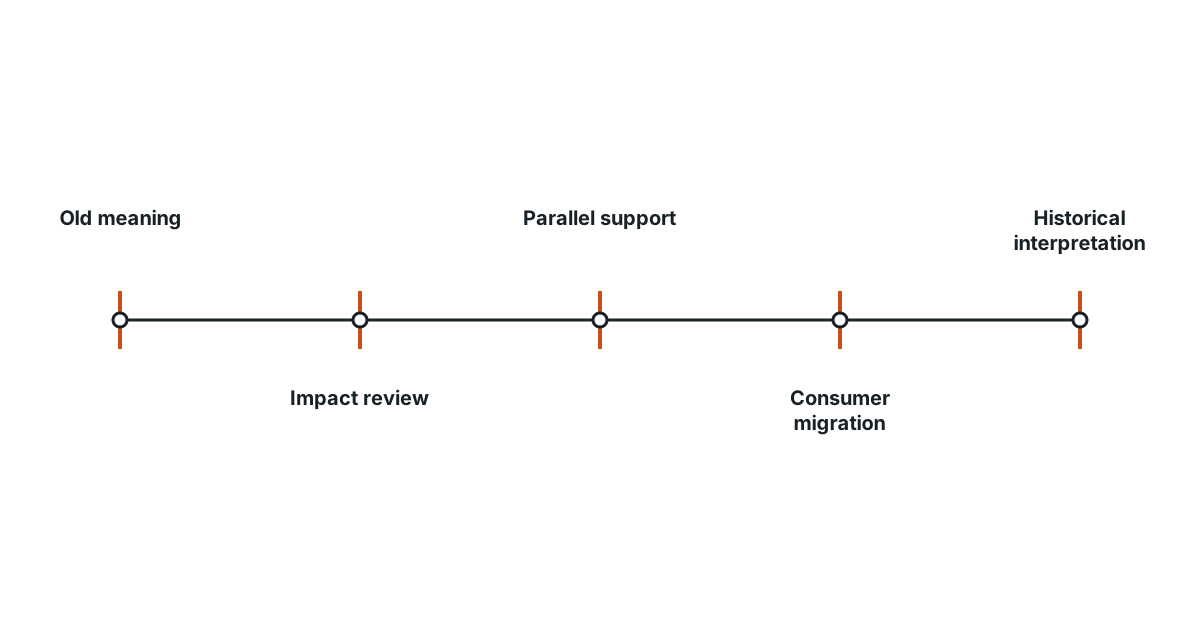
Classify what changed before assigning a version
A spelling correction differs from splitting “available stock” into physical stock and reservable stock. The second change can alter queries, eligibility rules, user expectations, and actions even when a database migration runs cleanly. Describe the changed interpretation in ordinary language and give a before-and-after decision that makes its consequence visible.
Find consumers beyond direct queries
Inventory mappings, constraints, dashboards, agent tools, policy inputs, exports, and historical decision records. Some dependencies arrive through cached projections or copied reports rather than a live schema reference. Name an owner for each affected consumer and determine whether it can read both meanings during migration. A dependency that is unknown is a migration risk to resolve, not an implicit compatible consumer.
Keep historical evidence interpretable
An earlier reservation may have been justified under a now-retired definition. Preserve the relevant contract and mapping revision with its evidence. A current view may recompute data under a new definition, but label that interpretation separately from what the operator knew at the original time. Changing the current model should not silently rewrite the explanation of past work.
Write a semantic migration record
| Record element | Concrete question |
|---|---|
| Meaning change | Which previously valid conclusion changes? |
| Affected consumers | Who reads or acts on the old interpretation? |
| Historical policy | What is preserved, recomputed, or annotated? |
| Parallel period | Which version combinations are supported? |
| Reversal | Can current use return safely to the old contract? |
| Retirement | What evidence proves old active use has ended? |
A numerical version label cannot answer these questions by itself. Keep the record beside the actual migration and compatibility tests.
Exercise mixed versions and late records
In a fictional migration, one regional adapter continues emitting the old availability flag after the central service supports the split fields. Verify whether the system translates, rejects, or quarantines those records. Test an old event arriving late and an agent resuming with an earlier projection. Do not let a successful deployment of the central schema stand in for migration of every consumer.
Retire active use without erasing the old contract
Observe adoption and resolve the remaining callers before removing the old path. Retain the minimum historical definitions and lineage needed to interpret recorded decisions under the applicable retention policy. If returning to the old contract would misinterpret newly created state, define a forward repair rather than promising a simple rollback. The release is complete when present operations and historical explanations are both coherent.
Evidence and scope
- W3C DCAT 3: DCAT describes cataloged datasets, distributions, and data services, including version relationships.
- W3C PROV-O: PROV-O represents entities, activities, agents, and derivation relationships.
The proposed checks are teaching tools; validate their behavior in the actual environment.
Evidence
DCAT describes cataloged datasets, distributions, and data services, including version relationships.
DCAT describes cataloged datasets, distributions, and data services, including version relationships.
Primary source · standard · checked Sep 11, 2026
Limit: This source supports the named mechanism, not the outcome or thresholds of the illustrative workflow.
PROV-O represents entities, activities, agents, and derivation relationships.
PROV-O represents entities, activities, agents, and derivation relationships.
Primary source · standard · checked Sep 11, 2026
Limit: This source supports the named mechanism, not the outcome or thresholds of the illustrative workflow.
Limitations
The scenarios and decision worksheets are original teaching examples. They are not measured deployments or guarantees; adapt the checks to the actual system and its documented behavior.
FAQ
- Is renaming a field always a breaking semantic change?
- No. Determine whether its interpretation, consumer behavior, or permitted actions change; spelling alone is not the whole contract.
- Should old definitions be deleted after migration?
- Retire unsupported active use, but preserve the information needed to interpret retained historical evidence and decisions.
Related guides
Continue within Ontology-driven enterprise delivery, or use one of these adjacent diagnostics:
Editorial QA: automated native-English, structure, source-presence, and link checks completed . This record is not an independent expert endorsement. Review boundary.