
Question-led guide · evaluation
How can a second customer test whether an ontology module is reusable?
A second-context experiment for distinguishing shared semantic commitments from copied code, local policy, mapping assumptions, and unsupported product obligations.
Direct answer
Choose a second context that deliberately varies a meaningful assumption, then test the proposed module without silently forking its shared contract. Record which meanings remain stable, which differences belong in supported extensions, and what operating effort transfers. Reuse is supported by a maintained capability that works across those differences, not by installing the first customer’s code twice.
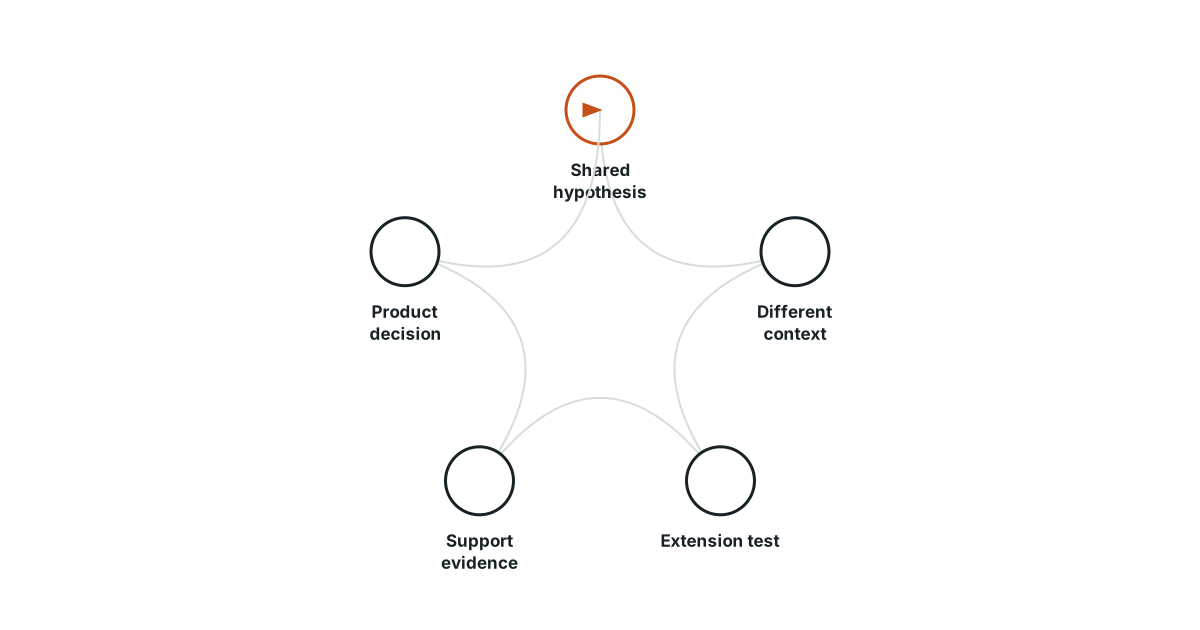
Choose a context that can disprove the abstraction
A second installation at an almost identical site may show repeatable deployment but reveal little about semantic reuse. Select a context with one important difference: source authority, approval timing, identity assignment, or lifecycle policy. State the hypothesis the module must survive. The test becomes more informative when the team knows in advance what failure would mean.
Separate reusable meaning from copied implementation
A fictional reservation package works for a manufacturer with centrally managed warehouses. The next customer uses independent service partners. Shared code may still run while the assumption of one inventory authority fails. Ask which facts, actions, and ownership promises remain valid. Copying a schema without its support obligations is installation reuse, not evidence of a product capability.
Preserve differences through supported extension points
Try representing the new context through documented mappings, policies, and extensions. Record any required change to the common kernel explicitly. A growing collection of customer-name conditionals can conceal unresolved differences in meaning. Conversely, forcing every local rule into the shared module can make both deployments harder to understand and change.
Collect a reuse evidence packet
| Evidence | What it distinguishes |
|---|---|
| Stable decision contract | The genuinely shared user outcome |
| Different source mapping | Local integration from common meaning |
| Extension exercised | Supported variation from an accidental fork |
| Compatibility result | Shared maintenance from copied code |
| Operating handoff | Transferable support from expert dependence |
| Correction cost | A sustainable module from permanent custom work |
Include failed attempts and support effort. The packet should enable a product owner to decline promotion when the module has not earned its continuing obligations.
Compare the available product dispositions
The right result may be a disposable engagement artifact, a supported customer extension, a domain module, or a shared kernel capability. Each choice has a different maintenance promise. Do not make common-product inclusion the only successful outcome of an FDE engagement. A well-bounded local extension can create value without requiring every customer to inherit its assumptions.
Fund the responsibility that reuse creates
Before promotion, name ownership for documentation, compatibility, migration, defects, and retirement. Ask a team outside the original engagement to interpret and correct a result. In this illustrative exercise, needing the original FDE for every unusual record is evidence of incomplete transfer. The second context supports a reuse claim only when both its behavioral fit and its ongoing operating cost are visible.
Evidence and scope
- W3C Data on the Web Best Practices: The recommendations address documentation, provenance, quality, versioning, and feedback for published data.
- W3C DCAT 3: DCAT describes cataloged datasets, distributions, and data services, including version relationships.
The proposed checks are teaching tools; validate their behavior in the actual environment.
Evidence
The recommendations address documentation, provenance, quality, versioning, and feedback for published data.
The recommendations address documentation, provenance, quality, versioning, and feedback for published data.
Primary source · official-doc · checked Sep 11, 2026
Limit: This source supports the named mechanism, not the outcome or thresholds of the illustrative workflow.
DCAT describes cataloged datasets, distributions, and data services, including version relationships.
DCAT describes cataloged datasets, distributions, and data services, including version relationships.
Primary source · standard · checked Sep 11, 2026
Limit: This source supports the named mechanism, not the outcome or thresholds of the illustrative workflow.
Limitations
The scenarios and decision worksheets are original teaching examples. They are not measured deployments or guarantees; adapt the checks to the actual system and its documented behavior.
FAQ
- Does a second customer prove product-market fit?
- No. It supplies bounded evidence about reuse across selected differences; adoption, economics, and wider demand need separate evidence.
- Must every successful field artifact enter the shared kernel?
- No. A supported extension or a deliberately temporary artifact can be the appropriate product decision.
Related guides
Continue within Ontology-driven enterprise delivery, or use one of these adjacent diagnostics:
Editorial QA: automated native-English, structure, source-presence, and link checks completed . This record is not an independent expert endorsement. Review boundary.