
Question-led guide · planning
How do I plan an exit from an observability platform?
Test export, semantic preservation, alert continuity, historical investigation, and ownership before a platform migration or contract renewal.
Direct answer
Plan the exit before dependence makes it urgent. Inventory signal sources, schemas, retention, derived views, alerts, dashboards, access rules, and incident links. Test whether a sample of historical evidence can be exported and interpreted in the target system, and whether active alerts continue during dual operation. Record what cannot migrate and who owns the gap. A standards-compatible ingest path is helpful, but it does not guarantee portable queries or history.
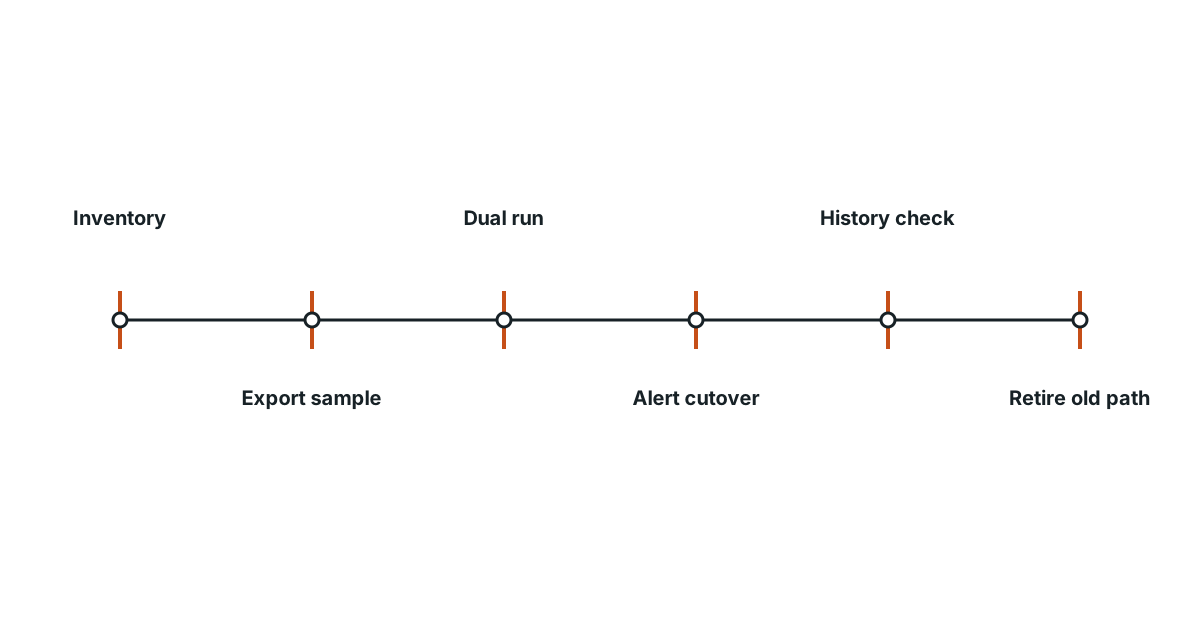
Inventory the objects people depend on
Raw logs, metrics, traces, and profiles are only part of an observability product. Teams depend on saved queries, alert definitions, dashboard variables, service catalogs, access controls, annotations, and links in incident records. Record owners and retention obligations for each. A migration that moves bytes while losing their interpretation can make prior incidents effectively unreadable.
Separate ingest portability from result portability
An OpenTelemetry-compatible export path may reduce producer lock-in, but platform-specific query languages, derived views, sampling rules, and storage layouts remain. Test a sample of raw and transformed data through the proposed path. Check units, temporality, resource identity, trace relationships, and timestamps after import. A successful HTTP transfer does not show that the next investigator will reach the same answer.
The old incident link becomes a dead end
In a fictional migration, a team switches exporters and immediately closes the old account. An incident report from last month links to a dashboard with a custom error-rate calculation; the link now fails and the new platform’s calculation excludes a tenant. The exit plan retains a governed historical view, records the formula, and tests an equivalent query before old access is retired.
Use an exit readiness register
Track each dependency through a measurable disposition.
| Object | Portability test | Disposition |
|---|---|---|
| Source telemetry | Export and import sample | Migrate or retain |
| Derived metric | Compare formula and population | Rebuild and verify |
| Active alert | Shadow and cutover rehearsal | Transfer owner |
| Historical link | Open an old incident path | Preserve or document gap |
| Access rule | Test least-privilege users | Recreate policy |
Dual-run with a clear interpretation rule
Send a bounded signal set to both systems while the old alert path remains authoritative. Compare counts and incident queries after accounting for sampling and ingestion delay. Record which platform is the source of truth for pages, corrections, and historical reports during each stage. Without that rule, differing values can trigger confusion or duplicate incidents instead of revealing a migration defect.
Retire only after the obligation is satisfied
Keep rollback target, contract dates, export rights, and a named owner for unmigrated history. Test a provider outage and a return to the old path before closing it. Some proprietary views may not be transferable; document the limitation and retain a lawful read-only archive if needed. Retiring an account is a separate decision from moving new telemetry.
Evidence boundary for platform exit
- OpenTelemetry vendor guidance: OpenTelemetry defines vendor support and implementation qualifications. Protocol support does not make saved queries or history portable.
- OpenTelemetry Collector resiliency: OpenTelemetry documents sending queues and failure recovery constraints. Those mechanisms do not guarantee complete dual-run equivalence.
The incident-link failure is invented. Export rights, retention, and historical access need contract and technical verification.
Evidence
OpenTelemetry distinguishes support for standard SDK and protocol output from custom implementation.
OpenTelemetry defines vendor support and implementation qualifications.
Primary source · standard · checked Oct 7, 2026
Limit: Protocol support does not make saved queries or history portable.
Export queues and retries have bounded behavior during endpoint changes.
OpenTelemetry documents sending queues and failure recovery constraints.
Primary source · official-doc · checked Oct 7, 2026
Limit: Those mechanisms do not guarantee complete dual-run equivalence.
Limitations
The register is a planning tool. Real portability depends on vendor interfaces, contract terms, data volume, and retention duties.
FAQ
- Does OpenTelemetry support guarantee an easy platform exit?
- No. It helps at instrumentation and transport boundaries, while queries, alerts, derived data, and history may remain platform-specific.
- When can the old platform be retired?
- After new alerts, historical obligations, access, and rollback have explicit verified dispositions, not merely after new telemetry starts flowing.
Related guides
Continue within Enterprise observability platform selection, or use one of these adjacent diagnostics:
Editorial QA: automated native-English, structure, source-presence, and link checks completed . This record is not an independent expert endorsement. Review boundary.