
Question-led guide · diagnostic
Why did my agent perform the same side effect twice after a timeout?
A retry-safe effect protocol using operation identity, idempotency, effect receipts, reconciliation, and explicit unknown completion states.
Direct answer
The timeout told the caller that it did not receive a conclusive response; it did not prove the server failed to apply the effect. If the agent retries with a new operation identity, the downstream system can perform the action again. Generate one stable operation key for the intended effect, persist it before execution, require an idempotent endpoint or reconciliation query, and record the returned effect receipt before claiming success.
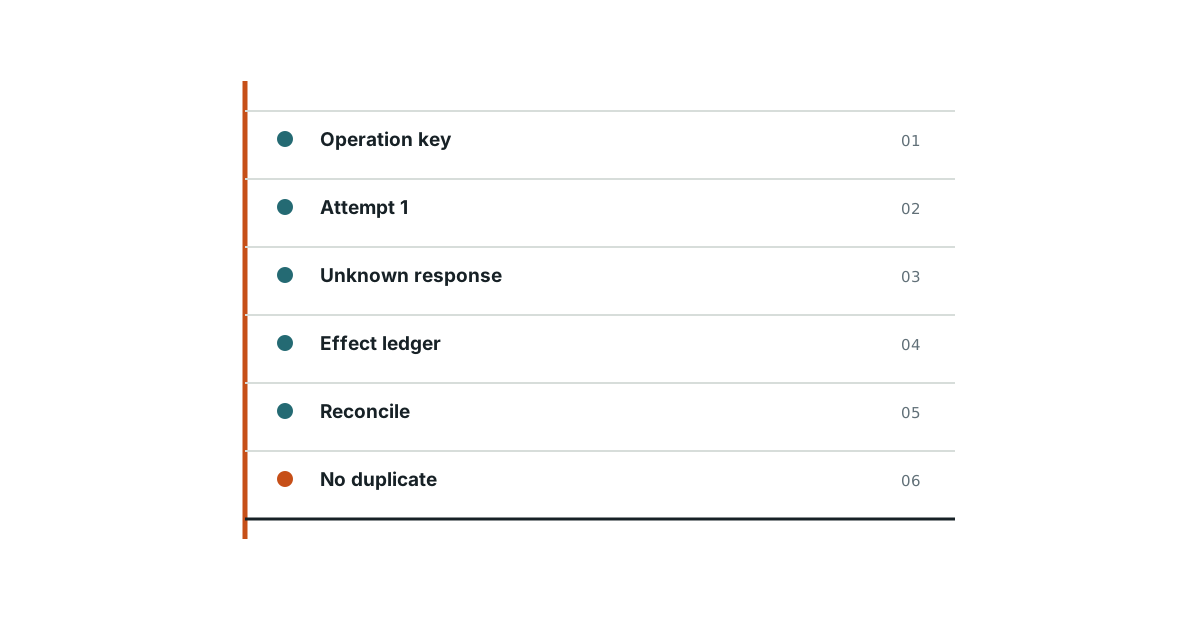
Unknown outcome is a first-class state
This guide applies to durable effects such as payments, refunds, tickets, messages, configuration changes, and record creation. It assumes retries can occur after network loss, process failure, queue redelivery, or human resume. Read-only queries may still produce audit or billing events, but the most serious risk is repeating non-idempotent business effects.
Why a timeout invites duplicate action
Distributed systems cannot always distinguish “the server did nothing” from “the server completed the effect but the response was lost.” Agent frameworks add another layer: the model may interpret a timeout message as permission to try again, while the tool wrapper creates a fresh request and key. The transcript then shows two reasonable attempts but not the downstream reality.
The email sent before timeout
The mail provider accepts a message but the client loses the response. Before retrying, the workflow queries by operation key, finds the provider message ID, records the effect, and continues without sending a second email.
At the application boundary, operation identity should be unique within the business scope:
create table effect_ledger (
  tenant_id text not null,
  operation_key text not null,
  state text not null check (state in ('planned','attempted','confirmed','unknown','compensated')),
  receipt_ref text,
  updated_at timestamptz not null,
  primary key (tenant_id, operation_key)
);
The constraint prevents two ledger identities; reconciliation is still needed to discover an external effect committed before a response was lost.
Follow one operation across attempts
- Find the first durable record that represents the intended business effect.
- Compare operation or idempotency keys across attempts.
- Determine whether the downstream service committed before the response path failed.
- Inspect queue redelivery, workflow replay, task lease expiry, and manual resume events.
- Verify whether deduplication and the business effect share an atomic boundary.
- Check key retention against the maximum retry and reconciliation window.
- Identify whether the agent claimed failure, success, or uncertainty before receiving an effect receipt.
Reconcile through an effect ledger
Use a two-phase protocol:
- Trusted code creates an effect proposal with subject, resource, action, parameters, policy, and stable operation key.
- Authorization approves or denies the exact proposal.
- The executor sends the stable key to an idempotent endpoint or records the key atomically with the effect.
- On timeout, workflow state becomes
effect_unknown, noteffect_failed. - A reconciliation query looks up the operation key or business identifier.
- The workflow records an effect receipt, then transitions to succeeded, failed, compensated, or needs review.
The model may explain the state and propose a next step, but it does not decide whether an unobserved effect occurred.
Effect-ledger template
| Field | Example meaning |
|---|---|
| operation_key | Stable identity for one intended effect across retries |
| proposal_hash | Canonical subject, resource, action, and parameters |
| policy_version | Authorization rules applied to the proposal |
| attempt_id | Unique transport attempt for diagnosis |
| status | proposed, authorized, executing, effect_unknown, succeeded, failed, compensated |
| downstream_reference | Provider or system identifier used for reconciliation |
| effect_receipt | Immutable reference showing the observed result |
| next_action | retry, reconcile, compensate, request review, or stop |
Idempotency claims that stop at request IDs
- Generating a new idempotency key on every retry.
- Marking a timeout as failure and immediately issuing another effect.
- Deduplicating only in the agent process rather than at the effect boundary.
- Reusing one key with changed parameters.
- Claiming exactly-once behavior without testing crash and concurrency boundaries.
Evidence
Automatic retry is safe only when request semantics are idempotent or the client can establish that the original request was not applied.
RFC 9110 defines idempotent methods and cautions against automatically retrying non-idempotent requests without additional knowledge.
Primary source · standard · checked Aug 25, 2026
Limit: HTTP method semantics do not guarantee that every implementation or secondary side effect is actually deduplicated.
An application can use an idempotency key to make repeated create or update requests return the original result rather than create a duplicate.
Stripe documents saving the first result for an idempotency key and returning it for subsequent requests with the same key.
Primary source · official-doc · checked Aug 25, 2026
Limit: Stripe's exact retention, validation, and endpoint behavior is provider-specific and should not be copied as a universal protocol.
Agent workflows need an explicit unknown-effect state and a reconciliation path.
The effect-ledger pattern separates request failure, response failure, and effect completion so recovery does not depend on model inference.
Signal Studio author framework · reviewed Aug 25, 2026
Limit: The downstream system must expose enough identity or lookup capability for reliable reconciliation.
Limitations
Idempotency does not automatically reverse partial multi-system effects or guarantee exactly-once delivery. Some operations require reconciliation, compensation, or human review. Retention windows and concurrency behavior must be designed for the downstream system and business risk.
FAQ
- Is a UUID enough to prevent duplicates?
- Only if the same intended effect reuses the same key and the enforcement point persists and checks that key atomically with the effect. A new UUID on every retry defeats deduplication.
- Should the model choose the idempotency key?
- No. Trusted workflow code should derive or issue the operation identity from the business intent and state transition, then keep it stable across retries.
Related guides
Continue within Context engineering, memory, and state, or use one of these adjacent diagnostics:
Editorial QA: automated native-English, structure, source-presence, and link checks completed . This record is not an independent expert endorsement. Review boundary.