
Question-led guide · operations
How do I protect ClickHouse ingestion from expensive investigations?
Bound investigative queries, replay, alerts, and background work with workload classes, resource limits, freshness objectives, and overload exercises.
Direct answer
Classify interactive investigation, alert evaluation, ingestion, replay, and maintenance as competing workloads. Bound query scope and execution, allocate resources deliberately, and preserve capacity for the service obligations that must survive overload. Validate the policy with concurrent traffic and a costly investigation; quotas alone do not prove isolation, fairness, or acceptable freshness.
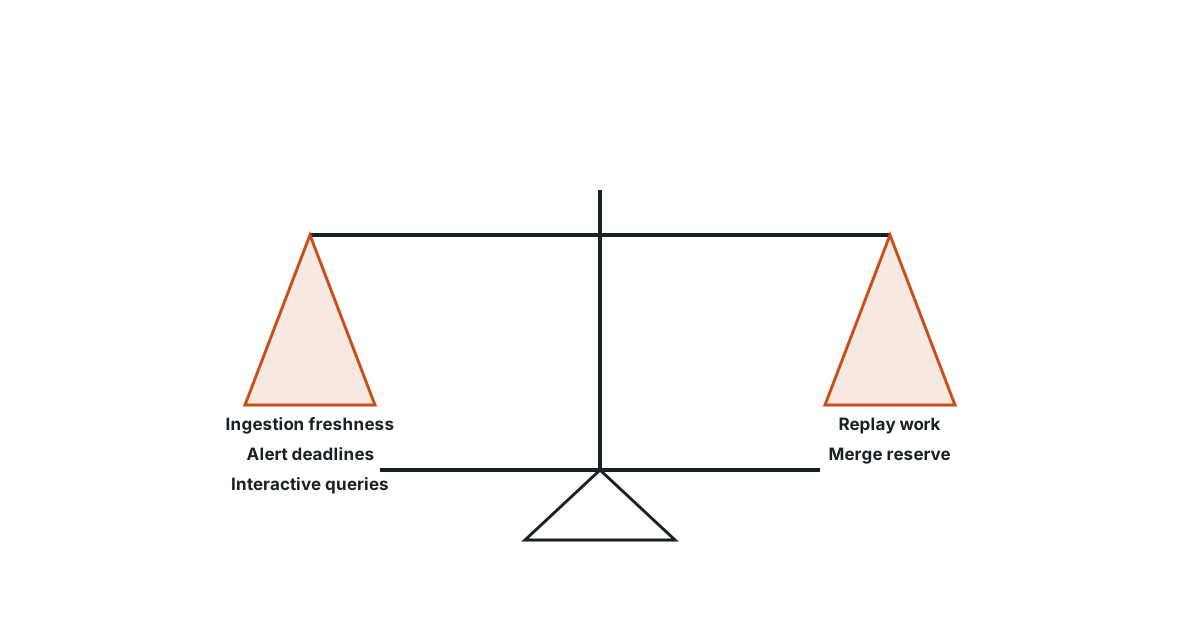
Identify the promise that overload must preserve
A fictional platform stays healthy until several responders search thirty days of logs during an incident. Ingestion then falls behind and the newest evidence becomes unavailable. The problem is a conflict between useful workloads. Decide which freshness and alerting obligations must survive that conflict before describing every accepted query as equally urgent.
Classify work at admission
Distinguish an interactive trace lookup from a large export, a scheduled alert, a replay job, and routine background maintenance. Give each class a documented scope and owner. An authenticated user can still issue work that is too expensive for the current capacity. Admission should consider the operation, interval, result size, concurrency, and workload class rather than only whether the user signed in.
Bound the query before the cluster pays for it
Require a reasonable time interval and authorized scope for investigative searches. Apply supported execution, memory, and result limits, with an explicit failure response. A shortened result must be labeled as partial; otherwise the interface may turn resource protection into false evidence. Offer a narrower query or a separately governed batch path for legitimate larger work.
Reserve room for invisible work
Merges, retention processing, derived-table maintenance, and backlog recovery consume resources even when user traffic is quiet. A TTL rule is not an immediate deletion receipt, so storage planning must account for background processing. Watch free space and maintenance debt alongside insert rate. Spending every spare resource on query throughput can leave no room to recover safely.
| Work class | Admission question | Useful operating signal |
|---|---|---|
| Ingestion | Which data may be accepted now? | Freshness and rejected records |
| Alert evaluation | Which deadline must be met? | Evaluation delay and gaps |
| Investigation | What bounded question is asked? | Tail latency and truncation |
| Replay | How fast can recovery safely run? | Oldest backlog and catch-up rate |
| Maintenance | What reserve must remain? | Merge pressure and free space |
Exercise a noisy neighbor and a returning backlog
Run a representative ingestion stream while one tenant issues expensive searches and another performs ordinary trace lookups. Then add replay after a bounded outage. Measure whether the quiet tenant, alerts, and ingestion remain within their stated objectives. Quotas restrict consumption over intervals, but the complete deployment still needs evidence about concurrent resource contention.
Explain the overload decision to operators
A rejected wide search should identify the bounded action the user can take next. A throttled replay should show its expected recovery progress. Record the policy and version responsible for each decision so that an incident review can separate insufficient hardware, an inappropriate limit, and an unexpectedly costly query. Increase capacity or revise the contract from those observations, rather than removing all limits during the busiest moment.
Evidence and scope
- ClickHouse quotas: ClickHouse quotas limit resource consumption over configured intervals.
- ClickHouse data TTL: TTL processing participates in background merges; a configured expiry is not a synchronous deletion acknowledgement.
The proposed checks are teaching tools; validate their behavior in the actual environment.
Evidence
ClickHouse quotas limit resource consumption over configured intervals.
ClickHouse quotas limit resource consumption over configured intervals.
Primary source · official-doc · checked Sep 11, 2026
Limit: This source supports the named mechanism, not the outcome or thresholds of the illustrative workflow.
TTL processing participates in background merges; a configured expiry is not a synchronous deletion acknowledgement.
TTL processing participates in background merges; a configured expiry is not a synchronous deletion acknowledgement.
Primary source · official-doc · checked Sep 11, 2026
Limit: This source supports the named mechanism, not the outcome or thresholds of the illustrative workflow.
Limitations
The scenarios and decision worksheets are original teaching examples. They are not measured deployments or guarantees; adapt the checks to the actual system and its documented behavior.
FAQ
- Do quotas guarantee tenant isolation?
- No. Validate concurrency, memory, scheduling, and failure behavior for the actual deployment.
- Can retention settings replace free-space monitoring?
- No. Background deletion and merge work may lag; maintain measured reserve and monitor the processing backlog.
Related guides
Continue within ClickHouse observability, or use one of these adjacent diagnostics:
Editorial QA: automated native-English, structure, source-presence, and link checks completed . This record is not an independent expert endorsement. Review boundary.