
Question-led guide · evaluation
How do I run a fair observability platform proof of concept?
Use fixed tasks, representative data, transparent assistance, workload conditions, and scored evidence to compare candidate platforms.
Direct answer
Write the acceptance tasks and scoring rules before configuring candidates. Use the same representative telemetry, user roles, incident cases, access restrictions, and mixed workload for each platform. Record versions, vendor assistance, missing integrations, data transformations, query paths, and costs. Include a failure and recovery drill. The result is a bounded comparison under tested conditions, not a universal vendor ranking or a reproduction of a proprietary analyst assessment.
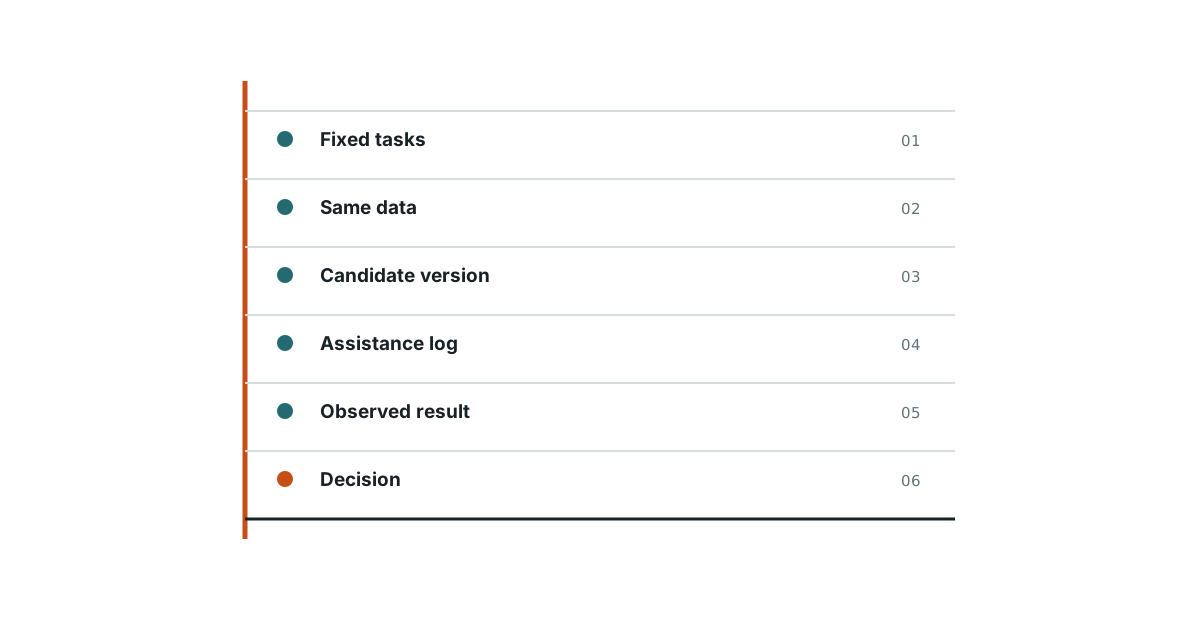
Freeze the acceptance tasks before seeing the demo
Choose several tasks: detect impact, investigate across signals, review a rollout, manage a data gap, enforce access, and recover from a collection failure. State how success will be judged and which failures are disqualifying. If criteria are written after the strongest demo, the comparison can reward whatever that candidate happened to show rather than the organization’s work.
Control the conditions without hiding reality
Give candidates equivalent input data, retention, roles, and test windows, but also record where their architectures legitimately differ. Use production-like distributions and a documented synthetic fault. Track manual preprocessing, proprietary field mappings, or vendor staff who intervene. Assistance is not forbidden; it must be visible so the team knows what it can operate after purchase.
Two candidates get different help
In a fictional selection, Platform A receives a vendor-built dashboard and custom trace transformation over two weeks. Platform B is installed by the internal team in two days. A score based only on final screenshots gives A an unfair advantage. The protocol records setup time and assistance, reruns fixed tasks with internal operators, and reports implementation effort beside task outcome.
Use a reproducible POC protocol
A concise protocol is enough when every row has evidence.
| Item | Required record |
|---|---|
| Data | Source, volume, changes, and rights |
| Tasks | User roles, start condition, outcome |
| Candidate | Build, topology, configuration |
| Assistance | Vendor and internal effort |
| Result | Query trail, gaps, timing, error |
| Cost | Ingest, storage, query, labor |
| Recovery | Failure drill and rollback |
Include one partial-failure drill
Stop an exporter, fill a queue, or deny access in a controlled setting. Observe whether the platform exposes dropped or delayed data and whether investigators can continue with a bounded conclusion. Test the platform’s own health signals and operator controls. A candidate that looks strong on clean steady data may fail precisely when the organization needs it most.
Write a decision whose limits are visible
Publish scores by task with raw evidence and unresolved issues. A candidate may win the tested investigation but still have unacceptable contract or migration risk. The recommendation should name the workloads, users, versions, and measured conditions it covers. Avoid transposing a local POC result into a general vendor ranking or an analyst-methodology claim.
Evidence boundary for platform proofs of concept
- Google SRE monitoring: Google SRE discusses what monitoring systems must help operators do. It does not provide procurement scores for these fictional candidates.
- OpenTelemetry Collector resiliency: OpenTelemetry documents resilience mechanisms and their limits. It does not evaluate any vendor deployment in this POC.
The comparison is a constructed example. Real selection needs agreed criteria, rights-cleared data, and observed candidate behavior.
Evidence
Monitoring systems should support operational questions and diagnosis.
Google SRE discusses what monitoring systems must help operators do.
Primary source · official-doc · checked Oct 7, 2026
Limit: It does not provide procurement scores for these fictional candidates.
Queue and retry behavior must be tested under collection failure.
OpenTelemetry documents resilience mechanisms and their limits.
Primary source · official-doc · checked Oct 7, 2026
Limit: It does not evaluate any vendor deployment in this POC.
Limitations
A proof of concept has bounded duration and data; contract, privacy, security, and future-scale risks require separate review.
FAQ
- Must every platform have identical internal architecture?
- No. Hold tasks, input conditions, and scoring stable while recording legitimate architecture differences.
- Is vendor assistance disqualifying?
- No, but record it and test whether the internal team can repeat the operational tasks after handoff.
Related guides
Continue within Enterprise observability platform selection, or use one of these adjacent diagnostics:
Editorial QA: automated native-English, structure, source-presence, and link checks completed . This record is not an independent expert endorsement. Review boundary.