
Question-led guide · evaluation
How do I evaluate an observability platform from user journeys?
Turn a platform comparison into timed incident, release, and planning journeys with inspectable evidence and failure states.
Direct answer
Start with the work a user must complete: detect impact, investigate a representative failure, coordinate a response, and verify recovery. Write the journey with data, roles, time limit, missing-signal behavior, and acceptance evidence before reviewing product features. Run the same tasks against candidate platforms under recorded conditions. A polished dashboard or category position does not establish that your team can complete the investigation.
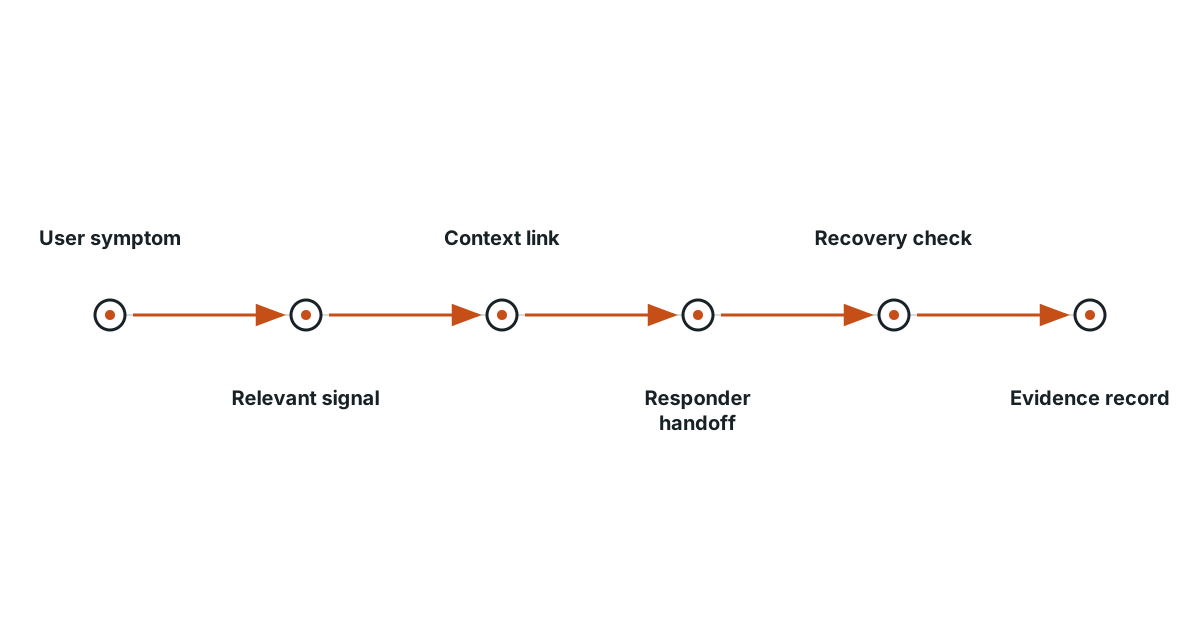
Choose an outcome that requires navigation
A platform buyer may need an incident commander to establish scope, an engineer to locate a failing dependency, and a service owner to confirm recovery. Define those roles and their questions before a product demo. “Shows traces” is a feature statement; “finds the failing checkout path from a user-impact alert in ten minutes” is an evaluation task with an observable result.
Keep the evidence path visible
The task should begin with the signal an operator would actually see. Record how the user moves through metrics, traces, logs, deployment context, and relevant ownership. A one-click transition is useful only when the underlying identity and time join are correct. If a signal is absent, the platform should expose the gap rather than imply that nothing happened.
A dashboard passes while the investigation stalls
In a fictional booking system, a demo dashboard shows rising checkout latency at 09:12. The operator cannot find representative failed traces because sampling excluded the affected region. A vendor presenter manually opens a prepared log search, but the on-call team would not know that query. The evaluation records the navigation failure and the missing coverage, not a passing score for the dashboard.
Use a journey card for each candidate
The card makes the test repeatable across products.
| Field | Record |
|---|---|
| Starting symptom | Actual alert and affected population |
| Required data | Metrics, traces, logs, change records |
| User roles | Investigator, commander, platform operator |
| Task result | Diagnosis scope and recovery observation |
| Missing evidence | Explicit detection and explanation |
| Conditions | Data volume, time limit, and access rights |
Compare observed work, not only elapsed clicks
Have the same role perform the journey on the same data and record whether the result is supported. Count navigation dead ends, incorrect joins, manual vendor assistance, and time to a defensible conclusion. A faster answer can be worse if it silently omits a region. Review both successful and unsuccessful cases and retain screenshots or query records sufficient to explain the result.
Put the candidate score in scope
The result belongs to the tested versions, permissions, workload, and data conditions. A platform may fit one team’s incident workflow while failing a compliance or cost requirement elsewhere. Use the journey outcome alongside architecture, governance, reliability, and exit checks. A market-category position can guide what to investigate, but the organization’s acceptance decision needs its own evidence.
Evidence boundary for platform user journeys
- Google SRE monitoring: Google SRE describes operational purposes for monitoring systems. Its guidance does not score any candidate platform here.
- OpenTelemetry signals: OpenTelemetry describes the individual signal types used in the journey. Signal support alone does not prove usable cross-signal navigation.
The booking incident is constructed. Candidate performance must be observed with an organization’s data and roles.
Evidence
Monitoring serves alerting, diagnosis, visual understanding, and longer-term planning.
Google SRE describes operational purposes for monitoring systems.
Primary source · official-doc · checked Oct 7, 2026
Limit: Its guidance does not score any candidate platform here.
Metrics, traces, and logs have distinct observation roles.
OpenTelemetry describes the individual signal types used in the journey.
Primary source · official-doc · checked Oct 7, 2026
Limit: Signal support alone does not prove usable cross-signal navigation.
Limitations
A journey card covers a bounded workflow and cannot replace security, cost, reliability, or contract review.
FAQ
- Should a feature checklist be discarded?
- Keep it as an inventory, then test the features in tasks that expose whether users can reach a supported result.
- Can a vendor-led demo count as proof?
- It is useful exploration; acceptance should involve your own roles, data, conditions, and recorded assistance.
Related guides
Continue within Enterprise observability platform selection, or use one of these adjacent diagnostics:
Editorial QA: automated native-English, structure, source-presence, and link checks completed . This record is not an independent expert endorsement. Review boundary.