
Question-led guide · decision
What belongs in a semantic kernel instead of a customer extension?
A boundary review for shared identity, lifecycle, constraints, source mappings, customer policies, and the commitments that justify common maintenance.
Direct answer
Put meanings in the shared kernel when multiple contexts must rely on the same interpretation and an owner can support that commitment through change. Keep local presentation, source peculiarities, and customer-specific policy in explicit extensions where possible. Test the boundary by varying one customer assumption and observing which consumers, validations, and decisions should actually change.
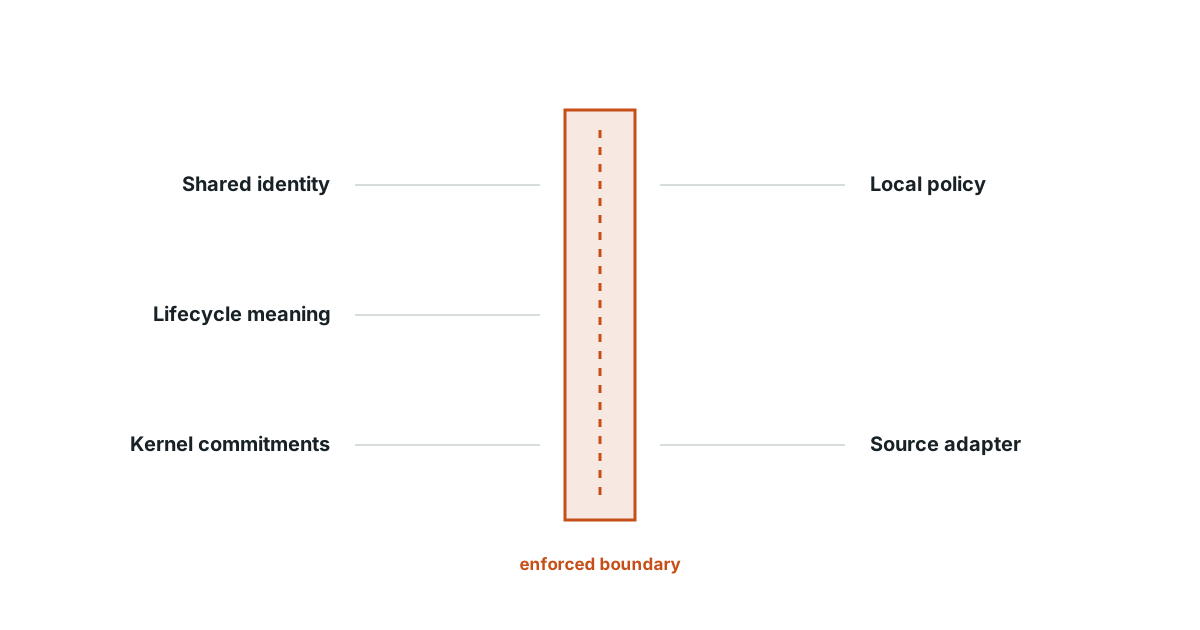
Define a kernel by responsibility
A small number of classes can still impose a huge enterprise commitment. Conversely, a larger package can have a narrow responsibility if its supported decisions are clear. Define the semantic kernel as the meaning that several producers and consumers may rely on: identity, lifecycle, relationships, and interpretation rules with named ownership. File size is a poor proxy for architectural scope.
Try one customer difference before generalizing
In an illustrative comparison, one customer marks stock available after warehouse inspection; another permits a provisional reservation before inspection. Both use the word “available.” If the common model silently makes either policy universal, the second deployment inherits a false promise. Separate physical presence, inspection state, and reservation eligibility so that a local policy can combine them explicitly.
Distinguish a concept mapping from operational equivalence
A vocabulary relationship can help people discover corresponding concepts. It does not prove that two fields authorize the same action or cover the same population. Record when a mapping is approximate, contextual, or narrower than it appears. Review any move from a descriptive association to a stronger equivalence as a change in what consumers may infer.
Classify candidate commitments
| Candidate | Likely home | Review question |
|---|---|---|
| Stable object identity | Kernel | Do consumers mean the same entity? |
| Shared lifecycle transition | Kernel if genuinely shared | Does the transition promise the same state? |
| Source field spelling | Mapping adapter | Can the source change independently? |
| Customer approval threshold | Policy extension | Who owns and may revise the threshold? |
| Screen-specific display grouping | Experience layer | Does it affect operational meaning? |
These are starting hypotheses, not automatic placements. A shared threshold can be appropriate if a real governing obligation makes it common.
Validate shape without confusing it with truth
A constraint can establish that a supplied record has the required fields and relationships. It cannot alone establish that a warehouse observation is accurate or that the planner may act on it. Keep data-shape validation, evidence quality, and action authorization separate. Otherwise a green validation badge can accumulate meanings that the validator never checked.
Give every shared commitment an evolution owner
Before admitting a concept to the kernel, identify consumers, supported interpretations, compatibility tests, and the person or team responsible for migration. Retain local extensions with documented boundaries instead of hiding them as exceptions in common code. A useful kernel reduces the cost of coordination; it should not force every field discovery into a change request for the entire enterprise.
Evidence and scope
- W3C SHACL: SHACL validates a supplied data graph against a shapes graph.
- W3C SKOS Reference: SKOS distinguishes exact, close, broader, narrower, and related mappings between concepts.
The proposed checks are teaching tools; validate their behavior in the actual environment.
Evidence
SHACL validates a supplied data graph against a shapes graph.
SHACL validates a supplied data graph against a shapes graph.
Primary source · standard · checked Sep 11, 2026
Limit: This source supports the named mechanism, not the outcome or thresholds of the illustrative workflow.
SKOS distinguishes exact, close, broader, narrower, and related mappings between concepts.
SKOS distinguishes exact, close, broader, narrower, and related mappings between concepts.
Primary source · standard · checked Sep 11, 2026
Limit: This source supports the named mechanism, not the outcome or thresholds of the illustrative workflow.
Limitations
The scenarios and decision worksheets are original teaching examples. They are not measured deployments or guarantees; adapt the checks to the actual system and its documented behavior.
FAQ
- Is the kernel just the smallest common vocabulary?
- No. It includes the shared interpretation and lifecycle commitments that consumers depend on, with ownership and change rules.
- Does a passing shape validation prove business correctness?
- It proves conformance to the selected constraints over the supplied data, not factual truth or permission to act.
Related guides
Continue within Ontology-driven enterprise delivery, or use one of these adjacent diagnostics:
Editorial QA: automated native-English, structure, source-presence, and link checks completed . This record is not an independent expert endorsement. Review boundary.