
Question-led guide · governance
Why must ontology facts be separate from authority to act?
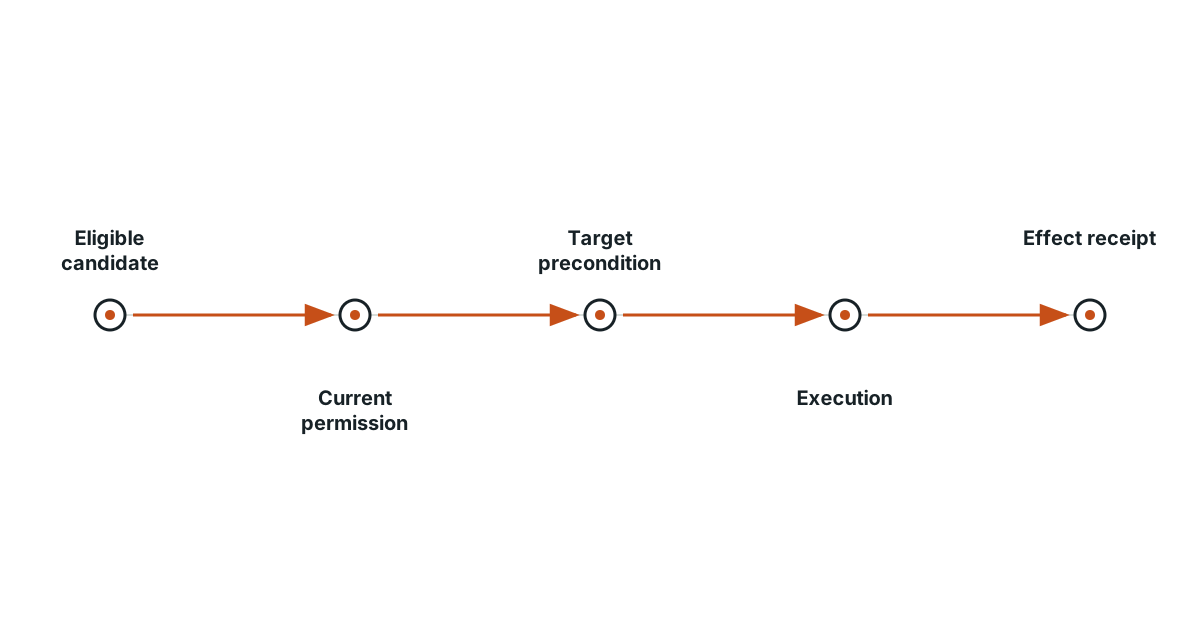
A governed-action design separating semantic eligibility, current authorization, target state, execution, and an attributable effect receipt.
Direct answer
A fact can support a candidate action without granting permission to execute it. Keep eligibility, current authorization, target preconditions, and execution as separate checks. Bind the permitted action to a specific actor, resource, purpose, and state, then verify its effect. A well-formed ontology or a confident agent answer does not replace the system that owns the change.
A true statement is not a permission grant
An illustrative planning system correctly identifies a spare part that meets a work order’s technical requirements. The user viewing the recommendation may still lack authority to reserve it, and another team may already have claimed it. The ontology helps explain eligibility. Permission and current target state belong to additional contracts that must hold when the action occurs.
Name three different decisions
Ask whether the action makes semantic sense, whether this actor may perform it, and whether the target still satisfies the required preconditions. A maintenance coordinator can be authorized to reserve parts yet unable to reserve a particular lot that has just been quarantined. Combining all three decisions into an opaque “eligible” flag makes the failure difficult to explain and correct.
Build a proposal with a narrow target
The proposal should name the resource, intended operation, relevant evidence, expected target version, and bounded parameters. Identify the user or workload on whose behalf the system acts. Give unresolved evidence an explicit state. The proposal is useful review material, but its presence should not itself confer a reusable capability to change arbitrary resources later.
Check authority at the execution boundary
| Boundary | Question it owns |
|---|---|
| Semantic evaluation | Does the candidate satisfy the modeled meaning? |
| Authorization | May this actor perform this action now? |
| Concurrency control | Is the target still in the expected state? |
| Executor | Was the permitted operation attempted as specified? |
| Effect observation | What changed, or remains unknown? |
Implement these responsibilities in the smallest appropriate architecture. They need distinct meanings even when one service owns several of them.
Preserve ambiguity after a timeout
If a reservation request times out, the system may not know whether it succeeded. Avoid treating the missing response as an instruction to reserve again. Use the target service’s supported operation identity and reconciliation mechanism. A later receipt should distinguish confirmed success, confirmed rejection, and unresolved completion. The evidence model helps connect those observations without inventing certainty.
Review the denial path as carefully as success
Exercise expired access, a changed resource, a withdrawn approval, and an action outside the permitted scope. Confirm that denial creates no side effect and provides an appropriate explanation without exposing forbidden data. Then inspect a successful action’s record: intent, authority, attempted parameters, target identity, and observed outcome should form an attributable chain. The resulting control is a tested operating contract, not a property of the ontology file alone.
Evidence and scope
- OWASP Authorization Cheat Sheet: Authorization must be checked on every request and enforced in a trusted component.
- W3C PROV-O: PROV-O represents entities, activities, agents, and derivation relationships.
The proposed checks are teaching tools; validate their behavior in the actual environment.
Evidence
Authorization must be checked on every request and enforced in a trusted component.
Authorization must be checked on every request and enforced in a trusted component.
Primary source · official-doc · checked Sep 11, 2026
Limit: This source supports the named mechanism, not the outcome or thresholds of the illustrative workflow.
PROV-O represents entities, activities, agents, and derivation relationships.
PROV-O represents entities, activities, agents, and derivation relationships.
Primary source · standard · checked Sep 11, 2026
Limit: This source supports the named mechanism, not the outcome or thresholds of the illustrative workflow.
Limitations
The scenarios and decision worksheets are original teaching examples. They are not measured deployments or guarantees; adapt the checks to the actual system and its documented behavior.
FAQ
- Can an ontology enforce authorization by itself?
- Only an implementation that actually controls access can enforce it. Descriptive facts and constraints alone do not provide that boundary.
- Does a successful recommendation prove an action is still valid later?
- No. Permission, approval, evidence, and target state may change before execution.
Related guides
Continue within Ontology-driven enterprise delivery, or use one of these adjacent diagnostics:
Editorial QA: automated native-English, structure, source-presence, and link checks completed . This record is not an independent expert endorsement. Review boundary.