
Question-led guide · planning
How do I ship agent security without blocking every useful action?
A risk-tier rollout that increases autonomy through evidence, reversibility, least privilege, sandboxing, approvals, canaries, and incident readiness.
Direct answer
Ship agent security by tiering actions by impact, reversibility, data sensitivity, and external reach. Begin with observation and draft-only work, then allow bounded reversible actions under short-lived identity, sandboxing, policy, budgets, audit, and canaries. Require explicit approval for higher tiers and prohibit actions whose effects cannot yet be contained or verified. Expand autonomy only when evaluation and production evidence meet predefined gates.
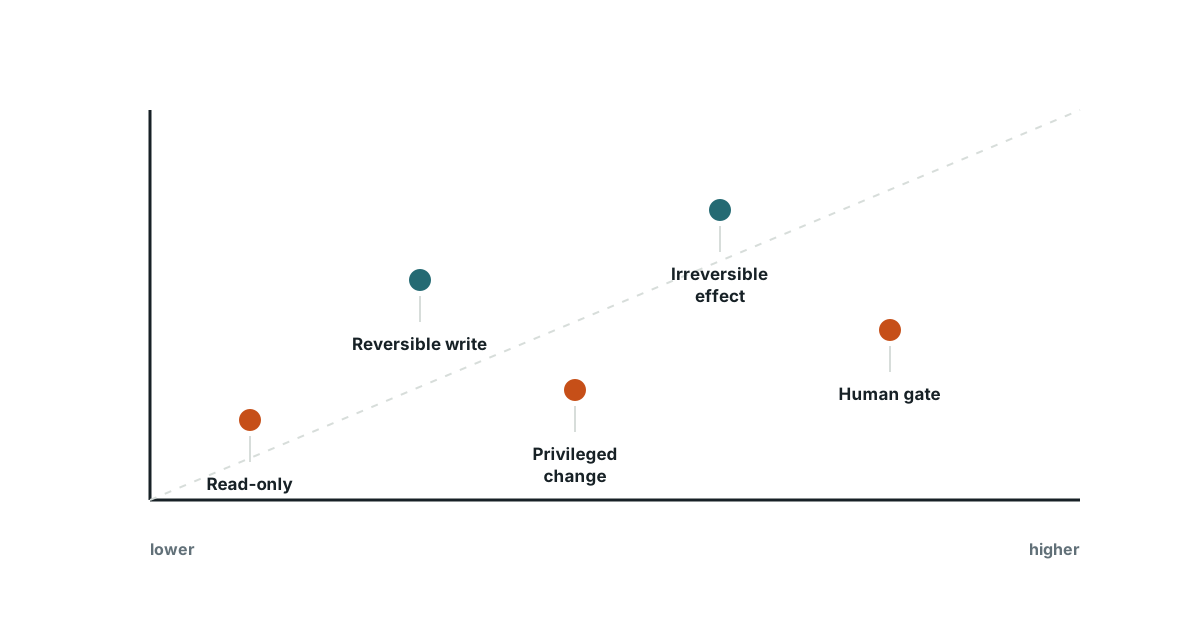
The release problem is uneven consequence
Use this rollout for an agent platform moving from prototypes to production actions. It covers how to expand useful authority without choosing between unrestricted autonomy and total prohibition. It assumes secure software and infrastructure practices are already part of the program.
Why one global approval rule fails
Prototype success creates pressure to expose every tool. Security responds with approvals on every call, and users bypass the agent because it is slower than manual work. Both outcomes come from one undifferentiated risk class.
Actions differ. Summarizing public documentation, drafting a ticket, querying a bounded metric, updating a reversible test record, and deleting production data should not share one policy. The controls and evidence should follow actual effect and blast radius.
Separate tiers for lookup and account closure
The same service agent can read public order status automatically, draft an address change for confirmation, and only propose account closure for a human operator. Each tier has different data, tools, monitoring, and rollback requirements.
Classify workflows by reachable harm
Inventory agent actions from target-system logs, not only declared tool schemas. Classify:
- data sensitivity and tenant scope;
- external communication or financial consequence;
- reversibility and compensation quality;
- target criticality and blast radius;
- observability and effect verification;
- prompt-injection and untrusted-input exposure;
- identity, approval, and sandbox support;
- serious failures seen in evaluation.
Identify “read” operations that export large datasets or cause expensive work and “reversible” operations whose users still see lasting effects.
Ship through graduated control profiles
Create progressive tiers. Tier 0 generates local suggestions with no external access. Tier 1 performs bounded reads. Tier 2 drafts changes for review. Tier 3 performs reversible, low-blast-radius actions under canary limits. Tier 4 covers material production actions with explicit approval and strong controls. Tier 5 remains prohibited until the system can contain and verify the effect—or permanently when policy requires.
Each promotion needs a gate: representative evaluation, targeted attacks, identity and permission checks, sandbox tests, audit completeness, outcome verification, rollback drill, monitoring, owner, and incident playbook. Deploy to limited users and targets, then expand only after the observation window.
Reduce friction through better boundaries, not weaker controls: preapproved operation templates, narrow resource scopes, digest-bound approvals, and batch review of truly equivalent proposals.
Risk-tier rollout plan
Maintain this rollout plan:
| Tier | Effect class | Required controls | Evidence to enter | Production limit | Exit/rollback trigger |
|---|---|---|---|---|---|
| 0 | Local analysis/draft | Data policy, content isolation | Basic quality/security tests | No external effect | Sensitive leakage |
| 1 | Bounded read | Short identity, scope, rate, redaction, audit | Access and injection tests | Test/public/limited tenant | Unauthorized data/load |
| 2 | Proposed change | Typed proposal, preview, digest, human review | Proposal accuracy and reviewer usability | No automatic commit | Misleading preview |
| 3 | Reversible low impact | Idempotency, canary, verification, rollback | Fault and rollback drills | Small targets/volume | Outcome or rollback failure |
| 4 | Material production | Strong auth, approval, separation, incident owner | Domain/security gate | Narrow action/tenant/window | Any serious failure |
| 5 | Prohibited/unsupported | Deny at policy and target | New design and independent review | None | Not applicable |
Security theater that adds friction without containment
- Classifying risk from tool name instead of target and effect.
- Calling an operation reversible without testing compensation and residual effects.
- Adding human confirmation while leaving credentials and scope broad.
- Promoting autonomy after average success while ignoring one serious failure.
- Keeping temporary canary permissions and exceptions indefinitely.
Evidence
Zero-trust architecture centers protection on resources, per-session access, dynamic policy, least privilege, and continuous evaluation rather than network location.
NIST SP 800-207 defines zero-trust concepts and deployment approaches relevant to bounded agent access.
Primary source · standard · checked Aug 26, 2026
Limit: It is an architectural model, not an agent rollout plan or certification of a specific control stack.
Secure AI system development guidance calls for security ownership, threat modeling, secure infrastructure, monitoring, incident management, and responsible release.
CISA and the UK NCSC summarize international guidelines for secure AI system design, development, deployment, and operation.
Primary source · official-doc · checked Aug 26, 2026
Limit: The guidance is principle-level and does not determine action tiers, metrics, or residual risk for a product.
Autonomy should be increased through a versioned risk-tier gate with explicit evidence and rollback, not through permanent blanket tool access.
The rollout plan below aligns controls and evidence with effect severity while preserving useful low-risk actions.
Signal Studio author framework · reviewed Aug 26, 2026
Limit: Risk classification can be wrong and organizational incentives can pressure teams to under-tier actions; independent review is needed for high impact.
Limitations
Tiering cannot make inherently unsafe or unlawful actions acceptable. Reversibility can be overstated, users and attackers adapt, and canaries may miss rare harms. High-impact domains need qualified safety, security, legal, and domain oversight.
FAQ
- Does human approval make a dangerous action safe?
- No. Approval is one control. The human needs clear proposal and impact information, current authority, enough time, and a system that still enforces scope, idempotency, audit, and rollback.
- Should production agents begin in read-only mode?
- Read-only or draft-only is a strong initial tier, but reads can expose data and create load. Apply identity, scope, data, rate, and audit controls from the beginning.
Related guides
Continue within AI agent security, or use one of these adjacent diagnostics:
Editorial QA: automated native-English, structure, source-presence, and link checks completed . This record is not an independent expert endorsement. Review boundary.