
Question-led guide · governance
How do I turn agent evaluation results into a production quality gate?
A versioned quality-gate record with predefined thresholds, serious failures, uncertainty, exceptions, owners, canary evidence, rollback, and expiry.
Direct answer
Turn evaluation into a gate by defining the release decision before running the suite. Bind task slices, environment, agent configuration, graders, trial plan, minimum outcome and safety thresholds, serious-failure vetoes, uncertainty, and coverage gaps to a named owner. Add a limited canary, production monitors, rollback triggers, and expiring exceptions. A benchmark report without enforcement and version identity is evidence, not a gate.
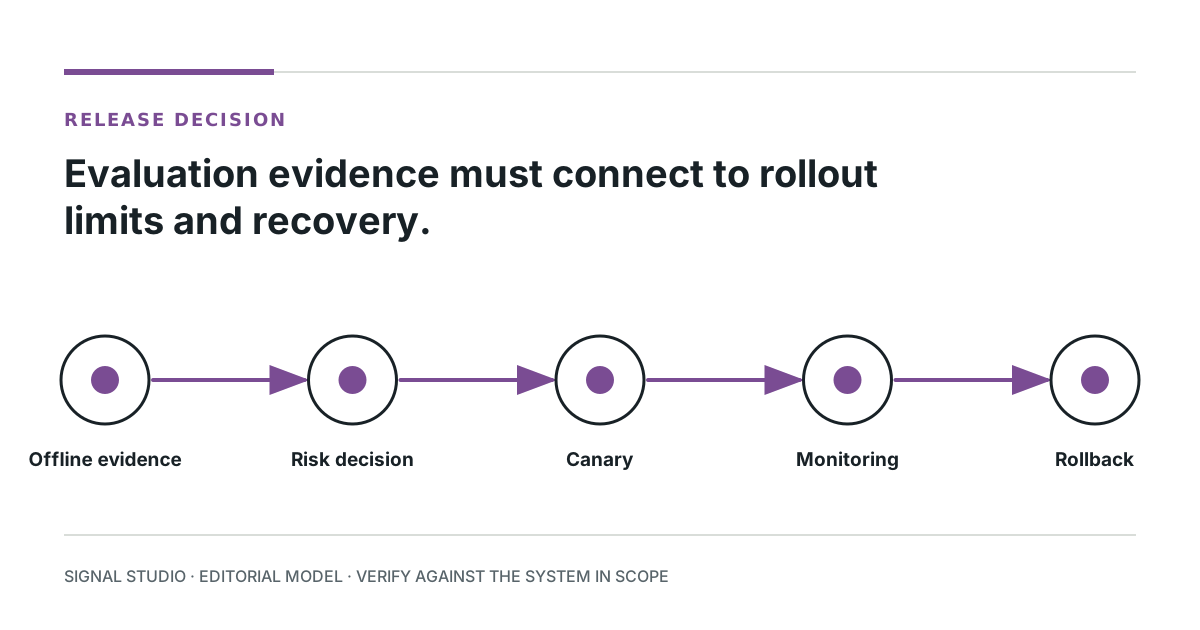
A score is not a release decision
Use this process when evaluation evidence must authorize or block deployment of an agent configuration. It covers model, prompt, tools, policies, workflow code, memory, and context versions as one release identity. The cost-specific release record is a companion input rather than a duplicate gate.
The gap between benchmark and production authority
Evaluation teams publish dashboards; release teams make decisions elsewhere. Thresholds are chosen after results arrive, weak slices are explained away, and the deployed prompt or tool version differs from the tested bundle. Even a sound evaluation has no operational force.
One aggregate score creates another failure. A high average can hide one unauthorized action, a weak language group, or a dangerous fallback path. Quality gates need both minimum floors and individually blocking events.
A better average with a worse serious-failure rate
A new build improves task success from 78% to 82% but doubles irreversible-action errors. The gate blocks broad rollout, permits a read-only canary, and names the remediation and evidence required for reconsideration.
Translate evidence into thresholds and exposure
Attempt to answer these questions from the last release record:
- What exact configuration was evaluated and deployed?
- Which production decision did each metric inform?
- Were thresholds and serious failures defined before results?
- Which tasks and users were outside coverage?
- How many trials and what uncertainty supported the claim?
- Who accepted residual risk and for how long?
- Which production signal would automatically stop or roll back the release?
Missing answers identify the distance between an evaluation report and a gate.
Operate canary, monitoring, and rollback as one gate
Create a release candidate manifest before execution. Freeze task suite, environment, graders, model/tool/policy versions, trial plan, slices, thresholds, and veto events. Keep a holdout or fresh task lane for decisions when tuning has repeatedly used the regression suite.
After offline passage, deploy to a bounded canary with the same trace and effect identity used in evaluation. Monitor verified outcomes, serious failures, handoffs, cost, latency, policy denials, and drift. Automatic rollback should not wait for a meeting when a predefined veto occurs.
Record exceptions as temporary branches of the gate. Re-evaluate when the model, tool, policy, target population, environment, or grader changes materially.
Production quality-gate record
The quality-gate record contains:
| Group | Required fields |
|---|---|
| Decision | Release, scope, traffic, users, regions, duration, and owner |
| Candidate identity | Code, model, prompt, tools, context, memory, policy, and data versions |
| Evaluation contract | Suite, environment, graders, trials, slices, and artifact hashes |
| Thresholds | Minimum outcome and policy floors plus practical-difference rule |
| Serious failures | Non-averaged vetoes and required targeted tests |
| Results | Numerators, denominators, intervals, slice findings, and exclusions |
| Coverage limits | Missing users, tools, attacks, dependencies, and delayed outcomes |
| Canary | Volume, observation window, monitors, human supervision, and stop rules |
| Rollback | Prior configuration, state compatibility, trigger, owner, and proof test |
| Exception/review | Approver, rationale, compensating control, expiry, and next review event |
The downloadable AI Agent Evaluation Release Gate turns those fields into a versioned example that connects offline evidence to a canary, live stop conditions, rollback, and named decision ownership.
Release gates with no consequence when they fail
- Selecting thresholds after seeing the candidate’s score.
- Testing one bundle and deploying another.
- Averaging serious failures into general quality.
- Treating offline passage as permission for unrestricted traffic.
- Keeping a gate valid after model, policy, task mix, or tool behavior changes.
Evidence
Production ML readiness includes testing, monitoring, data and model checks, infrastructure, and operational practices beyond offline model quality.
The ML Test Score presents a rubric for production-readiness practices and technical-debt reduction across data, model, infrastructure, and monitoring.
Primary source · paper · checked Aug 26, 2026
Limit: The paper predates modern generative agents and its rubric must be extended for tools, authority, trajectories, and effects.
Generative-AI risk controls should connect pre-deployment measurement with monitoring, governance, incident response, and risk treatment.
NIST AI 600-1 maps generative-AI risks and suggested actions across governance, measurement, and management functions.
Primary source · standard · checked Aug 26, 2026
Limit: The voluntary profile does not choose product thresholds or approve any specific agent release.
A gate should be an enforceable, expiring decision record that preserves evidence and cannot average away serious failures.
The quality-gate record below connects evaluation artifacts to deployment scope, owner, canary, rollback, and review.
Signal Studio author framework · reviewed Aug 26, 2026
Limit: Thresholds and release authority require product, domain, safety, security, legal, and operations input proportional to risk.
Limitations
A gate is only as valid as its tasks, environment, graders, and thresholds. Production users and dependencies change, rare failures may be absent, and canaries can miss delayed harm. Keep the release bounded and re-evaluate on material change.
FAQ
- Should one overall score determine release?
- Usually no. Preserve outcome, safety, policy, evidence, efficiency, and slice results. Serious failures and minimum floors should remain separate from optimizable averages.
- Can a failed threshold receive an exception?
- Only through explicit authority, bounded scope, compensating controls, a rationale, monitoring, expiry, and a removal condition. Some serious failures should be non-waivable.
Related guides
Continue within AI agent evaluation, or use one of these adjacent diagnostics:
Editorial QA: automated native-English, structure, source-presence, and link checks completed . This record is not an independent expert endorsement. Review boundary.