
Question-led guide · how-to
How can I shorten context without damaging task quality?
An evidence-preserving method for reducing LLM context through necessity tests, structured compression, retrieval, and paired quality evaluation.
Direct answer
Shorten context by removing material that cannot change the task decision, not by applying a blind token target. Protect instructions, current state, authoritative facts, exceptions, and evidence needed for verification. Compress repeated history into typed state, retrieve supporting records on demand, preserve provenance, and run paired evaluations on difficult slices before accepting the token reduction as a real saving.
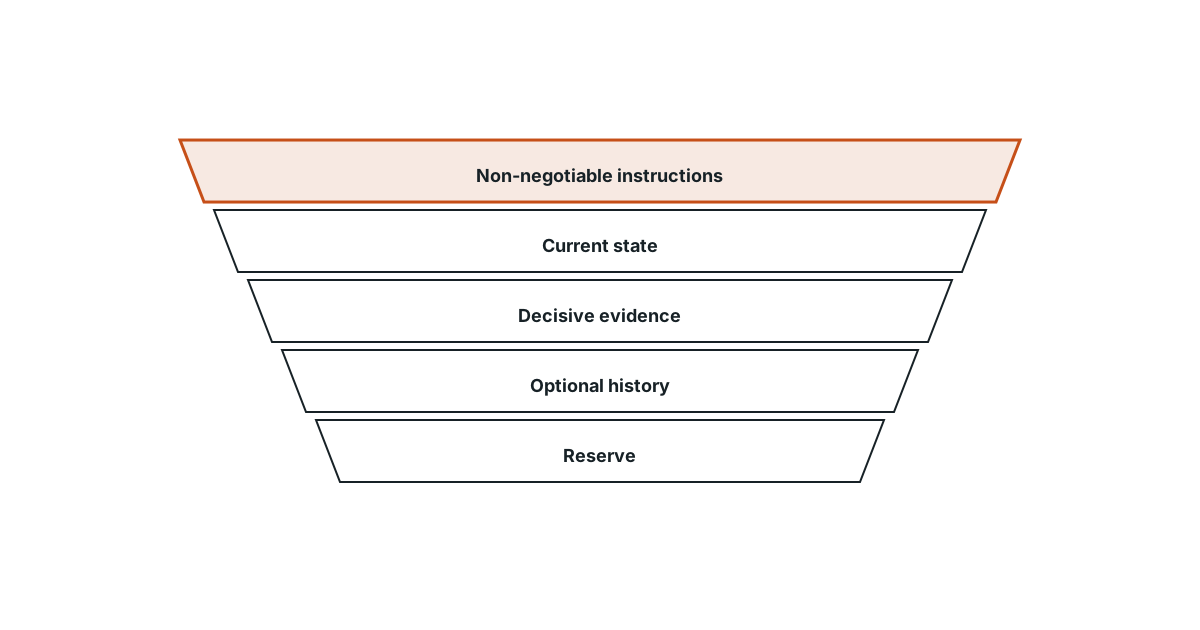
Token reduction begins with task sufficiency
Use this method when input tokens, latency, or context limits are constraining a production application. It targets context reduction while preserving the information required to decide and verify the task. It is different from allocating the entire context window: here the starting frame already exists and must be made smaller safely.
Why uniform truncation destroys decisive evidence
Context grows because append-only chat history is easy. Tool outputs, duplicate instructions, superseded plans, verbose errors, and retrieved documents accumulate. A team then applies a simple remedy—keep the last N messages or summarize everything—and discovers that rare constraints or evidence disappear.
Not every token has equal value. A short authorization boundary may be essential, while a thousand-token successful tool transcript may add nothing after its result has been normalized. Position and distraction also matter, so a shorter, structured frame can outperform a long chronological one. That is an empirical possibility, not a guaranteed optimization.
Removing repeated policy text but preserving the exception
A support workflow deduplicates boilerplate policy paragraphs and summarizes old turns, yet pins the current account state and the one exception clause that controls eligibility. An ablation suite checks accepted outcomes and serious errors.
Measure contribution by context class
For a sample of costly tasks, annotate each context segment by function: instruction, authority, current state, required fact, candidate evidence, tool contract, history, example, or output reserve. Then ask a counterfactual question: Which allowed decision or verification check could change if this segment were absent?
Look for:
- repeated facts with no authoritative source marker;
- raw tool responses whose typed result is already stored;
- superseded plans mixed with current state;
- retrieved passages unrelated to a pending decision;
- error stacks that could be replaced by an error class and stable artifact reference;
- conversation tone being used as workflow state.
Measure task outcomes by slice before optimizing. An average can hide damage to long-tail policies, multilingual requests, or tool-failure recovery.
Compress with protected budgets and ablations
Establish a protected core: current instructions, authority, task goal, committed state, invariants, open decisions, and evidence required for the next step. Normalize tool outputs into typed records with provenance. Keep large artifacts outside the prompt and retrieve them through stable references.
Apply three treatments: retain verbatim when exact wording matters; compress structurally when fields matter; retrieve on demand when relevance is conditional. Delete only material that has no remaining decision or audit value.
Run an A/B evaluation with the same tasks, model settings, tools, and trials. Compare verified outcome, serious failures, evidence use, latency, total attempts, and full outcome cost—not only tokens in the first call.
Context-budget decision table
Use this table during a context review:
| Context object | Can change next decision? | Exact wording required? | Freshness/provenance risk | Treatment | Quality test |
|---|---|---|---|---|---|
| System and policy instructions | Usually | Often | Version drift | Retain/version | Policy cases |
| Current workflow state | Yes | Fields, not prose | Stale state | Typed compression | Resume/failure cases |
| Retrieved evidence | Sometimes | Relevant excerpt | Source/version drift | On-demand with citation | Recall and support |
| Tool result | Sometimes | Usually no | Partial/failed call | Normalize + artifact link | Effect verification |
| Prior conversation | Varies | Rarely | Contradictions | Extract decisions, then trim | Multi-turn cases |
| Examples | Sometimes | Often | Overfitting | Select by task slice | Contrast cases |
Add a release line: token change, latency change, outcome delta, serious-failure delta, review date, and rollback trigger.
Savings reported without matched outcome quality
- Optimizing the initial prompt while retries increase total tokens.
- Keeping recent text and discarding older binding constraints.
- Summarizing evidence without retaining source and version references.
- Evaluating only easy average cases.
- Assuming a provider’s maximum context size is the model’s reliable working context for the task.
Evidence
Longer context does not guarantee that a model will use relevant information reliably, especially when important material is positioned among distractors.
Lost in the Middle evaluates long-context use and reports sensitivity to the position of relevant information across studied tasks and models.
Primary source · paper · checked Aug 26, 2026
Limit: The experiments are task- and model-specific and do not prescribe a universal context layout or compression ratio.
Effective context engineering involves selecting and managing the limited set of information available to an agent rather than accumulating all history.
Anthropic's engineering article discusses context selection, compaction, structured notes, retrieval, tools, and long-running agent practices.
Primary source · official-doc · checked Aug 26, 2026
Limit: This is first-party engineering guidance, and its examples do not prove one compression strategy will preserve quality in another product.
A context reduction is acceptable only when savings and task-quality effects are measured on the same representative slices.
The decision table below classifies context by decision value and requires paired outcome tests before removal.
Signal Studio author framework · reviewed Aug 26, 2026
Limit: Teams must define their own serious failures, evidence requirements, and uncertainty thresholds.
Limitations
The approach cannot guarantee quality across all model versions or tasks. Compression can hide rare exceptions, retrieval can miss required evidence, and paired tests may underrepresent future traffic. High-impact workflows need conservative retention and ongoing production checks.
FAQ
- Should I summarize the entire conversation after every turn?
- Usually no. Update durable typed state only when facts or decisions change, and retain references to source records. Repeated free-form summarization can accumulate omissions and unsupported reinterpretation.
- Can retrieval replace a large prompt?
- It can move optional evidence out of the initial frame, but retrieval introduces its own recall, freshness, authorization, latency, and provenance failures. Evaluate the whole path.
Related guides
Continue within AI cost engineering, or use one of these adjacent diagnostics:
Editorial QA: automated native-English, structure, source-presence, and link checks completed . This record is not an independent expert endorsement. Review boundary.