
Question-led guide · evaluation
How can I simulate users without fooling myself?
A validation card for agent-evaluation user simulators covering persona distributions, hidden goals, behavior calibration, leakage, and transfer to real users.
Direct answer
Use simulated users as controlled test instruments, not substitutes for user evidence. Define which behaviors they represent, hide task truth from them, calibrate response patterns against consented real interactions, test multiple simulator models and adversarial personas, and report divergence by slice. Keep deterministic state and policy checks outside the simulator, then confirm important conclusions with real users or production observation.
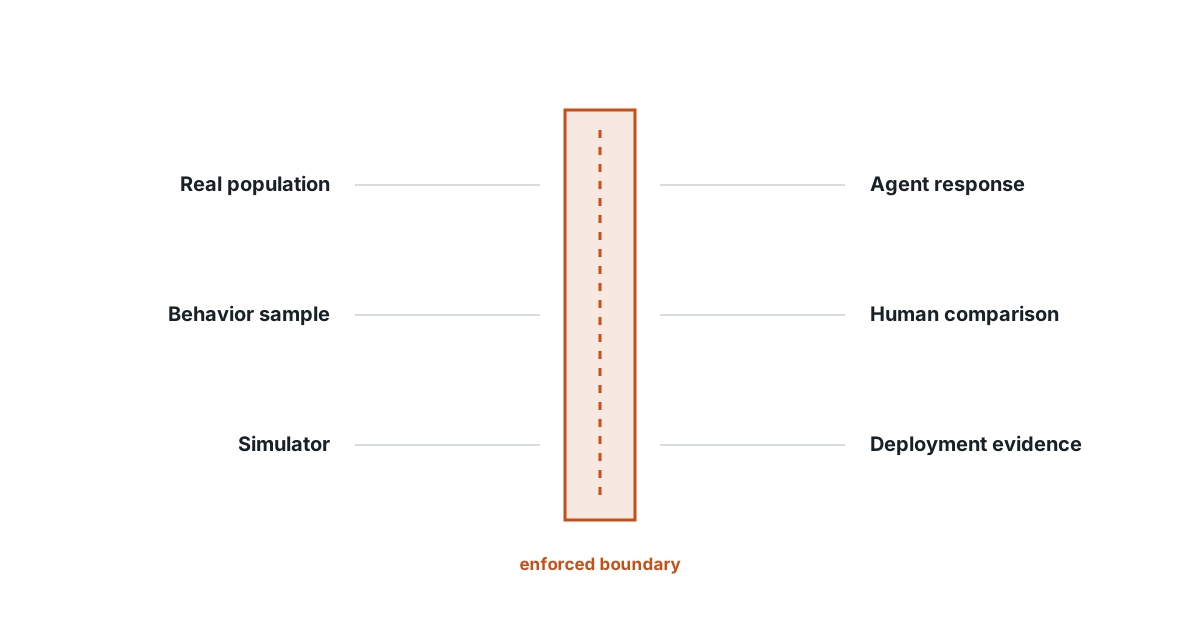
A simulator is an instrument
Use simulators when an agent needs multi-turn clarification, negotiation, correction, or user response and running every evaluation with people is impractical. A simulator can support regression and stress testing. It cannot establish product-market fit, user trust, or real-world impact by itself.
How synthetic users inherit the designer’s assumptions
Simulated conversations look natural, so teams treat them as user evidence. The simulator may know the task answer, accept jargon that real users reject, provide missing facts immediately, or follow policy perfectly. If the same model family powers both sides, shared assumptions can create artificial coordination.
Prompt authors also design personas from intuition. A list of “novice, expert, impatient” characters is not a distribution of real behavior. The suite can pass while omitting abandonment, contradiction, disability needs, language variation, adversarial incentives, and partial information.
An overly cooperative support user
The simulator always supplies requested order IDs and accepts clarifying questions. A real-user holdout reveals missing identifiers, interruptions, and refusal; the simulator is revised and its claims restricted to the behaviors it reproduces.
Compare the simulated and real populations
Collect a lawful, de-identified sample of real interaction features appropriate to the product: turn count, corrections, missing fields, response delay, refusal, misunderstanding, escalation, language, and outcome. Do not give raw sensitive transcripts to a model merely to create realism.
Run identical agent tasks with real participants, recorded interaction scripts, and one or more simulators. Compare behavioral distributions and the downstream agent ranking. A simulator that preserves average turn count but reverses which agent performs better is invalid for that decision.
Test leakage by inserting a false expected answer in evaluator-only metadata. The simulated user should not reveal or align to it.
Use simulation inside explicit validity limits
Define a population model before a persona prompt. Weight scenarios by observed frequency and add separate risk slices for rare consequential behavior. Give the simulator private user facts and goals, a communication policy, and realistic limits on knowledge and cooperation.
Keep the world state and outcome oracle external. The simulator produces user actions; it does not decide whether a refund, booking, or access change is correct. Version its model, prompt, sampling, private state, and termination rules.
Use simulators to find failures, compare controlled variants, and run adversarial cases. Confirm major product and safety decisions with people, historical replay, or monitored deployment evidence.
User-simulator card
The user-simulator card records:
| Field | Required evidence |
|---|---|
| Intended use | Regression, capability, adversarial testing, or exploration |
| Target population | Product, geography, language, expertise, access needs, and period |
| Behavior dimensions | Cooperation, knowledge, errors, delay, correction, refusal, and abandonment |
| Distribution | Frequency source and risk slices |
| Private state | Goals and facts visible to simulator but not agent |
| Leakage controls | Separation from expected path, graders, and hidden environment state |
| Calibration | Real/recorded comparison, metrics, sample, and disagreement analysis |
| Robustness | Multiple simulator models/prompts and sensitivity results |
| Known gaps | Unsupported users, behaviors, channels, and consequences |
| Review | Version, owner, expiry, privacy basis, and required real-user confirmation |
Synthetic scale mistaken for external validity
- Equating fluent dialogue with representative behavior.
- Letting the simulator see the reference trajectory or grader state.
- Using one persona prompt for an entire customer population.
- Allowing the simulated user to grade the external business outcome.
- Reporting simulator-only improvements as proven user benefit.
Evidence
Tool-agent-user benchmarks can use a language model as a user simulator, but simulator behavior becomes part of the evaluation system.
Tau-bench defines multi-turn tasks with user simulators, domain policies, tools, and database state and evaluates consistency in those environments.
Primary source · paper · checked Aug 26, 2026
Limit: Synthetic users and bounded retail/airline-style domains do not establish representativeness for another product's customers.
Deployment simulation can compare model behavior in controlled synthetic scenarios before release, while remaining an approximation of deployment.
OpenAI describes a first-party deployment-simulation approach for studying model behavior under generated scenarios before release.
Primary source · official-doc · checked Aug 26, 2026
Limit: It is company research and methodology; synthetic deployments cannot reproduce all incentives, users, feedback loops, or harms.
A simulator should have a versioned validity card with a target population, calibration evidence, known gaps, and prohibited claims.
The user-simulator card below prevents plausible dialogue from being mistaken for representative outcome evidence.
Signal Studio author framework · reviewed Aug 26, 2026
Limit: Calibration depends on lawful access to suitable real interactions and may still miss future user adaptation.
Limitations
Real-user data may be sparse, sensitive, or shaped by the current product, and simulators can reproduce model biases or become overly cooperative. Validation is always conditional on population, period, product surface, and tasks represented.
FAQ
- Can I use the same model for the agent and simulated user?
- You can, but shared biases, knowledge, and style may make interaction unrealistically cooperative. Compare different simulator families and validate against real behavior before generalizing.
- Should the simulator know the expected solution?
- Usually it should know its private goal and facts, not the agent's target trajectory or grader answer. Otherwise it can steer the agent toward the benchmark's intended path.
Related guides
Continue within AI agent evaluation, or use one of these adjacent diagnostics:
Editorial QA: automated native-English, structure, source-presence, and link checks completed . This record is not an independent expert endorsement. Review boundary.