
Question-led guide · governance
What belongs in an AI cost release gate?
A release record that ties AI unit cost to quality, reliability, sensitive-data handling, capacity, fallbacks, owners, and rollback thresholds.
Direct answer
An AI cost release gate should approve a bounded operating envelope, not a single monthly estimate. Include cost per verified outcome by task slice, quality and serious-failure floors, latency and capacity limits, retry and fallback budgets, sensitive-data constraints, forecast assumptions, owner, exception expiry, canary plan, and automatic rollback triggers. Cost savings fail the gate when they move unacceptable risk or labor elsewhere.
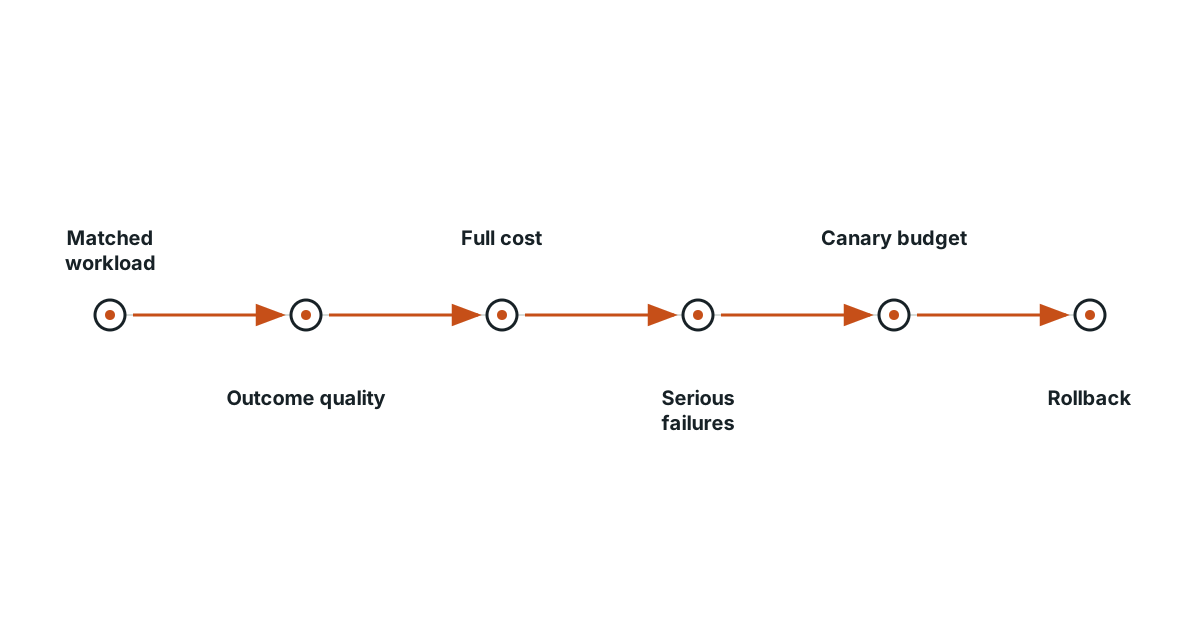
Cost change is a production claim
Use this gate before releasing a model, prompt, router, context policy, cache, provider, capacity mode, or tool workflow that materially changes unit cost. The gate is cost-centered but cannot be separated from outcome quality and operating risk. A broader evaluation gate may incorporate this record as one input.
Why a provider bill cannot approve a release
Cost review is often a spreadsheet signed before quality testing. Evaluation is a separate report. Reliability, privacy, and capacity live in other systems. A release can therefore look cheaper in one document while increasing retries, escalations, stale cache hits, or sensitive-data exposure elsewhere.
Another failure is approving an average. Average cost hides expensive slices and tail events. A low overall number can coexist with an unbounded tool loop, a premium fallback used for one tenant, or a rare but costly repair path.
Prompt compression increases escalations
A shorter prompt saves $8,000 per month in model cost but sends 14% more cases to human review. The gate includes review labor, latency, acceptance, serious failures, and a canary rollback threshold.
Match workload, quality, risk, and full cost
Take the last material AI release and try to reconstruct the approval. Can you identify the exact model and prompt versions, representative tasks, price date, cache behavior, retry limits, quality floors, serious failures, capacity assumptions, and person authorized to accept the trade-off? Can you tell which observed metric would have caused rollback?
If those answers live only in chat or are spread across unversioned dashboards, the organization had a review conversation, not an enforceable gate.
Bind economics to rollout and rollback
Define an operating envelope by task slice. For each slice, record expected volume, cost per verified outcome, resolution rate, latency, human intervention, and upper bounds for retries and tool work. Establish non-negotiable quality and policy floors before comparing cost.
Run a production-like canary with budget caps. Reconcile provider usage to task IDs and outcome records. Test fallback paths and one provider or capacity impairment. Set automatic stops for runaway cost, serious failures, and outcome degradation.
Assign an owner who can approve, expire, or revoke an exception. Re-review when provider terms, model versions, task mix, or policy changes—not only on a calendar.
Cost-and-evaluation gate record
The cost-and-evaluation gate record contains:
| Section | Required evidence |
|---|---|
| Release identity | Model, prompt, router, tools, cache, policy, provider, and code versions |
| Decision and scope | Task slices, traffic percentage, regions, tenants, and duration |
| Unit economics | Cost per attempt and verified outcome, attribution rules, price date, and range |
| Quality floors | Outcome metric, serious failures, calibration, and slice thresholds |
| Operating limits | Latency, concurrency, tokens, retries, tools, fallback, and human review |
| Data controls | Sensitive fields, retention, cache isolation, and provider processing boundary |
| Capacity and failure | Quotas, provisioned base, overflow, impairment test, and degraded mode |
| Canary and rollback | Sample, observation window, stop metrics, prior version, and owner |
| Exception | Rationale, approver, compensating control, expiry, and removal condition |
Savings that move expense outside the measured boundary
- Approving model price without measuring cost per verified outcome.
- Letting improved average quality offset a serious unauthorized or incorrect effect.
- Omitting retries, fallbacks, tool cost, and human repair from the envelope.
- Using current provider price without a checked date and sensitivity range.
- Granting permanent exceptions with no owner or expiry.
Evidence
Generative-AI risk management should connect measurement, monitoring, governance, and risk treatment across the lifecycle.
NIST AI 600-1 provides cross-sector actions for governing, mapping, measuring, and managing generative-AI risks.
Primary source · standard · checked Aug 26, 2026
Limit: The profile is voluntary and broad; it does not define a financial threshold or this release-record format.
Evaluation should be grounded in representative tasks, clear objectives, suitable graders, and continuous iteration rather than one aggregate score.
OpenAI's evaluation guidance describes task-driven evaluation design, datasets, graders, and iterative evaluation practices.
Primary source · official-doc · checked Aug 26, 2026
Limit: It is provider guidance and does not validate an organization's cost model or release authority.
A cost gate should reconcile technology spend with a defined business unit and preserve quality and failure constraints.
FinOps unit-economics guidance connects technology cost to business-value units for decision support.
Primary source · official-doc · checked Aug 26, 2026
Limit: The framework does not specify how an AI product verifies outcomes, attributes labor, or blocks serious failures.
Limitations
A pre-release gate cannot predict all production demand, provider changes, adversarial use, or downstream labor. Forecasts and evaluations have uncertainty, so the approved envelope needs canary limits, ongoing telemetry, exception expiry, and a tested rollback path.
FAQ
- Is a budget alert a release gate?
- No. An alert reports observed spend. A gate records the evidence and authority for releasing a particular configuration within quality, cost, capacity, data, and rollback boundaries.
- Should cost and quality be combined into one weighted score?
- Usually keep serious-failure and minimum-quality constraints separate. Optimize cost only among configurations that satisfy those floors, then report trade-offs rather than hiding them in one weight.
Related guides
Continue within AI cost engineering, or use one of these adjacent diagnostics:
Editorial QA: automated native-English, structure, source-presence, and link checks completed . This record is not an independent expert endorsement. Review boundary.