
Question-led guide · decision
When is a microservice the wrong architecture?
A constraint-first architecture decision for teams considering microservices without independent change, scale, ownership, or reliability needs.
Direct answer
A microservice is the wrong architecture when its independent deployment, scaling, isolation, or ownership benefits do not solve a measured constraint. If one small team changes the same data and features together, operational maturity is limited, and cross-service consistency dominates, a modular monolith is usually the safer starting point. Record the forces, test boundaries, and split only where independent change earns the coordination cost.
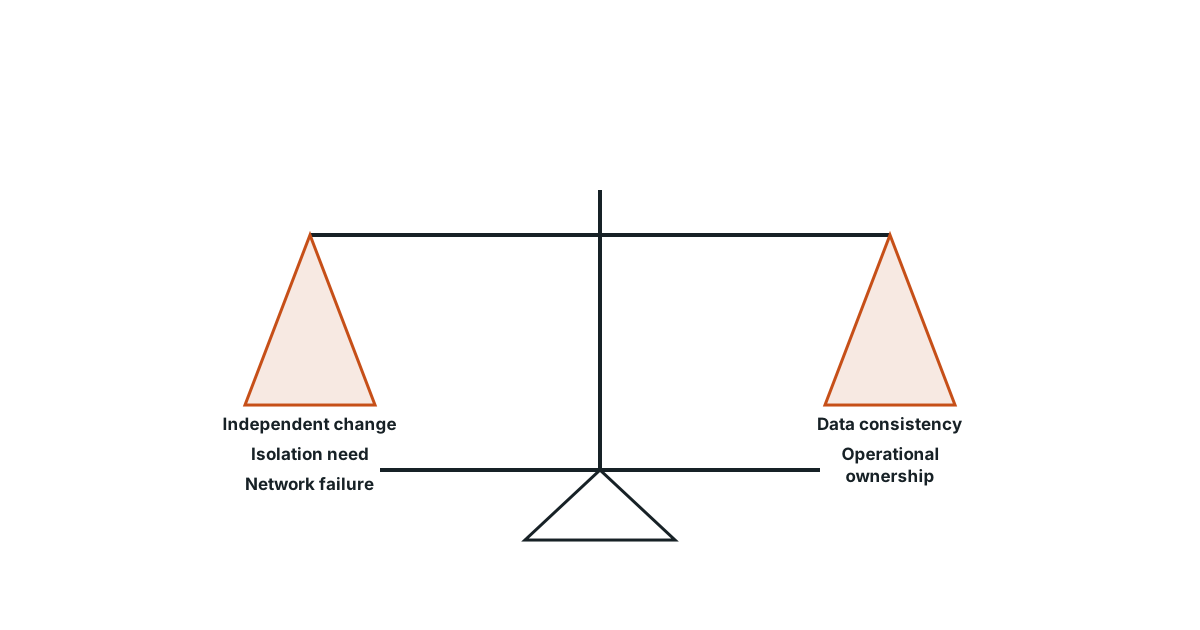
A boundary must solve a measured constraint
Use this guide when a new product or decomposition project is considering independently deployed services. The question is whether microservices solve current constraints better than a well-structured deployable unit. It does not argue that monoliths are always simpler or that existing services should be merged automatically.
The distributed tax arrives immediately
Architecture labels carry status and ready-made diagrams. AI coding tools can scaffold many services quickly, making file generation feel like the hard part. The real cost appears later: contracts, deployment pipelines, identity, network failure, retries, observability, data ownership, migrations, on-call boundaries, and compatibility.
Benefits are also real. Independent scale, fault containment, release cadence, regulatory boundaries, or team autonomy may justify that cost. Judgment begins by naming which benefit matters and how the organization will know it arrived.
Splitting billing calculations too early
A six-person team proposes a service for code ownership, but deploys together, shares one database transaction, and has no independent scaling need. A module boundary preserves ownership without adding network failure and cross-service consistency work.
Test the proposed service against its burden
Write three quality-attribute scenarios before naming services. Each scenario includes a stimulus, environment, affected artifact, desired response, and measure. Examples include a traffic burst, a schema change, a tenant-isolation incident, or a rollback during partial dependency failure.
Then examine candidate boundaries:
- Do the capabilities change and deploy independently in practice?
- Can one team own the data and production outcome end to end?
- Is the boundary stable, or does work routinely cross it?
- Does a separate failure domain reduce user impact, or add a new dependency?
- Is independent scaling material after measuring the bottleneck?
- Can the organization operate versioned contracts and distributed incidents?
If most user changes require coordinated releases and transactions across the proposed services, the boundary is working against the change pattern.
Prefer the least costly boundary that works
Start with modules whose interfaces and dependency directions are enforced in code and tests. Keep domain ownership and data rules explicit even in one deployment. That preserves learning without paying the network and operational tax immediately.
For a contested boundary, run a thin experiment: measure call volume, change coupling, failure propagation, deploy frequency, and scaling profile. Record a decision with triggers for extraction, such as sustained independent scaling or a proven isolation requirement. Also record triggers for stopping the split.
When microservices are justified, fund the platform work as part of the decision: service identity, deployment, contract tests, telemetry, incident ownership, timeouts, retries, and data reconciliation.
Architecture-constraint matrix
Complete one row per candidate boundary:
| Constraint | Evidence now | Benefit of separation | New coordination cost | Test/measure | Decision trigger |
|---|---|---|---|---|---|
| Independent change | Contract/version work | Change-coupling history | |||
| Independent scale | Targeted capacity | Network/queue overhead | Load profile | ||
| Failure isolation | Smaller blast radius | New dependency modes | Failure drill | ||
| Data/regulatory boundary | Stronger control | Distributed consistency | Data-flow review | ||
| Team ownership | Autonomous decisions | Cross-team protocols | Work-item analysis | ||
| Technology constraint | Specialized runtime | Skills and operations | Prototype |
End the record with the selected option, rejected alternatives, assumptions, review date, extraction conditions, and rollback path.
Reasons that sound architectural but contain no evidence
- Counting generated repositories as evidence of architectural progress.
- Splitting nouns into services without studying transaction and change boundaries.
- Assuming a network boundary creates team autonomy.
- Ignoring data migrations, partial failure, and operational ownership.
- Making a permanent choice without review triggers or evidence that would reverse it.
Evidence
Architecture descriptions should address stakeholder concerns through explicit viewpoints rather than present structure without context.
ISO/IEC/IEEE 42010 defines concepts for architecture descriptions, stakeholders, concerns, viewpoints, views, and architecture decisions.
Primary source · standard · checked Aug 26, 2026
Limit: The public standard page and abstract do not prescribe microservices, and the full standard is not reproduced here.
Architecture evaluation should examine trade-offs among quality attributes under concrete scenarios.
The SEI Architecture Tradeoff Analysis Method presents a stakeholder- and scenario-based method for identifying risks, sensitivities, and trade-offs.
Primary source · official-doc · checked Aug 26, 2026
Limit: ATAM is a general evaluation method and does not produce an automatic answer or a universal service-size threshold.
A service boundary should be justified by an independent operational or change constraint and revisited with observed evidence.
The architecture-constraint matrix below makes benefits and coordination taxes comparable before a split.
Signal Studio author framework · reviewed Aug 26, 2026
Limit: The decision remains context-specific and should include experienced engineering, operations, security, and data stakeholders.
Limitations
This guide cannot choose an architecture from a short checklist. Regulatory isolation, geography, existing platforms, acquisitions, team topology, traffic, and failure consequences may justify distribution even when feature development is coupled. Validate the decision with scenarios and prototypes.
FAQ
- Are microservices wrong for small teams?
- Team size is one constraint, not a prohibition. A small team may need strong isolation or independent scale, but it must still afford the deployment, observability, data, testing, and incident-response surface it creates.
- Does choosing a modular monolith prevent a later split?
- No. Clear modules, owned interfaces, dependency rules, and measured hot spots create evidence for a later extraction. A distributed system built too early can be harder to reshape.
Related guides
Continue within Engineering judgment with AI, or use one of these adjacent diagnostics:
Editorial QA: automated native-English, structure, source-presence, and link checks completed . This record is not an independent expert endorsement. Review boundary.