
Question-led guide · diagnostic
Why can retries make an incident worse?
A failure exercise for retry amplification, duplicate effects, synchronized load, stale work, budget exhaustion, and unsafe compensation.
Direct answer
Retries worsen incidents when they multiply load on a slow dependency, repeat non-idempotent effects, outlive the user's deadline, synchronize without jitter, or occur independently at several layers. Retry at one controlled layer, spend a shared deadline and attempt budget, use exponential backoff with jitter for suitable transient failures, enforce idempotency, and stop when the expected benefit is lower than the added load or risk.
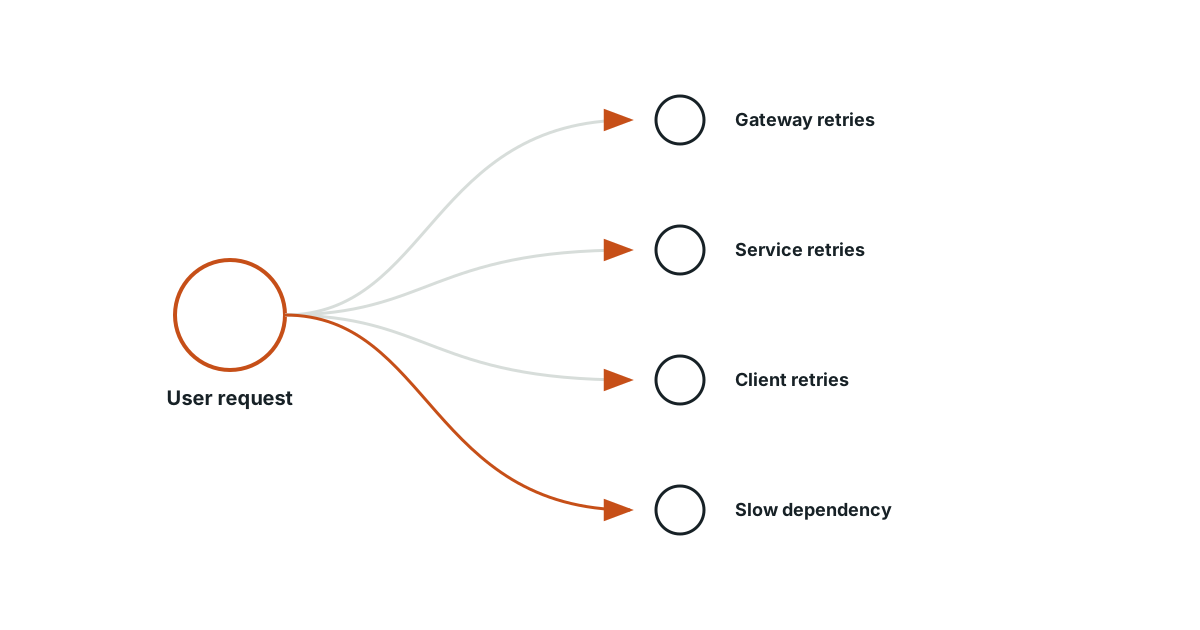
Retry policy is a system property
Use this guide for service, queue, tool, model, or workflow calls that may be retried after timeout, throttling, transport failure, or transient server error. It focuses on incident amplification, not on selecting one timeout value for every dependency.
How local resilience becomes global load
A retry is locally rational: another attempt may succeed. At system scale, each caller makes the same decision while the dependency is already slow. If three layers each make three attempts, one user operation can expand into many downstream calls. Capped backoff can even synchronize clients at the cap without sufficient jitter.
Unknown outcomes create a second risk. The server may have committed before the client timed out. A repeated payment, message, deployment, or tool action can duplicate the effect. Even idempotent reads can add enough load to delay recovery.
Three retries at three layers
A gateway, service, and SDK each allow three attempts, turning one request into as many as 27 downstream calls. During a latency incident, a single retry owner and shared deadline reduce load while idempotency handles unknown outcomes.
The call path should spend one budget:
for (let attempt = 1; attempt <= budget.maxAttempts; attempt += 1) {
  if (Date.now() >= budget.deadlineMs) throw new DeadlineExceeded();
  const result = await callOnce({ operationKey, signal: budget.signal });
  if (result.ok || !result.transient) return result;
  await wait(jitteredBackoff(attempt, budget.deadlineMs - Date.now()));
}
Real code must also reconcile unknown effects before the next attempt; a loop alone does not make a side-effecting operation safe.
Exercise the complete attempt tree
Trace one user operation through every layer and annotate timeout, retry count, backoff, queue, deadline, idempotency behavior, and circuit breaker. Compute the maximum attempt tree and compare it with dependency capacity during impairment.
Run a controlled failure exercise:
- add latency without returning errors;
- fail after commit but before response;
- return throttling with and without server retry guidance;
- keep a queued request alive past the user’s deadline;
- recover the dependency while stale retries remain in flight.
Observe total attempts, concurrent load, duplicate-effect prevention, useful successes after deadline, and recovery time.
Centralize budget, deadlines, and reconciliation
Choose one layer to own the retry policy for each call path. Propagate an absolute deadline and remaining attempt budget. A downstream client cannot spend time the user no longer has. Use bounded exponential backoff with jitter for eligible transient failures and honor explicit server guidance.
Require idempotency identity for side-effecting operations and reconcile unknown outcomes before another attempt. Shed or queue work by priority when the dependency is impaired. Couple retry metrics to the original task ID so the team sees amplification per outcome.
Stop retrying when the failure is permanent, authority or preconditions changed, the deadline expired, the budget is spent, or added load threatens recovery.
Retry-failure record
For each exercise, complete this record:
| Field | Entry |
|---|---|
| User deadline and outcome | |
| Call tree and retry-owning layer | |
| Failure injected | Latency, throttle, transport, post-commit loss, or dependency outage |
| Attempt budget | Per task and per dependency |
| Backoff/jitter | Algorithm, cap, and server guidance |
| Idempotency | Key scope, lifetime, result replay, and conflict behavior |
| Unknown-outcome reconciliation | Query and authoritative source |
| Load result | Calls, concurrency, queue depth, and recovery time |
| Effect result | Duplicates prevented, residual effects, and late successes |
| Stop/rollback decision | Threshold, owner, and configuration change |
Recovery settings that amplify impairment
- Enabling default retries independently in every library and gateway.
- Retrying a timeout as if it proves the server did nothing.
- Using backoff without a total deadline, attempt limit, or jitter.
- Counting successful retry calls while ignoring user abandonment and recovery delay.
- Testing individual clients without measuring the shared dependency under a retry storm.
Evidence
Retries can amplify overload, and backoff, jitter, timeouts, and retry limits are needed to control their behavior.
The Amazon Builders' Library article explains timeout selection, retry multiplication, capped exponential backoff, jitter, and overload concerns.
Primary source · official-doc · checked Aug 26, 2026
Limit: The guidance is based on Amazon's experience and must be adapted to a service's actual failure semantics and traffic.
Idempotent API contracts are central to making repeated requests safe when outcomes are uncertain.
The article describes client request identifiers and semantic behavior for repeated operations and late-arriving requests.
Primary source · official-doc · checked Aug 26, 2026
Limit: Idempotency requires correct server implementation and scope; it cannot undo every external or physical effect.
A retry decision should be exercised across the complete call tree with a shared budget and explicit outcome states.
The retry-failure exercise below exposes amplification that is invisible when each client library is reviewed alone.
Signal Studio author framework · reviewed Aug 26, 2026
Limit: Safe budgets depend on latency objectives, dependency capacity, business deadlines, and failure consequences.
Limitations
Retry behavior depends on queueing, autoscaling, rate limits, client diversity, and failure modes that a test may not reproduce. Idempotency stores can fail or expire, and some effects cannot be made repeatable. Use service-specific load and fault experiments.
FAQ
- Which errors should be retried?
- Only failures classified as transient for that operation, within the remaining deadline and budget, when repetition is safe. Status code alone is often insufficient; consider operation state and server guidance.
- Does exponential backoff solve retry storms?
- It reduces pressure when combined with jitter and limits, but layered retries, long queues, non-idempotent effects, and excessive total deadlines can still make the incident worse.
Related guides
Continue within Engineering judgment with AI, or use one of these adjacent diagnostics:
Editorial QA: automated native-English, structure, source-presence, and link checks completed . This record is not an independent expert endorsement. Review boundary.