
Question-led guide · security
What happens if approval or authority expires while an agent is waiting?
A commit-time authorization check for agents whose identity, approval, policy, target, or proposed action can change during a pause.
Direct answer
Expired approval or authority must invalidate the pending commit, even if planning began while it was valid. Freeze the exact proposed action, then re-check current actor, delegated identity, token audience and scope, policy version, target identity and state, approval digest, conditions, and deadline immediately before execution. If any binding field changed, obtain a new approval or recompute the proposal; never silently refresh authority.
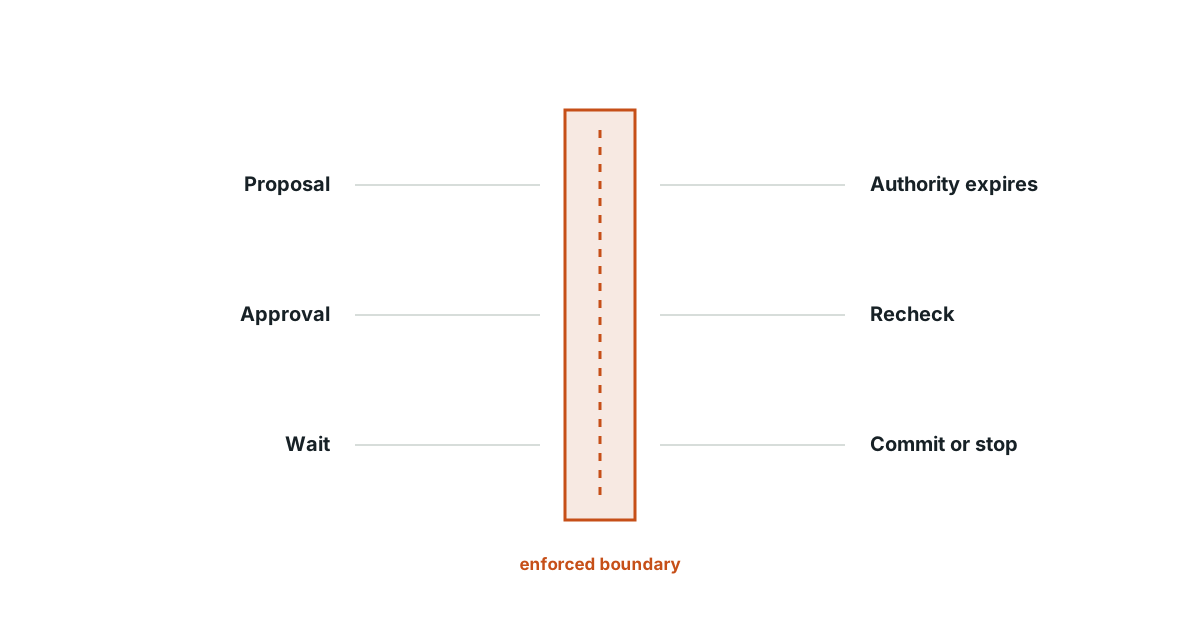
Approval has a time and state boundary
Use this gate when an agent proposes an external change, pauses for approval or a scheduled event, and later attempts to execute. It applies to configuration, data, access, messages, deployments, purchases, and other durable effects. It is narrower than the full delegated-identity design.
How waiting invalidates an earlier decision
Planning and execution occur at different times. During the gap, a token expires, an approver changes role, policy is updated, a resource receives a new version, impact increases, or another actor completes the work. Many orchestrators resume from the old branch and treat “approved” as a permanent Boolean.
Automatic token refresh can conceal the problem. The agent receives valid credentials and executes a proposal that no longer matches the conditions the human saw. Identity validity and action approval are related but separate facts.
A purchase approved before the price changed
A manager approves a $900 order, but the supplier price rises to $1,140 while the workflow waits. The commit check detects a changed proposal digest and routes the new amount for a fresh decision.
Re-evaluate at the commit point
Review waiting workflows and identify which fields are frozen. An approval record should answer: who approved, under which role and policy, for which actor, target version, operation, parameters, expected effect, risk tier, conditions, deadline, and proposal digest.
Test four changes during the wait:
- revoke the actor or approver role;
- change a material target field;
- update the policy version;
- alter one action parameter while preserving conversational wording.
The commit must fail closed or route to a new decision. A system that proceeds because the token refreshed or the session still says approved has stale authorization.
Bind approval to current proposal and authority
Canonicalize the proposal and hash its material fields. Bind approval to that digest, the target resource version, conditions, and expiry. Keep approval separate from access tokens.
Immediately before the effect, resolve the current protected resource and retrieve fresh authorization. Evaluate actor, delegation, audience, scopes, policy, approver authority, target state, deadlines, and budget. Use target-side preconditions such as version matches so the state cannot change unnoticed between check and write.
When a check fails, do not auto-refresh the approval. Recompute the proposal from current state, explain the difference, and ask an authorized decision-maker again. Preserve the old approval as an audit record, marked unusable.
Commit-time authority checklist
Run this checklist at commit:
| Check | Pass condition |
|---|---|
| Actor and delegation | Current actor and delegation chain are active and task-bound |
| Token | Valid, audience-bound, sender-constrained where applicable, and minimally scoped |
| Policy | Current version permits this action and risk tier |
| Approval | Approver is still authorized; record is unexpired and unrevoked |
| Proposal digest | Operation, parameters, target, expected effect, and conditions match exactly |
| Target identity | Stable canonical ID, correct tenant/environment, and expected version |
| Current state | Preconditions still hold and impact has not materially changed |
| Time and budget | Deadline, lease, rate, spend, and retry limits remain valid |
| Effect safety | Idempotency key, atomic precondition, audit sink, and rollback are ready |
| Failure path | Changed fields create a new proposal and approval request |
Approvals treated as reusable bearer tokens
- Treating approval as a timeless Boolean in workflow state.
- Refreshing a token and assuming the original human decision was refreshed too.
- Binding approval to prose rather than canonical action parameters and target version.
- Checking policy at planning time but not at the target service.
- Performing the write without a target-side version precondition.
Evidence
OAuth authorization for MCP uses protected-resource discovery and audience-bound access-token behavior rather than treating token possession as universal access.
The MCP authorization specification describes protected resource metadata, authorization servers, scopes, token audience, and security requirements.
Primary source · standard · checked Aug 26, 2026
Limit: Protocol compliance does not define an application's approval semantics or prove that target state remains unchanged.
OAuth clients and authorization servers should follow current security practices for tokens, redirects, sender constraints, and least privilege.
RFC 9700 is the current OAuth 2.0 Security Best Current Practice and updates threat mitigations beyond the original framework.
Primary source · standard · checked Aug 26, 2026
Limit: The RFC secures OAuth deployments; it does not bind a human approval to an exact agent action or current resource version.
The action must be authorized against current conditions at commit time, with a digest binding approval to the proposal.
The checklist below separates planning-time permission from the final decision to create a permanent external effect.
Signal Studio author framework · reviewed Aug 26, 2026
Limit: Digest fields, approval authority, and acceptable drift require local policy and target-system support.
Limitations
Commit-time checks reduce stale authority but cannot eliminate races after validation. Target systems need atomic preconditions or compare-and-set behavior where possible. Clock skew, revocation delays, compromised identity infrastructure, and ambiguous resource identity remain material risks.
FAQ
- Can the platform automatically refresh the access token?
- It may refresh identity under policy, but it must still reauthorize the exact action. A fresh token must not silently extend a human approval or accept changed target state.
- What if only a harmless description field changed?
- Define material fields in policy. Nonmaterial drift can be recorded and accepted automatically, while target, parameters, impact, owner, policy, and preconditions normally require recomputation or renewed approval.
Related guides
Continue within Context engineering, memory, and state, or use one of these adjacent diagnostics:
Editorial QA: automated native-English, structure, source-presence, and link checks completed . This record is not an independent expert endorsement. Review boundary.