
Question-led guide · decision
What should I verify before admitting a registry-listed MCP server?
Separate MCP registry discovery from production admission using an evidence packet for origin, artifact, permissions, observed behavior, and renewal.
Direct answer
Treat an MCP registry listing as discovery metadata, then decide admission for one exact deployment and purpose. Verify publisher identity, artifact or endpoint binding, requested permissions, data destinations, catalog definitions, and observed behavior under constrained credentials. Record missing evidence, enforce approved limits, and name renewal triggers. Registry presence, a signature, and a clean scan each support narrower claims than production suitability.
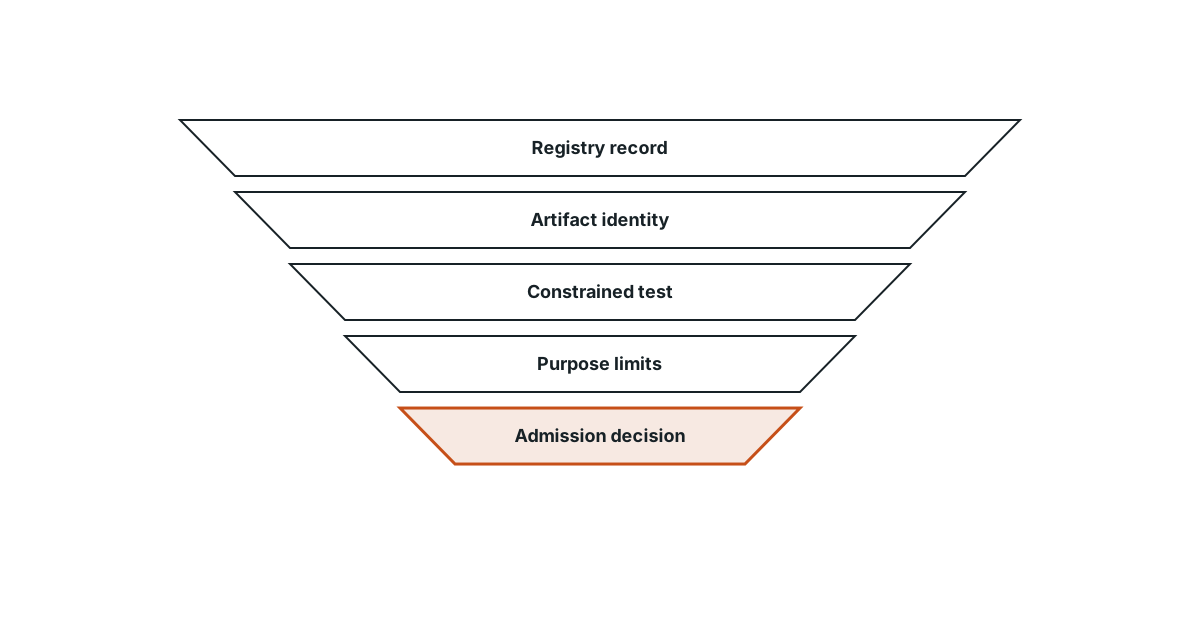
Define the requested use before judging the server
“Can we approve this MCP server?” is too broad to answer well. Approval for a sandbox using public documents is different from approval for an employee workstation with personal credentials or a production tenant with customer records.
Ask for the exact tools, deployment location, callers, data classes, credentials, and intended outcome. That scope becomes the subject of admission. A server can be unsuitable for one use while remaining acceptable for a narrower one; the record should explain which boundary determines the decision.
Interpret registry evidence at its actual scope
The official MCP Registry hosts discovery metadata and authenticates namespaces. Its documentation assigns code security scanning to other parts of the ecosystem. A listing is therefore a starting point for identifying a supplier and installation route.
Preserve the record you reviewed, its retrieval date, and the exact package or remote endpoint it names. Then verify those relationships independently where practical. A public repository, registry namespace, distributed package, and live endpoint may have different operators or release histories.
A read-only package asks for a developer’s environment
Imagine a hypothetical team requesting a documentation MCP package for an internal onboarding assistant. Its tool catalog contains only find_article, but the installation instructions expect the process to inherit the user’s full environment and home-directory access.
The requested production deployment needs only an API credential restricted to one documentation collection. The reviewer tests a pinned package in an isolated runtime with that credential, a small empty writable directory, and egress restricted to the documentation service. Startup fails because the package also expects an unrelated analytics destination.
That failure is evidence of a deployment dependency, not a passing scan. The admission remains pending until the destination’s purpose and data flow are explained or the dependency is removed. The package’s read-only tool label did not describe its entire operating footprint.
Build an admission packet that can be challenged
Use the following evidence packet to connect each conclusion to an inspectable observation.
| Review area | Record | Evidence that can challenge the claim |
|---|---|---|
| Publisher | Namespace, repository, ownership check date | Unexpected ownership or package binding |
| Executable | Exact version, digest, installation path | Resolved artifact differs from reviewed artifact |
| Build origin | Available provenance and trusted verifier | Unrecognized builder or unmatched source |
| Tool surface | Definitions, aliases, data and effect scope | Undeclared tool or changed definition |
| Runtime reach | Credentials, files, egress, child processes | Access outside the requested purpose |
| Behavior | Successful startup, useful task, negative cases | Test never reached the intended code path |
| Operations | Owner, disable path, renewal triggers | Tool cannot be suspended independently |
SLSA provenance can support the build-origin row. The other rows require their own evidence; provenance does not make the behavioral test unnecessary.
Distinguish absent evidence from passing evidence
A scanner that could not install the package has not tested its runtime behavior. A synthetic request rejected before reaching the intended tool has not exercised tenant isolation inside that tool. Record reached stages, configuration, fixtures, and failures alongside results.
Limit discovery and test execution before introducing production credentials. Candidate metadata and installation scripts are inputs to the review, not instructions that can expand its authority. Practical runtime isolation is covered by the separate agent sandboxing guide.
Turn conditions into deployment constraints
An approval that says “use carefully” is difficult to enforce or renew. Prefer conditions such as a pinned artifact, two enabled tools, one permitted collection, a named host cohort, restricted egress, and a review expiry. Verify that the deployed configuration actually implements those conditions.
Where an exception is necessary, name the unmet requirement, compensating constraint, owner, and expiry. Keep that exception visible during renewal. It should not become a permanent blanket admission when another team reuses the server.
Reopen admission when its subject changes
Trigger review on publisher transfer, artifact drift, new tools, broader credentials, changed destinations, or unexpected outcomes. Compare the new subject with the original packet rather than relying on a server name that stayed the same.
For managed endpoints, continue with a remote-provider exit plan. A live service can change outside your build pipeline, so its admission needs ongoing observations and a tested way to stop depending on it.
Evidence
The official MCP Registry focuses on namespace authentication and metadata hosting.
Its trust section delegates code security scanning to package registries and downstream aggregators.
Primary source · official-doc · checked Sep 8, 2026
Limit: Registry documentation does not establish the security of an individual artifact or hosted endpoint; the service is in preview.
SLSA provenance records verifiable information about an artifact's origin and production process.
The provenance model connects software artifacts to where and how they were produced.
Primary source · standard · checked Sep 8, 2026
Limit: Provenance is not proof that a correctly produced artifact is safe or appropriate for a particular workflow.
Limitations
The packet is an author-designed admission method. Scanning and test coverage are incomplete, namespace ownership can change, and a remote operator may run code unrelated to a public package. Admission applies to its recorded scope and does not replace per-request enforcement.
FAQ
- Does a verified registry namespace mean the server passed a security review?
- No. Namespace verification supports the publisher identity claim. Review the exact package or endpoint, runtime permissions, data handling, and behavior needed for the proposed deployment.
- Can a server without build provenance ever be admitted?
- That depends on the requested use and your documented policy. An isolated public-data experiment may tolerate gaps that a tenant-data or write-capable deployment cannot. Record the constraint and its expiry explicitly.
Related guides
Continue within MCP in production, or use one of these adjacent diagnostics:
Editorial QA: automated native-English, structure, source-presence, and link checks completed . This record is not an independent expert endorsement. Review boundary.