
Question-led guide · how-to
How do I prepare an exit from a remote MCP provider?
Rehearse removal of a remote MCP dependency while preserving workflow continuity, pending-operation evidence, credentials control, and historical meaning.
Direct answer
Prepare a remote MCP exit by identifying the user promise that must survive, the provider-specific state and data to recover, and the controls that stop new calls. Rehearse catalog removal, traffic blocking, credential revocation, historical-result access, and a permitted substitute or manual workflow. Resolve pending effects before substitution, and distinguish a provider's deletion assurance from evidence you can independently observe.
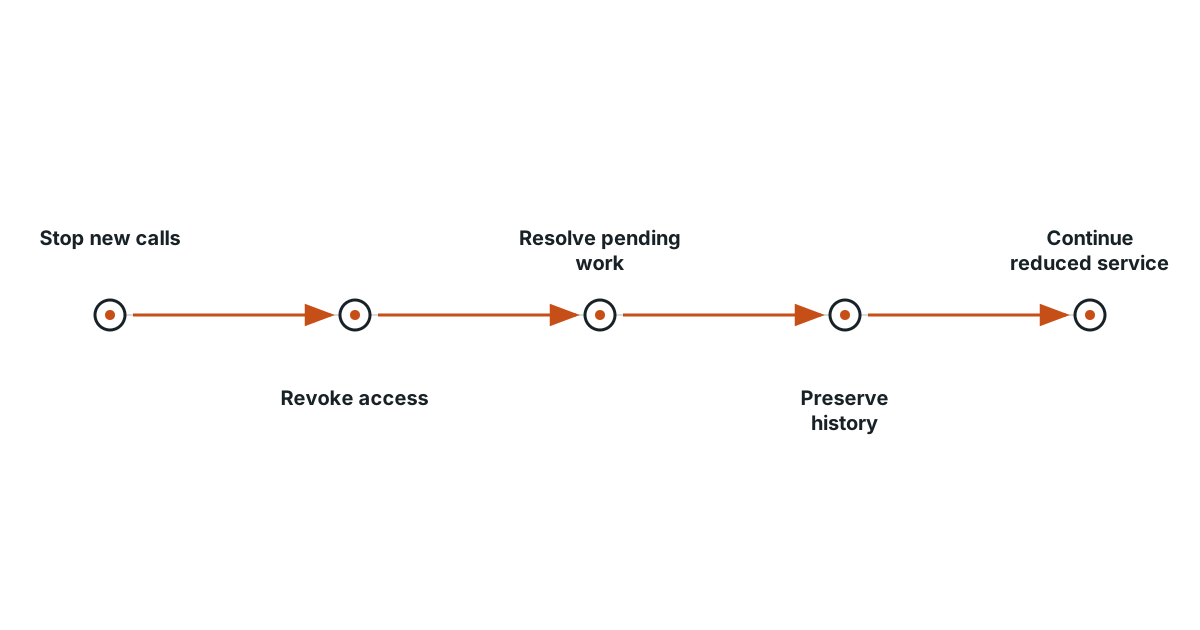
Preserve the workflow’s minimum useful promise
A remote MCP endpoint can disappear through outage, compromise, contract termination, or an unacceptable behavior change. Plan for that loss while the provider is cooperative. Begin with the work users must still complete and the reduced service they can accept.
For example, an assistant may need verified shipment status while a provider’s narrative summary is optional. The continuity plan can preserve status through an admitted internal source and temporarily remove summarization. Calling that reduced result equivalent to the original service would conceal a product change.
Find dependencies hidden outside the endpoint
Inventory provider-specific configuration, result codes, stored handles, cached data, evaluation fixtures, dashboards, and support procedures. Historical conversations may render provider output through a live lookup. A status page may assume proprietary reason codes. Those couplings can break after the tool disappears even when new calls are blocked successfully.
Assign an owner to each dependency and record whether it is exportable, replaceable, retainable for history, or unavailable without the provider. This inventory defines the exercise; an endpoint list alone does not.
A freight assistant loses its summary provider
Consider a hypothetical freight assistant handling 400 daily read requests. Its external MCP provider produces shipment summaries and returns opaque report handles that expire after twenty-four hours. The company also has an admitted internal shipment-status API, but it cannot reproduce those summaries.
During an exit rehearsal for ten test users, new requests switch to explicitly labeled internal status. The host continues to start, but older conversation links fail because they resolve report handles through the suspended provider. The team changes historical rendering to retain the permitted status fields and source timestamp under its own retention policy.
The exercise does not justify copying every provider response indefinitely. It identifies the minimum approved record needed to explain past work and the agreement needed to retain it.
Test the independent ways to stop new use
Remove the tool from eligible catalogs, deny dispatch to its binding, and restrict outbound traffic at the controlled execution boundary. Exercise each applicable control from a previously configured host. Otherwise an old catalog or direct integration can bypass the visible removal.
MCP authorization requires resource-bound token handling. Preserve a separate provider credential boundary so removing this dependency does not require disabling unrelated services. Verify actual access behavior after revocation instead of treating a dashboard update as the entire result.
Run the exit sheet without vendor assistance
Use this rehearsal sheet in an isolated cohort with synthetic data. Its pass conditions are local proposals and should reflect the agreed continuity promise.
| Exercise | Observable pass condition | Remaining external dependency |
|---|---|---|
| Remove catalog entry | Host starts and explains unavailable capability | None for locally managed host |
| Block dispatch and egress | Old configuration cannot send a new provider request | Coverage of unmanaged clients |
| Revoke credentials | Subsequent authorized test request is rejected | Provider revocation propagation |
| Recover history | Prior outcomes retain source and time meaning | Export and retention permissions |
| Invoke substitute | Reduced result is labeled and uses admitted data flow | Substitute capacity and semantics |
| Resolve pending work | Every operation has an explicit disposition | Provider evidence for unknown effects |
| Request deletion | Request, response, and assurance are retained separately | Provider-held copies and retention duties |
RFC 7009 defines token revocation but recognizes propagation concerns. Traffic controls and an observed post-revocation test address different parts of the stop-use claim.
Reconcile effects before redirecting work
The freight scenario is read-only. A provider that books transport or updates an external record introduces a different cutover obligation: determine whether each pending operation already happened. Another provider may not recognize the original idempotency key or target identity.
Hold unresolved operations for reconciliation and report the uncertainty. The detailed duplicate-effect design belongs in preventing duplicate agent side effects; the exit plan must prove that this dependency is owned before automated substitution begins.
Distinguish an exit you control from assurances you receive
You can often verify that your host no longer calls an endpoint and that your stored history remains usable. You may only receive a contractual statement about deletion inside the provider. Label those evidence types accurately and record the residual dependency.
Renew the exit exercise when tool semantics, provider ownership, data flows, or business criticality change. A successful old drill is useful history, but a new durable handle or write capability can invalidate its assumptions.
Evidence
MCP authorization binds access tokens to the intended protected resource.
The authorization specification requires resource-bound token handling rather than unrestricted token forwarding.
Primary source · standard · checked Sep 8, 2026
Limit: Resource binding does not itself provide a vendor exit, data deletion, or completed-effect reconciliation.
OAuth token revocation has authorization-server behavior and propagation limitations.
RFC 7009 defines revocation requests and describes the possibility of propagation delays.
Primary source · standard · checked Sep 8, 2026
Limit: A revocation response does not undo completed operations or establish deletion of previously transferred data.
Limitations
This is an author-designed continuity exercise. The customer cannot independently inspect every provider-held copy or internal change. Contracts and operator attestations may be necessary, and some proprietary workflows have no equivalent replacement. Unknown effects constrain cutover.
FAQ
- Can another provider with the same tool name be an automatic fallback?
- Only after its data scope, freshness, result meaning, authority, and effect semantics are admitted as an acceptable substitute. Similar names are not a compatibility contract, especially for pending writes.
- Does successful token revocation prove the provider can no longer use our data?
- No. It concerns token validity, with deployment-specific propagation. Previously received data, internal copies, completed operations, and contractual deletion duties require separate evidence and controls.
Related guides
Continue within MCP in production, or use one of these adjacent diagnostics:
Editorial QA: automated native-English, structure, source-presence, and link checks completed . This record is not an independent expert endorsement. Review boundary.