
Question-led guide · diagnostic
Can an AI agent really find root cause from OpenTelemetry data?
A practical test for deciding when an AI-assisted incident investigation has enough evidence to state a root cause, a contributing factor, or only a hypothesis.
Direct answer
Yes—but only when OpenTelemetry is part of a larger evidence contract. Traces can show recorded execution paths, logs can expose events, metrics can show population behavior, and resources can identify observed entities. None of those signals automatically proves causality. A defensible agent must state its claim level, show the joins and counterevidence, test alternatives, expose observation gaps, and stop at “unknown” when the evidence cannot distinguish competing explanations.
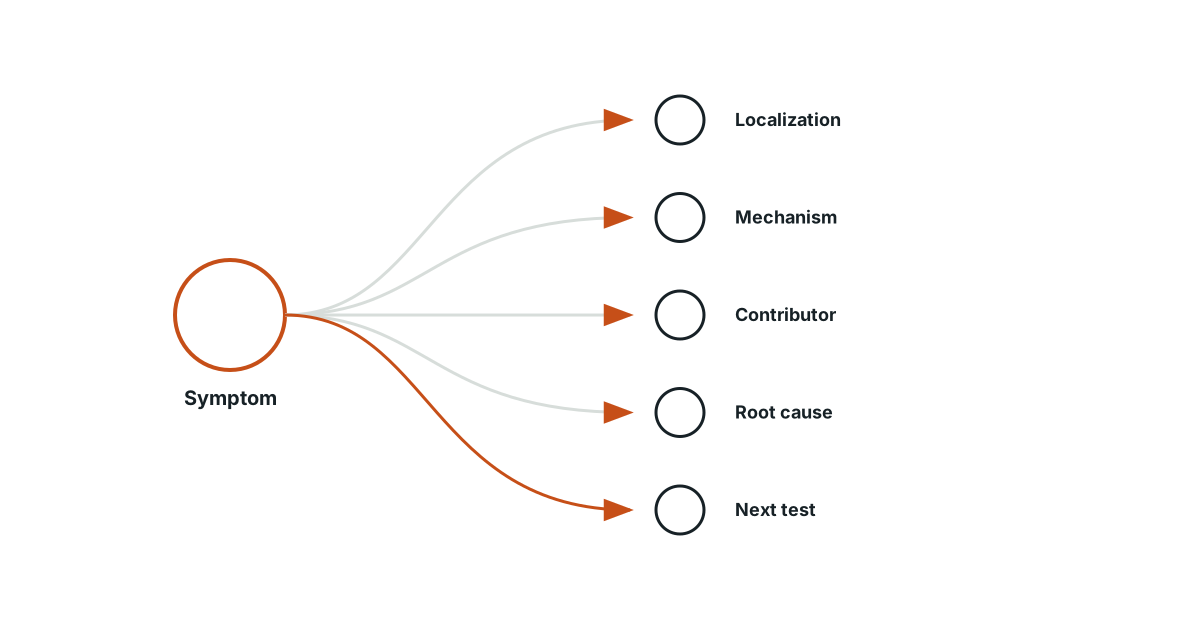
Define the claim before asking the agent
Use this method for production services where the agent can query traces, logs, metrics, resource attributes, and at least one source of topology or change evidence. It applies to assisted diagnosis, not to autonomous remediation. Before implementation, the incident owner must define what “root cause” means for the organization and which claim levels require human approval.
Why telemetry does not certify causality
Telemetry is attractive because it looks objective and machine-readable. The trap is moving from “this span was slow” to “this component caused the incident” without a discriminating test. A trace may omit unsampled requests, work outside the instrumented boundary, downstream state, or a control-plane change. Logs may record application interpretation rather than physical fact. Metrics aggregate populations and can hide the request that matters.
An agent amplifies this problem when it is rewarded for a complete narrative. If the tool contract only asks for “the root cause,” the model has no representation for partial localization, competing hypotheses, counterevidence, or an unobservable boundary.
Latency after a deployment
Traces localize delay to a database client and a deployment occurred five minutes earlier. The agent reports a candidate mechanism, queries pool saturation and unchanged cohorts, and withholds a root-cause claim until the configuration change explains the observed queueing.
Climb the evidence ladder
- Name the impact and interval. State the affected user outcome, population, region, service, and evidence window. Do not start from a component name.
- Check observation health. Record sampling, collector loss, clock uncertainty, missing resource attributes, and instrumentation changes.
- Localize without claiming cause. Identify where the failing population diverges from a healthy comparison by path, version, resource, dependency, or change cohort.
- Write competing mechanisms. Require at least one plausible alternative when impact is material.
- Run a discriminating query. Ask what observation should differ if hypothesis A is true and hypothesis B is false.
- Search for counterevidence. Healthy requests through the suspected component or failures that bypass it can weaken the claim.
- Declare the claim level. Use
observed symptom,localized fault,supported mechanism,contributing factor,root-cause claim, orunknown.
Operate a falsifiable investigation
Give the agent narrow tools that return typed evidence rather than a bulk telemetry dump. Each tool response should include the query, source, time range, resource identity, sampling or completeness note, and a stable reference. The agent should maintain a hypothesis ledger with supporting evidence, counterevidence, tests attempted, and unresolved observation gaps.
Make stopping behavior part of the contract. The agent must hand over when two material hypotheses remain indistinguishable, when evidence quality falls below policy, when the suspected mechanism crosses an unobserved boundary, or when the next test would require unsafe production action.
Root-cause claim checklist
Use this root-cause claim checklist before accepting the final statement:
| Check | Pass condition |
|---|---|
| Impact | Affected outcome, population, and interval are explicit. |
| Identity | Every cross-signal join uses a documented resource or request identity. |
| Mechanism | The claim explains how the suspected condition produced the impact. |
| Alternatives | Material competing hypotheses were listed and tested. |
| Counterevidence | Evidence that weakens the preferred explanation is visible. |
| Observation gaps | Sampling, missing signals, clock, and instrumentation limits are stated. |
| Reproduction | Another operator can rerun the decisive queries from saved references. |
| Authority | The claim does not itself grant permission to remediate or close the incident. |
Use the downloadable Incident Hypothesis Ledger to keep each observation, candidate mechanism, counterexample, claim level, next test, and operational-authority decision in a separate field.
Confident conclusions built from correlation
- Treating the alert, last error, slowest span, latest deployment, or largest metric change as the answer.
- Joining data by display name when deployment, namespace, instance, or tenant identity differs.
- Asking the model for confidence without defining evidence thresholds or calibration data.
- Hiding missing telemetry so the narrative appears complete.
- Evaluating only whether the final diagnosis matches a label instead of grading evidence use and abstention.
Evidence
OpenTelemetry resources provide a shared identity pivot across telemetry signals.
The specification says all signals are associated with a Resource and describes Resource identity as a correlation point for the observed entity.
Primary source · standard · checked Aug 25, 2026
Limit: A shared resource identity supports correlation; it does not establish which event caused an incident.
A trace represents recorded operations and relationships, not a complete causal model.
The OpenTelemetry overview defines traces, spans, links, resources, metrics, logs, and context propagation as telemetry concepts.
Primary source · standard · checked Aug 25, 2026
Limit: The specification defines telemetry representation and collection semantics, not an automated root-cause proof procedure.
Root-cause confidence should be earned through discriminating tests, counterevidence, and explicit observation limits.
The Signal Studio claim ladder prevents the agent from collapsing localization, mechanism, contributing factors, and unknowns into one label.
Signal Studio author framework · reviewed Aug 25, 2026
Limit: This is an author-created review framework and must be adapted to local incident policy and risk.
Limitations
This guide does not define a universal meaning of root cause, guarantee that telemetry is complete, or authorize automated remediation. Sampling, clock behavior, instrumentation gaps, asynchronous work, and missing change or topology data can leave causal questions unresolved.
FAQ
- Does the slowest span identify the root cause?
- No. It identifies a recorded operation with high duration. That operation may be a victim, a retry, a queueing point, or an observation artifact; compare alternatives before making a causal claim.
- Can the agent close an incident automatically?
- Only under a separately approved policy. Analytical confidence, operational authority, and incident closure are different decisions and should have independent controls.
Related guides
Continue within AI agents for SRE and root cause analysis, or use one of these adjacent diagnostics:
Editorial QA: automated native-English, structure, source-presence, and link checks completed . This record is not an independent expert endorsement. Review boundary.