
Question-led guide · how-to
How do I join traces, logs, and metrics without false correlations?
A join-order and evidence worksheet for correlating OpenTelemetry signals through explicit identity, time, exemplars, topology, and change data.
Direct answer
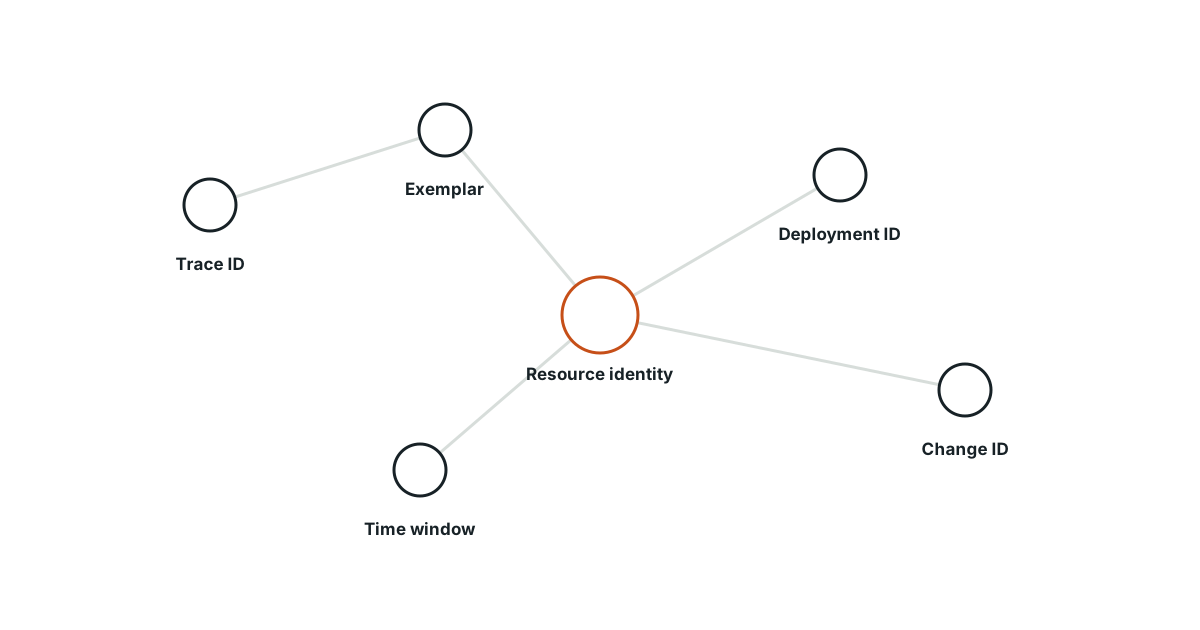
Join telemetry from the strongest key outward. Use trace and span identifiers for request-level relationships, exemplars to pivot from an aggregate metric to a representative trace, and consistent OpenTelemetry Resource identity to compare signals from the same observed entity. Treat time windows, service names, hostnames, and proximity as candidate filters—not proof of relationship. Preserve join type, key source, clock uncertainty, and unmatched records in every result.
A join is an evidence claim
This guide covers operational joins among OpenTelemetry traces, logs, and metrics, with optional pivots to topology and change records. It assumes you control or can inspect instrumentation and resource attributes. It is not a recipe for joining arbitrary observability exports solely by timestamp and display name.
Why timestamps and names create false relationships
False correlations appear when a convenient field is mistaken for a key. Two services can share a display name across environments. One host can run several processes. A deployment can overlap old and new replicas. A log timestamp may reflect buffering rather than event time. A metric point summarizes many requests, while the trace under investigation represents one path.
The risk increases when an agent converts candidate matches into prose without retaining the join predicate or unmatched records. A polished timeline can conceal that half of the evidence was connected by a broad time window.
Two deployments share a service name
Logs and metrics both say checkout, but one refers to blue and the other to green deployment. Resource and deployment identifiers correct the join; a nearby timestamp alone would have attributed the error rate to the wrong revision.
Rank candidate join keys
- Write the question the join must answer: request path, affected entity, population comparison, change cohort, or possible dependency.
- Inventory the available identity at each signal: trace ID, span ID, resource attributes, deployment ID, instance ID, tenant scope, and schema version.
- Classify every proposed join as
exact,declared mapping,bounded candidate, orinferred. - Measure unmatched records and one-to-many expansion. A high match rate can still be wrong if one unstable value connects unrelated entities.
- Inspect event time, collection time, and clock behavior separately.
- Re-run the join on a healthy comparison interval and a deliberately mismatched environment to expose over-broad predicates.
Preserve identity, provenance, time, and uncertainty
Use this order of preference:
- Trace or span identity for events emitted inside the same propagated request context.
- Exemplar to trace when a metric implementation records an exemplar for the relevant point.
- Resource identity for comparing signals from the same observed entity and deployment boundary.
- Governed topology or change mapping with source, validity interval, and direction.
- Time-bounded candidate set only when stronger identity is absent; keep the result explicitly uncertain.
Return the join contract with every query result. It should state left and right datasets, fields, schema versions, time semantics, cardinality expectation, filter, missing-key behavior, and confidence class. Never discard unmatched rows during investigation; absence can reveal propagation or instrumentation failure.
Cross-signal join worksheet
Complete one row for each pivot:
| From → To | Question | Key and source | Expected cardinality | Time semantics | Missing-key action | Evidence class |
|---|---|---|---|---|---|---|
| Metric → Trace | Which request illustrates the high-latency bucket? | Exemplar trace_id/span_id | 0..n examples per point | Measurement interval | Report no exemplar | Exact recorded pivot, sampled |
| Trace → Log | Which events occurred inside this operation? | trace_id + span_id | 0..n logs per span | Event time | Search resource/time as candidate only | Exact if propagated |
| Signal → Resource | Which deployment emitted this data? | governed resource key set | n..1 | Resource validity interval | Stop cross-signal claim | Declared identity |
| Resource → Change | Which changes affected this entity? | deployment or asset mapping | n..n | Effective interval | Preserve unknown mapping | Governed or candidate |
Correlation paths that silently change entity
- Using
service.nameor hostname as a globally unique identifier. - Treating an exemplar as a statistically representative sample without checking the reservoir and sampling policy.
- Converting all timestamps to one format but ignoring clock uncertainty and buffering.
- Joining current topology to historical telemetry without a validity interval.
- Hiding unmatched records, duplicated keys, and cardinality explosions from the agent.
Evidence
Metric exemplars can carry trace and span context for a specific recorded measurement.
The OpenTelemetry metrics data model defines exemplars with optional trace_id and span_id and identifies trace-to-metric correlation as a use case.
Primary source · standard · checked Aug 25, 2026
Limit: An exemplar is a selected measurement and does not prove that it represents every request in the aggregate.
Resource identity is intended to help correlate telemetry produced for the same observed entity.
The Resource specification requires identification of the observed entity and describes shared resource attributes as a signal correlation pivot.
Primary source · standard · checked Aug 25, 2026
Limit: Incorrect, missing, or reused resource attributes still create false joins.
Trace identifiers have defined propagation semantics across conforming systems.
The W3C Trace Context Recommendation defines interoperable trace context propagation using traceparent and tracestate.
Primary source · standard · checked Aug 25, 2026
Limit: Propagation can be broken, duplicated, or deliberately omitted, and a common trace does not itself establish root cause.
Limitations
This procedure cannot reconstruct relationships that were never propagated or recorded. It also does not make vendor-specific derived correlations equivalent to raw signal identity. Validate local instrumentation, sampling, clock, and aggregation behavior before relying on a join in an incident decision.
FAQ
- Can I join everything by timestamp?
- Use time to bound candidates, not to assert identity. Clock skew, batching, retries, queues, and long-running work make temporal proximity an ambiguous relationship.
- Is service.name enough?
- Usually not. Add the resource dimensions needed to distinguish namespace, environment, region, deployment, instance, and tenant boundaries relevant to the question.
Related guides
Continue within AI agents for SRE and root cause analysis, or use one of these adjacent diagnostics:
Editorial QA: automated native-English, structure, source-presence, and link checks completed . This record is not an independent expert endorsement. Review boundary.