
Question-led guide · diagnostic
Why does CMDB data become stale even after a cleanup?
A systems diagnosis of CMDB staleness covering identity, evidence, reconciliation, lifecycle events, ownership, freshness budgets, and decision feedback.
Direct answer
A CMDB becomes stale when it is treated as a periodically cleaned inventory instead of a continuously tested decision system. Real infrastructure changes faster than manual ownership, discovery sources disagree, identities drift, reconciliation hides conflicts, and records lack observed time or confidence. Fix the operating loop: define which decisions need which configuration facts, assign authoritative evidence by attribute, design stable identity and lifecycle events, preserve conflicts and provenance, set freshness budgets, and measure whether consumers can detect unsafe uncertainty.
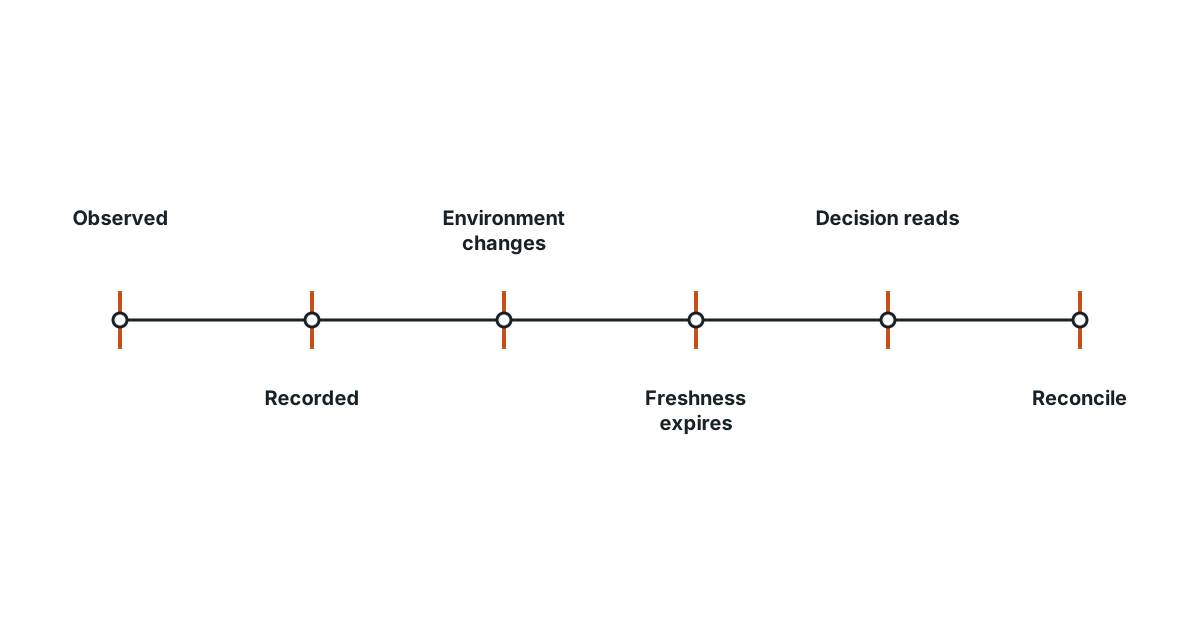
Freshness belongs to a decision
Use this approach when a configuration database supports incident response, change risk, security exposure, software ownership, cost allocation, or compliance. The relevant unit is not “the CMDB” as a whole; it is a fact used by a specific decision under a time constraint.
How synchronized records still become unsafe
A cleanup project corrects today’s records but leaves the production mechanism unchanged. Cloud resources appear and disappear, software is deployed outside known pipelines, services change owners, and business relationships evolve. Discovery tools observe different surfaces at different times. Reconciliation rules pick a winner but may erase the disagreement that operators need to see.
Staleness is also semantic. A server may still exist while its application relationship, support group, criticality, or data classification is wrong. A single last-updated timestamp cannot describe the freshness of every attribute.
A server owner is fresh enough for reporting, not access
The owner field was verified 20 days ago. That may be acceptable for a monthly inventory, but not for granting production access after a team reorganization; the access decision requires current authoritative confirmation.
Measure source, observation, valid time, and change rate
Start from a failed or risky decision, not from the table count:
- Which configuration fact was used or missing?
- What real-world event should have changed it?
- Which source could observe that event, and when?
- How was the entity identified across sources?
- Did reconciliation preserve conflict, provenance, and observation time?
- Who owned the attribute and the exception?
- What should the consumer have done after the freshness budget expired?
Repeat across incident, change, security, and cost use cases. Different facts will need different sources and freshness targets.
Define a decision-freshness contract
Define an evidence contract for each decision-critical attribute. Name the authoritative or corroborating sources, stable identity keys, observed time, effective time, confidence, maximum lag, conflict rule, owner, and safe fallback. Represent unknown and disputed states explicitly instead of selecting a convenient value.
Connect lifecycle events to updates: provisioning, deployment, ownership transfer, network change, retirement, contract change, and deletion. Use discovery as one source, not as the entire lifecycle. Test for orphaned relationships, impossible states, identity collisions, expired overrides, and sources that stopped reporting.
Measure freshness at consumption. A record can pass a generic health score and still be too old for a change approval or security response. Make the consumer warn, degrade, require confirmation, or block an action when the relevant fact exceeds its budget.
Close the loop from real incidents and decisions. When a configuration fact fails, classify the mechanism—missing event, identity mismatch, source delay, reconciliation error, ownership gap, or semantic ambiguity—and improve the pipeline rather than only repairing the record.
Freshness contract
Create one decision-freshness contract per critical fact:
| Field | Example question |
|---|---|
| Decision | Which action depends on this fact? |
| Attribute | What exact property or relationship is needed? |
| Identity | How is the entity resolved across sources? |
| Evidence | Which source observed what, and when? |
| Freshness budget | How old may the evidence be for this decision? |
| Conflict behavior | Preserve, escalate, rank, or block? |
| Owner | Who fixes the source and who accepts exceptions? |
| Consumer fallback | Warn, degrade, confirm, or deny? |
Global age thresholds that ignore consequence
- Running a one-time cleanup without changing lifecycle events and accountability.
- Using one “last updated” value for attributes with different evidence sources.
- Letting reconciliation discard conflict and provenance.
- Measuring population completeness while ignoring decision-critical relationships.
- Treating manual overrides as permanent truth without expiration.
- Adding discovery sources before solving identity and ownership.
Evidence
CMDB health includes dimensions beyond whether a record exists.
ServiceNow documents CMDB health concepts that include correctness, completeness, and compliance-related evaluation.
Primary source · official-doc · checked Aug 25, 2026
Limit: The implementation and terminology are product-specific and do not prove that enabled health jobs match an organization's operational decisions.
Health metrics require defined rules and thresholds rather than a single generic quality score.
ServiceNow's CMDB health documentation describes metrics used to assess configuration data under configured health rules.
Primary source · official-doc · checked Aug 25, 2026
Limit: Configured metrics can still reward record hygiene that does not improve incident, change, security, or cost decisions.
Freshness should be defined per decision and attribute using evidence time, source, and uncertainty.
The Signal Studio decision-freshness contract connects each configuration fact to a consumer, maximum lag, authoritative evidence, and safe behavior when uncertain.
Signal Studio author framework · reviewed Aug 25, 2026
Limit: This is an author-created operating framework and must fit local discovery technology and accountability.
Limitations
This guide does not provide product-specific discovery configuration or a universal CMDB data model. Regulatory and contractual systems of record may impose additional controls.
FAQ
- Will more discovery tools solve CMDB staleness?
- Not alone. More sources can improve coverage but also create identity and conflict problems. Each source needs an explicit authority, reconciliation, provenance, and freshness role.
- Should users be allowed to edit discovered fields manually?
- Only under explicit ownership rules. Preserve the override, reason, scope, author, and expiration; otherwise manual values silently defeat the evidence pipeline.
Related guides
Continue within Ontology and operational semantics, or use one of these adjacent diagnostics:
Editorial QA: automated native-English, structure, source-presence, and link checks completed . This record is not an independent expert endorsement. Review boundary.