
Question-led guide · comparison
How should I choose between on-demand and provisioned AI capacity?
A capacity decision method that uses arrival patterns, service levels, utilization ranges, commitment risk, and failure cost instead of average tokens.
Direct answer
Choose provisioned capacity for a predictable base load whose latency and availability value justifies a commitment; use on-demand capacity for uncertain, bursty, or experimental demand. Model requests by token shape, arrival burst, service level, and regional constraints—not daily averages. Compare a hybrid plan across utilization ranges, queueing, overflow, commitment term, model changes, and the business cost of throttling or idle capacity.
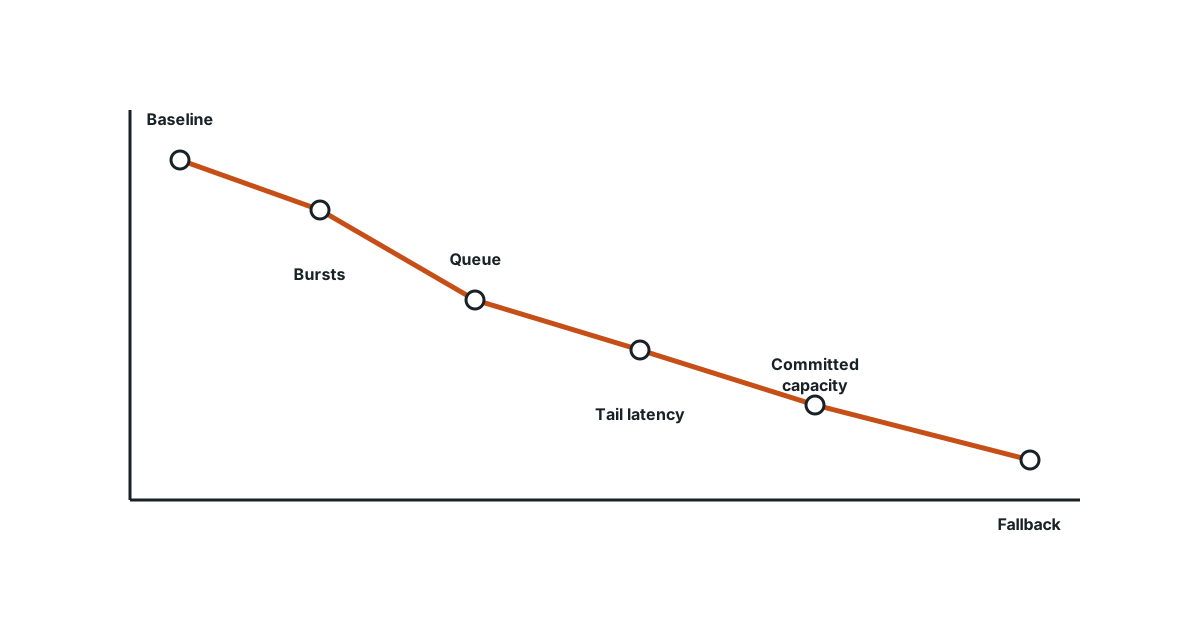
Capacity is a workload-shape decision
Use this comparison for hosted model inference where both consumption-based and reserved/provisioned purchasing modes are available. The decision concerns capacity and service behavior, not which model or cloud is best.
Why average token volume is insufficient
Teams divide monthly tokens by seconds and call the result demand. That erases the workload shape. A chat request with a long streaming response occupies capacity differently from a short classification. Batch jobs can move in time; interactive calls cannot. Bursts, retries, regional failover, and long-tail outputs determine queueing even when the daily average looks modest.
Provisioning also creates option cost. A commitment may save money at stable utilization but reduce flexibility when a new model, architecture, or product changes the workload. On-demand capacity preserves flexibility but may expose the service to quotas, variable latency, or a more expensive steady base.
A cheap commitment that misses the morning burst
Daily average load fits reserved capacity, but 55% of work arrives in a 40-minute window. The plan prices queue delay and overflow while testing whether scheduled batching can reshape demand before buying more capacity.
Model utilization, queueing, and fallback
Build a four-week demand profile at one-minute or finer resolution. Separate traffic by model, input and output token bands, latency objective, priority, region, and whether it can wait. Record arrival bursts, service time, throttles, retries, and abandoned requests.
Then ask:
- Is there a base level present in most intervals?
- Which percentile must meet the latency objective?
- Can overflow degrade, queue, route, or fail safely?
- What happens during a regional or provider impairment?
- How likely is the model or workload to change during the commitment?
- What is the cost of idle capacity versus a missed outcome?
Compare commitments under matched service objectives
Model at least three plans: on-demand only, provisioned only, and hybrid. For each, simulate low, expected, and high demand plus one failure scenario. Use current provider capacity measurements or load tests; do not translate units from marketing labels alone.
For a hybrid plan, assign the predictable, latency-sensitive base to provisioned capacity. Define overflow eligibility, priority, maximum queue time, and quality implications. Keep batch or delay-tolerant work away from the interactive reserve unless spare-capacity use is explicitly safe.
Add a renewal decision before the commitment expires. Review actual utilization, overflow, outcome failures, price changes, and model migration plans.
Capacity decision sheet
Complete one sheet per candidate plan:
| Decision input | Low | Expected | High/failure |
|---|---|---|---|
| Requests and token shape by class | |||
| Arrival burst and concurrent work | |||
| Required p50/p95/p99 latency | |||
| Provisioned units and measured headroom | |||
| On-demand overflow and quota | |||
| Queue, degrade, route, or reject rule | |||
| Idle, usage, overflow, and commitment cost | |||
| Failed-outcome or delay cost | |||
| Region/provider failure behavior | |||
| Model-change exit cost |
Record the quote date, provider documentation version, load-test artifact, owner, renewal date, and rollback plan.
Purchasing decisions made from headline unit price
- Sizing from average daily tokens.
- Assuming a provider unit maps to a fixed request rate across token shapes.
- Counting provisioned cost without on-demand overflow, or vice versa.
- Ignoring commitment risk when models and product behavior change quickly.
- Reserving capacity without a tested queue, overflow, and regional-failure policy.
Evidence
Provisioned model throughput is a committed capacity product with model- and term-specific configuration and operational constraints.
Amazon Bedrock documentation describes Provisioned Throughput, model units, commitment options, and supported purchasing workflows.
Primary source · official-doc · checked Aug 26, 2026
Limit: Commercial terms, supported models, regions, and capacity mechanics are provider-specific and can change.
Provisioned throughput planning depends on workload shape and measured capacity rather than a universal requests-per-second conversion.
Azure documentation describes provisioned throughput units, workload considerations, utilization, and deployment planning for supported models.
Primary source · official-doc · checked Aug 26, 2026
Limit: The concepts and calculators apply to Azure's current service and do not create a portable break-even point across providers.
Average concurrency is related to arrival rate and time in system, so latency and bursts affect required in-flight capacity.
Little's foundational result relates average number in a stable system to average arrival rate and average time in system.
Primary source · paper · checked Aug 26, 2026
Limit: The relationship is not a complete capacity model for token-based inference, burst tails, provider scheduling, or unstable queues.
Limitations
This guide does not quote prices or guarantee provider capacity. Regional availability, model lifecycle, token shapes, batching, quotas, priority behavior, contract terms, and workload growth can change the decision. Validate with current provider documentation and a production-like load test.
FAQ
- What utilization makes provisioned capacity cheaper?
- There is no durable universal percentage. Use current quotes and measured workload shape, then include commitment, overflow, idle time, model migration, and service-level consequences in a sensitivity range.
- Should all production traffic use provisioned capacity?
- Often a hybrid is safer: reserve a measured base and route eligible overflow or lower-priority work to on-demand capacity, with tested behavior when either path is unavailable.
Related guides
Continue within AI cost engineering, or use one of these adjacent diagnostics:
Editorial QA: automated native-English, structure, source-presence, and link checks completed . This record is not an independent expert endorsement. Review boundary.