
Question-led guide · planning
What should a thin ontology production slice prove?
Choose one decision-shaped delivery slice and test evidence, mappings, authority, failure handling, user value, and operational handoff before expanding.
Direct answer
A thin slice should complete one bounded decision journey with real identity, relevant evidence, inspectable mappings, appropriate authority, and an observable outcome. Begin with proposals or shadow operation where useful, then expand only when the unresolved risks have owners and tests. Its success criterion is a repeatable operational result, not the number of connected systems or modeled concepts.
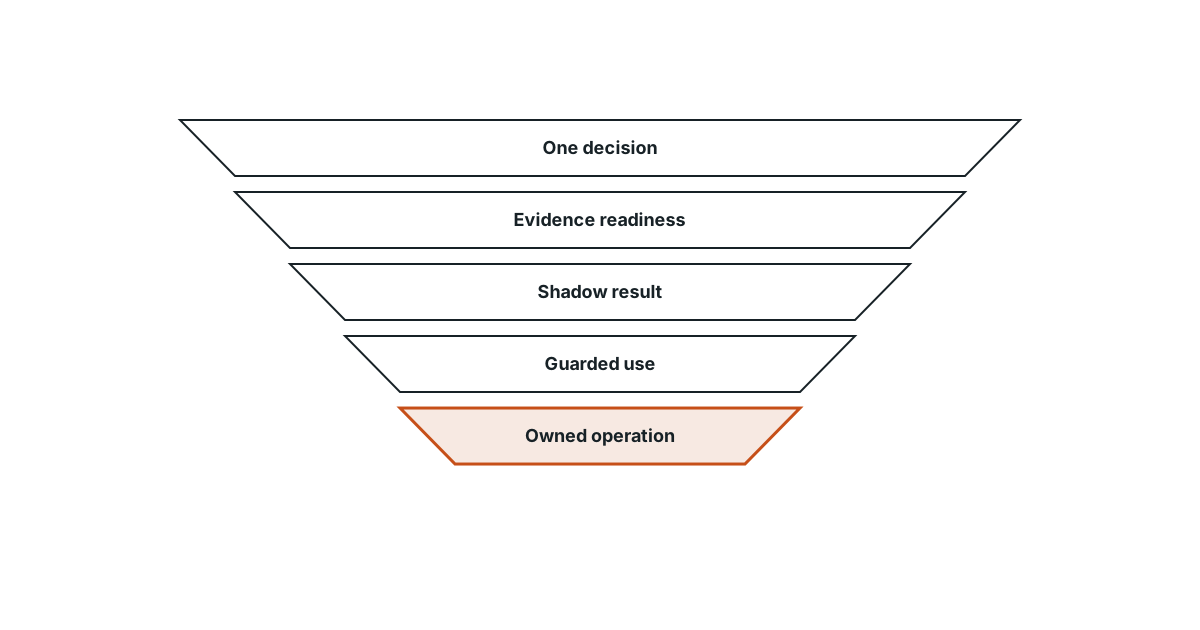
Slice through a decision rather than a technology layer
A fictional team proposes to spend its first month integrating five databases before showing a planner anything. A thinner slice instead supports one work-order decision across only the necessary evidence and services. It still reaches the user and the relevant operating boundary. A partially completed data layer cannot establish whether the intended decision is useful or understood.
State what improvement would matter
Define the expected change in the planner’s work: less reconciliation, fewer invalid candidates, faster correction, or clearer handoff. Record a baseline and a way to observe the outcome. Avoid choosing the measure only after the demonstration succeeds. The slice should also name a stopping condition, such as unresolved identity ambiguity that prevents reliable candidate selection.
Use actual boundaries with limited consequence
Start with authentic identity and appropriately scoped data access, while keeping the first result a proposal where that meets the purpose. Mocking every permission and conflict can hide the hardest part of enterprise delivery. Conversely, giving a first prototype unrestricted authority adds consequences without improving the evidence needed for the initial decision.
Progress through explicit evidence gates
| Gate | Evidence that permits the next step |
|---|---|
| Decision | User, alternative, and desired outcome are clear |
| Mapping | Relevant source meanings and conflicts are reviewed |
| Shadow use | Results can be compared without changing production |
| Limited action | Authorization and target preconditions are enforced |
| Operation | Failures have detection, response, and recovery owners |
| Handoff | The receiving team can run and correct the slice |
These gates are an author-designed review sequence. Their value comes from evidence, not from completing a checklist as a ceremony.
Compare a wrong answer with a correct refusal
During a shadow trial, include missing evidence, an outdated supplier statement, and a candidate outside the caller’s scope. A correct refusal or request for clarification may be the best available result. Grade these cases separately from successful recommendations so that pressure for a higher completion rate does not reward unjustified confidence or excessive access.
Finish with an operating handoff
Give the receiving team a supported scenario, known limitations, correction process, and a rehearsed response to one realistic failure. Ask it to explain a result without the original FDE present. If only the implementation team can interpret the mapping or repair the pipeline, the slice has not completed its ownership transfer. Expansion should follow demonstrated operating value and supported reuse, rather than a polished demonstration alone.
Evidence and scope
- W3C Data Quality Vocabulary: DQV provides vocabulary for expressing quality measurements and their context.
- OWASP Authorization Cheat Sheet: Authorization must be checked on every request and enforced in a trusted component.
The proposed checks are teaching tools; validate their behavior in the actual environment.
Evidence
DQV provides vocabulary for expressing quality measurements and their context.
DQV provides vocabulary for expressing quality measurements and their context.
Primary source · official-doc · checked Sep 11, 2026
Limit: This source supports the named mechanism, not the outcome or thresholds of the illustrative workflow.
Authorization must be checked on every request and enforced in a trusted component.
Authorization must be checked on every request and enforced in a trusted component.
Primary source · official-doc · checked Sep 11, 2026
Limit: This source supports the named mechanism, not the outcome or thresholds of the illustrative workflow.
Limitations
The scenarios and decision worksheets are original teaching examples. They are not measured deployments or guarantees; adapt the checks to the actual system and its documented behavior.
FAQ
- Can a shadow-only slice be useful?
- Yes, when the agreed purpose is to validate recommendations and evidence before granting authority to change production.
- How small should the first slice be?
- Small enough to own one decision end to end, while retaining its real identity, evidence, failure, and handoff obligations.
Related guides
Continue within Ontology-driven enterprise delivery, or use one of these adjacent diagnostics:
Editorial QA: automated native-English, structure, source-presence, and link checks completed . This record is not an independent expert endorsement. Review boundary.