
Question-led guide · how-to
How should agent workers drain before a deployment?
Define a bounded deployment drain that stops queue polling, accounts for active work, preserves durable handoff, and checks retirement beyond Pod readiness.
Direct answer
Drain a worker by preventing new assignments, stopping queue polling, and giving its current bounded steps time to finish or establish a durable handoff before process termination. Account for lease ownership, callbacks, and unresolved operations explicitly. Align the application drain budget with the deployment grace period and verify the replacement cohort can continue the work. A readiness change alone does not stop an application's queue consumer.
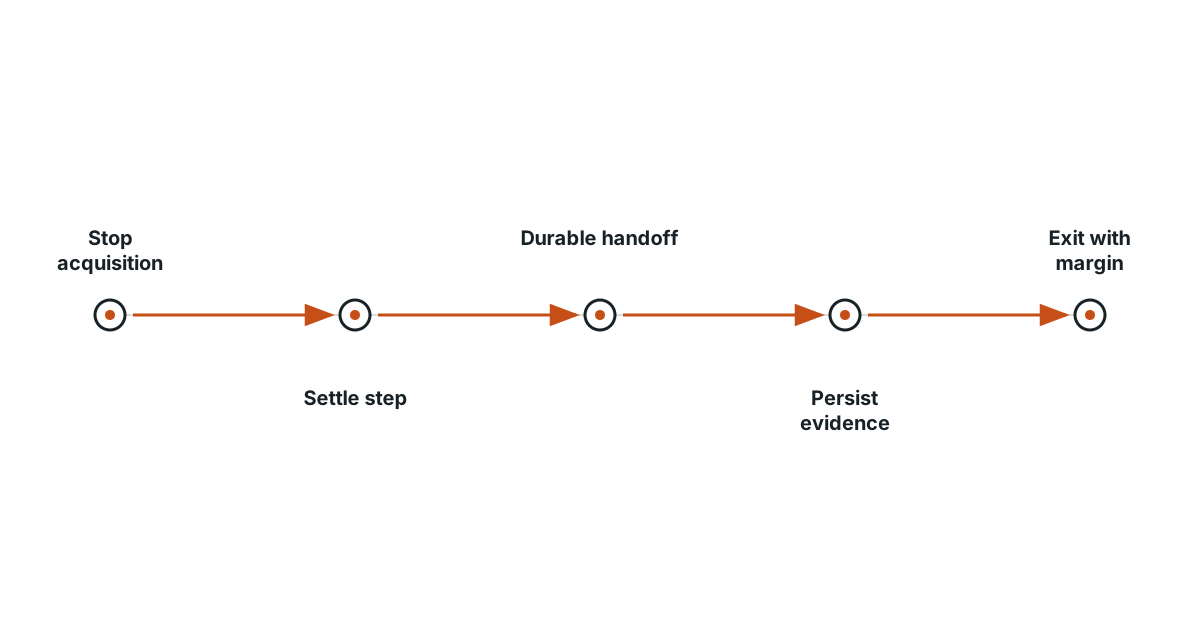
Deployment termination has a shorter clock than the task
An investigation may remain active for hours, while its worker is expected to exit within a short deployment window. The process should own bounded execution, not the entire lifetime of the task. Human waits and delayed callbacks need a durable owner that survives worker retirement.
The deployment drain therefore ends when current work is finished or transferred under the execution contract. It should not wait for every business task to become terminal. That distinction makes routine releases possible without abandoning accepted work.
Stop every source of new assignments
Changing readiness can remove a worker from ordinary service traffic, but an application may also poll a broker or receive assignments through a dispatcher. Disable each acquisition path. Make the drain flag idempotent so a deployment hook and a termination signal cannot produce conflicting shutdown behavior.
Continue only the operations required to settle current ownership: state commits, supported lease maintenance, evidence persistence, and handoff. A shutdown handler that disables its database client before recording the final task disposition defeats its own protocol.
A ninety-second shutdown with a forty-second step
In a constructed deployment exercise, a worker receives a 90-second termination budget while a model step has up to 40 seconds remaining. The service stops polling within five seconds, allows the bounded step to complete, and reserves time for state persistence and exit. A separate task waiting for approval is already represented durably and does not keep the process alive.
If the step cannot finish within the usable budget, the runtime follows its established interruption and handoff contract. It must not mark the task completed because the process is stopping, or acknowledge queue work before the required durable transition exists.
Use a drain timeline with observable milestones
The values below are teaching budgets. Measure actual shutdown behavior before selecting production limits.
| Milestone | Illustrative deadline | Observable condition | If the condition fails |
|---|---|---|---|
| Stop acquisition | 5 seconds | Pollers stopped; dispatcher excludes worker | Halt rollout expansion |
| Settle bounded step | 50 seconds | Step result or supported interruption recorded | Start the defined handoff path |
| Transfer durable ownership | 65 seconds | Replacement route exists; old ownership closed safely | Retain explicit unresolved disposition |
| Persist required evidence | 75 seconds | Required records committed; export gap stated | Apply evidence-failure policy |
| Exit with margin | 80 seconds | Process exits before 90-second budget | Investigate forced-termination exposure |
Do not interpret the handoff row as permission to release a lease while the old executor can still commit. The runtime must fence stale ownership or otherwise establish an equally explicit protection.
Budget the hook and the process together
Kubernetes Pod lifecycle documentation describes a finite grace period, including lifecycle-hook handling, before forced shutdown. A long sleep in a hook consumes useful drain time; it does not create extra capacity for application cleanup.
Account for the actual signal path, process-one behavior, container ordering, and evidence sidecar lifetime. Confirm how the deployment mechanism reports progress when a drain stalls. Avoid treating replacement Pod readiness as proof that the departing process transferred its work.
Verify replacement using task records
Run a deployment exercise with a running step, a durable wait, and a delayed callback. Confirm that no new work reaches the draining worker, accepted tasks remain discoverable, and compatible replacements can advance eligible work. Include a forced termination to expose the residual reliance on graceful exit.
SQS’s redelivery behavior is one reminder that shutdown cannot rely on one-time delivery. The complete mechanism for ambiguous external operations belongs in preventing duplicate agent side effects.
A clean exit is one piece of release evidence
Draining verifies process retirement. It does not prove task quality, cancellation of remote effects, or cross-version state compatibility. Review active-task release compatibility before shrinking an old cohort, and use safe task resume for reconstruction after interruption. AI Agent Platform Engineering connects these boundaries into the operating contract.
Evidence
Kubernetes graceful Pod termination has a finite grace period that includes preStop handling and can end in forced process termination.
The Pod lifecycle documentation describes preStop, termination signals, endpoint readiness, the grace-period countdown, and forced shutdown.
Primary source · official-doc · checked Sep 8, 2026
Limit: These process and routing mechanics do not implement an application's task handoff or queue-consumer shutdown.
A queue message may be delivered again, so process retirement must not rely on the assumption that a delivered job has disappeared permanently.
Amazon SQS documents possible repeated delivery for standard queues and the need for idempotent application handling.
Primary source · official-doc · checked Sep 8, 2026
Limit: The source does not define worker leases or a shutdown protocol; those depend on the selected execution runtime.
Limitations
The timeline is a proposed application protocol, not a portable Kubernetes hook implementation. Runtime shutdown APIs, signal handling, broker leases, remote cancellation, sidecars, and forced termination require local drills. Durable handoff and external-effect safety need their own verified contracts.
FAQ
- Can I set a very long grace period and wait for every task?
- That can block deployments indefinitely when tasks wait for people or external callbacks. Drain bounded execution steps and preserve durable waits under a supported executor instead of tying task lifetime to process lifetime.
- Does marking a Pod unready stop queue polling?
- No application-level guarantee follows from that alone. The consumer must stop acquiring new work through its own shutdown mechanism, and the dispatcher must stop assigning work where applicable.
Related guides
Continue within AI agent platform engineering, or use one of these adjacent diagnostics:
Editorial QA: automated native-English, structure, source-presence, and link checks completed . This record is not an independent expert endorsement. Review boundary.