
Question-led guide · how-to
How do I roll out an agent revision without stranding active tasks?
Plan worker compatibility, retained release cohorts, waiting tasks, migration decisions, and retirement evidence before replacing an agent revision.
Direct answer
Roll out new admissions and active-task compatibility as separate decisions. Keep each accepted task associated with a supported release, retain a compatible worker cohort for outstanding work, and migrate only through an explicit tested transition. Count waiting, scheduled, and retained-history obligations before retiring old capacity. Reverting new traffic does not reverse already written state or external effects, so rollback needs a task disposition plan as well as a deployment command.
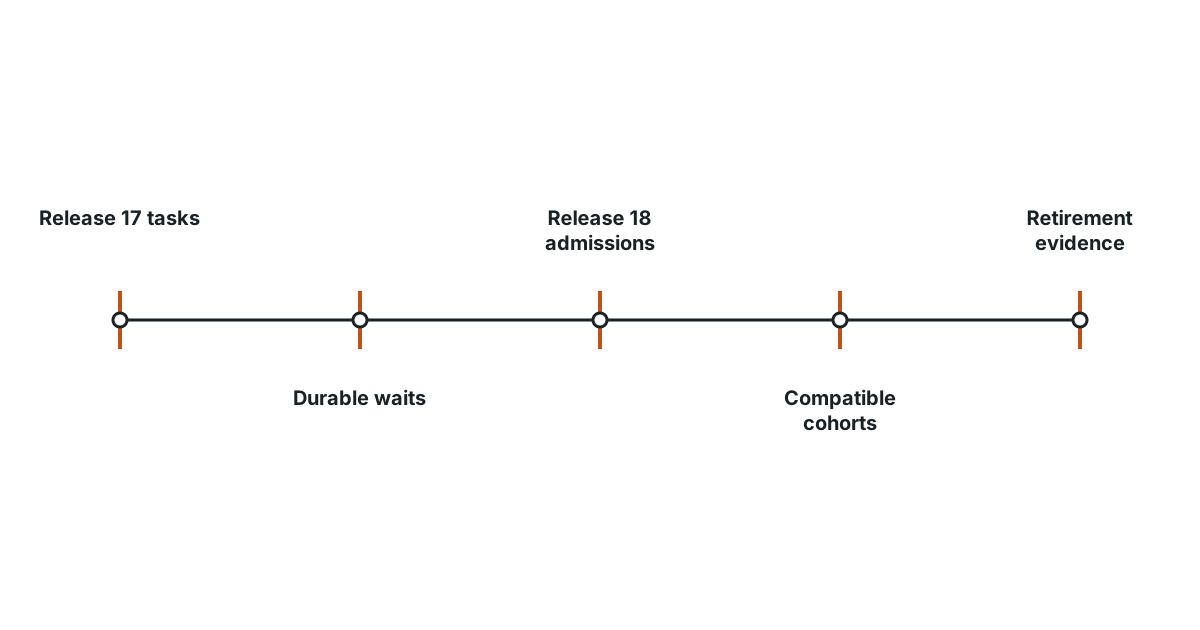
New traffic is only one population in a rollout
A percentage-based canary routes newly arriving work. An agent service may also hold accepted tasks from yesterday that are sleeping, waiting for a callback, or awaiting a reviewer. Their next step can arrive after the deployment team has declared the rollout complete.
The release inventory must therefore include future runnable work. Queue depth is an incomplete view because many legitimate waits do not occupy the execution queue. Use the task system of record to enumerate the revisions that still have obligations.
Choose a compatibility rule before replacing workers
One possible rule keeps a task on its original release until completion. Another allows a compatible new worker to interpret older state. A third performs an explicit migration at a defined boundary. Each carries a different burden: retained capacity, backward compatibility, or a tested transformation with recovery.
Temporal’s Worker Versioning documentation gives a concrete product example of pinned and upgradeable workflows. An ordinary message queue has no such guarantee unless the application builds the routing and compatibility contract. Use the runtime’s actual semantics rather than borrowing the product terminology as a promise.
Completion may leave additional support obligations. Temporal notes that a closed Workflow can execute code paths when queried within its retention period while workers of that version are polling. Distinguish reading stored history from a worker-executed Query, and explicitly retain or retire the latter capability under the service contract.
The approval that arrives after the last old worker leaves
Consider a hypothetical fleet with 180 tasks accepted under release 17. At rollout time, 160 have completed and 20 remain active: 12 are waiting for human review, and eight are waiting for scheduled evidence refreshes. The execution queue is empty. The team removes release 17 workers and assigns every worker release 18, whose state reader no longer accepts one field used by release 17.
The next morning, an approval arrives and the task cannot advance. The failure began at worker retirement, not at approval delivery. A release inventory would have shown 20 outstanding obligations and stopped retirement until the team retained capacity or established a supported disposition.
Maintain a release disposition table
Copy this artifact into the rollout record. The counts and revisions here belong to the constructed scenario.
| Task population | Count | Allowed executor | Disposition before retirement | Required evidence |
|---|---|---|---|---|
| Finished on release 17 | 160 | Compatible executor if historical Queries or replay require one | Retain supported query/replay capability or approve its retirement | Terminal state, retention window, and query disposition verified |
| Awaiting reviewer | 12 | Release 17 cohort | Continue pinned or reviewed migration | Future approval route tested |
| Scheduled refresh | 8 | Release 17 cohort | Preserve wakeup and assets | Timer-to-worker route exercised |
| New admissions | Variable | Release 18 canary | Expand only within release policy | Candidate manifest and serving health |
| State already written by 18 | Measured live | Compatible executor | Assess separately if rollback requested | Old reader compatibility or repair plan |
Add owners and expiry dates to retained cohorts, including the disposition of historical queries after worker retirement. An unsupported task should become a visible exception requiring disposition, never silently fall back to the newest worker.
Retire a revision only after its obligations end
The retirement gate queries nonterminal tasks, durable timers, outstanding callback routes, and any policy-governed operations that can create more work for the revision. It checks retained-history Query and replay commitments against their support and retention windows, then confirms that no new admissions can target the old cohort. A runtime’s drained status is insufficient if promised historical operations still need its workers.
Keep enough compatible capacity to meet the support contract while the population shrinks and retained operations remain supported. A single neglected worker that cannot be restarted from retained assets is not a dependable support strategy. Test replacing an old-cohort worker after the main fleet has moved forward, including a supported Query against a closed workflow when the runtime requires execution.
Rollback changes routing before it repairs history
Stop further exposure to a faulty revision, then inspect what its tasks have already persisted or changed. Kubernetes rollback restores a Pod template revision; it cannot restore an application’s earlier database contents or reverse a tool action.
This article owns deployment population and compatibility decisions. Use safe long-running task recovery for state reconstruction and effect reconciliation. Do not replace that process with a blanket instruction to rerun every task on the old image.
Long support windows change the architecture decision
Weeks-long waits can require several compatible releases, retained model assets, and explicit support ownership. If those costs are excessive, reconsider task lifetime or choose a runtime with suitable migration capabilities. Continue with worker draining during deployment and the connected release strategy in AI Agent Platform Engineering.
Evidence
Workflow systems can distinguish pinned execution from automatic version upgrades, with compatibility obligations differing between those modes.
Temporal documents Worker Deployment Versions, Pinned versus Auto-Upgrade behavior, replay-safety requirements, and possible code execution when closed workflows are queried during retention.
Primary source · official-doc · checked Sep 8, 2026
Limit: Temporal's routing semantics are product-specific and do not automatically apply to an ordinary queue or other runtime.
Kubernetes Deployment rollback concerns Pod template revisions and does not undo application data changes.
The Deployment documentation describes revision history and rollback of the Pod template.
Primary source · official-doc · checked Sep 8, 2026
Limit: Task migration, data rollback, and external-effect handling are responsibilities of the application and its stores.
Limitations
The disposition table does not supply a workflow migration algorithm. Runtime routing, replay rules, schema evolution, history retention, historical-query support, and external operations vary. Validate each supported transition against the exact deployed runtime and representative waiting and closed states.
FAQ
- Can I retire the old workers when their queue is empty?
- Not from that observation alone. Waiting approvals, scheduled wakeups, callbacks, and delayed deliveries may create future work for the old revision. Check authoritative task records, routing dependencies, and any retained-history query or replay commitments.
- Can every old task be moved to the new revision?
- Only when the target can interpret its state, outstanding commands, and required assets correctly under an approved transition. Some tasks need retained compatible capacity or an explicit supported termination path.
Related guides
Continue within AI agent platform engineering, or use one of these adjacent diagnostics:
Editorial QA: automated native-English, structure, source-presence, and link checks completed . This record is not an independent expert endorsement. Review boundary.