
Question-led guide · evaluation
How do I evaluate exploration and collaboration in observability?
Test whether investigators can preserve a query trail, share bounded evidence, and hand off an incident without losing context or exposing unrelated data.
Direct answer
Give representative responders an unfamiliar incident and observe how they move from overview to raw evidence, compare hypotheses, and hand findings to another role. Require saved query state, timestamps, source links, annotations, and permission-aware sharing. A screenshot of a dashboard is not a sufficient handoff. The platform should preserve what was seen, what was inferred, and what remains unknown so the next responder can continue without restarting the investigation.
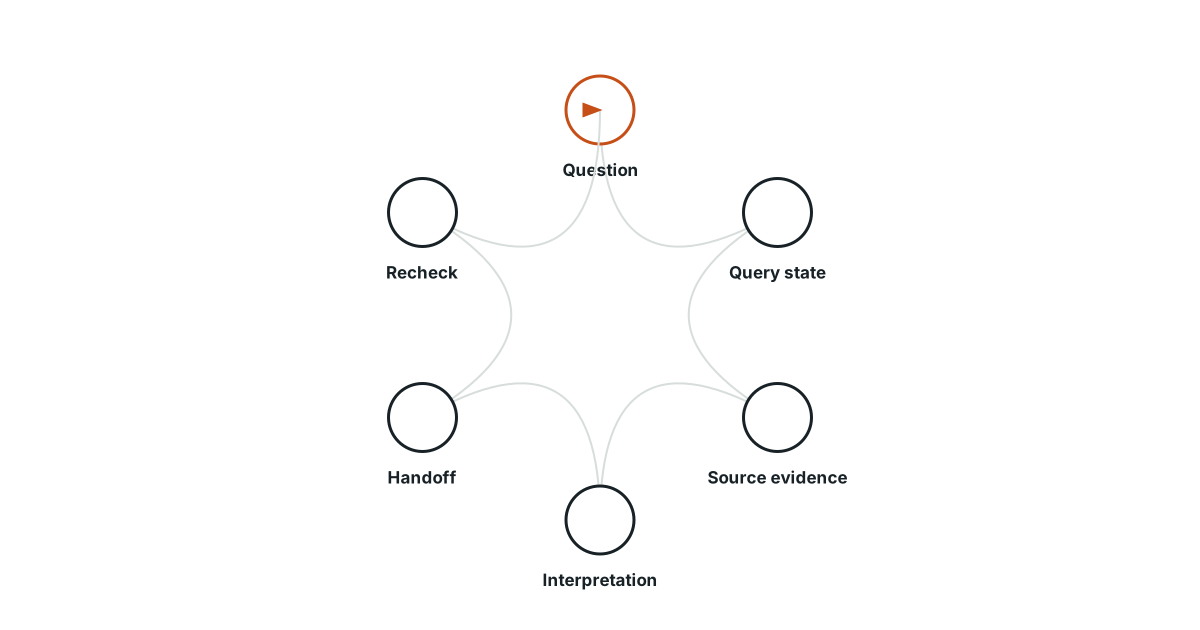
Test the investigator, not only the interface
A product tour often follows a prepared path with a knowledgeable presenter. Give an on-call engineer an unfamiliar symptom and let them choose their own next query. Observe whether the platform supports comparison across time, cohorts, and evidence types without forcing them into an opaque dashboard. Record dead ends and how they recover from a mistaken hypothesis.
Make every shared view reconstructable
An incident link should retain query text or identity, filters, time range, timezone, signal source, and revision. A screenshot preserves pixels but may lose the population behind a graph. An annotation needs its author and observation time. If data has expired or access changed, the handoff should say so rather than showing a stale view as current evidence.
The screenshot travels without its filter
In a constructed incident, one engineer shares a graph of payment latency after filtering to failed mobile sessions. The next shift sees only the image and assumes it represents all payments. The platform’s saved-query link includes the mobile filter, 20-minute window, and source revision; the receiver notices the limit and checks desktop sessions before widening the impact statement.
Use a handoff card to grade collaboration
The card keeps evidence and interpretation separate.
| Handoff item | Required detail |
|---|---|
| User question | Impact and affected population |
| Reproducible query | Filter, time, source, and permissions |
| Observed result | Raw evidence or stable reference |
| Hypothesis | Why it might explain impact |
| Counterevidence | What points elsewhere |
| Next action | Owner, safety boundary, and time |
Include roles with different access
A security reviewer, service engineer, and incident commander may have different rights. Test whether a shared link respects those permissions and provides a useful redacted explanation when data is unavailable. Do not widen access just to make a demo smooth. A collaboration feature is only usable when recipients can see the approved evidence or know exactly what is withheld.
Measure continuity across a real handoff
Have one investigator stop after a fixed time and another continue from the saved record without verbal coaching. Record time to re-establish context, repeated queries, missed caveats, and unsupported conclusions. The result is specific to the tested role permissions and retention period. Use failures to improve query persistence or the response process rather than assuming a chat integration solves handoff quality.
Evidence boundary for incident exploration handoffs
- Google SRE incident response: Google SRE describes clear roles, coordination, and a running incident record. It does not evaluate this fictional platform interface.
- Google SRE monitoring: Google SRE discusses monitoring as a tool for investigation and visibility. A monitoring view alone does not preserve all handoff context.
The mobile-session case is invented. Real collaboration needs policy-approved sharing and user testing.
Evidence
Incident management requires coordinated roles and a working record.
Google SRE describes clear roles, coordination, and a running incident record.
Primary source · official-doc · checked Oct 7, 2026
Limit: It does not evaluate this fictional platform interface.
Monitoring systems support diagnosis and visual understanding.
Google SRE discusses monitoring as a tool for investigation and visibility.
Primary source · official-doc · checked Oct 7, 2026
Limit: A monitoring view alone does not preserve all handoff context.
Limitations
The card describes a handoff test, not a universal interface design. Local permissions and retention can change what recipients can inspect.
FAQ
- Is a dashboard screenshot sufficient for an incident handoff?
- No. It loses filters, source revision, time scope, and the distinction between observation and interpretation.
- Should every responder receive identical data access?
- No. Test role-aware sharing and preserve an explicit unavailable-data state where access is restricted.
Related guides
Continue within Enterprise observability platform selection, or use one of these adjacent diagnostics:
Editorial QA: automated native-English, structure, source-presence, and link checks completed . This record is not an independent expert endorsement. Review boundary.