
Question-led guide · governance
How do I govern observability cost, quality, and access together?
Set telemetry retention and sampling policies that preserve investigation value while bounding spend and sensitive-data access.
Direct answer
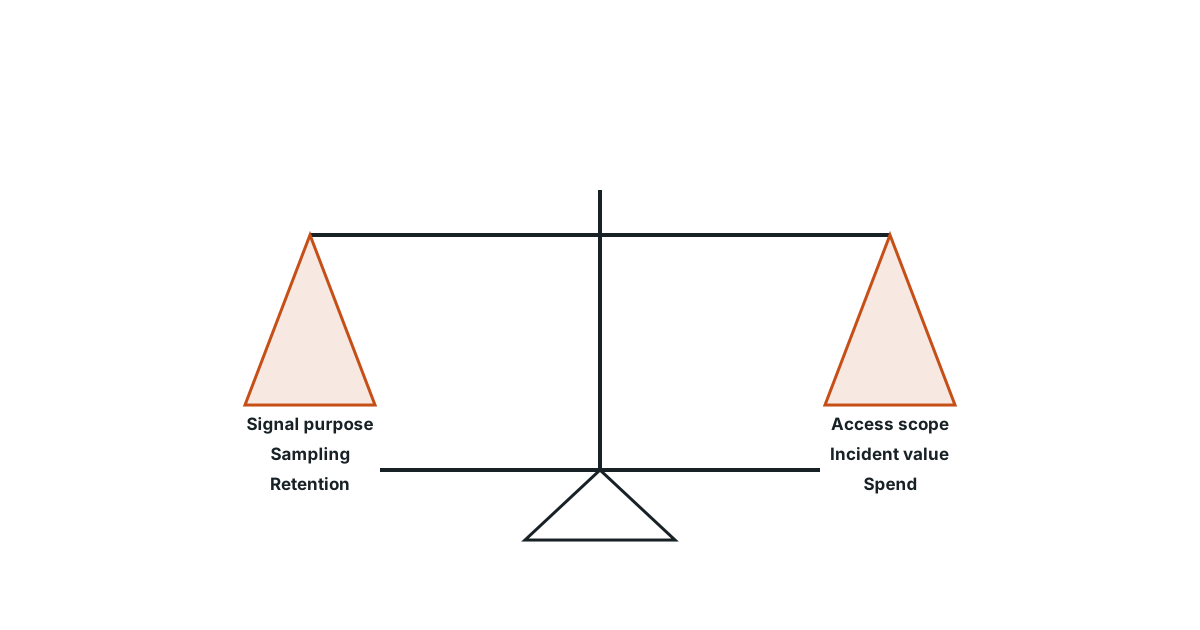
Treat cost, evidence quality, and access as one policy decision per signal and use case. Record who needs which fields, at what resolution, for how long, under what privacy constraints, and at what maximum cost. Test the incident questions that sampling or retention might break. Apply role-based access and redaction before widening capture. A lower ingest bill is not a saving if it destroys the evidence needed to resolve consequential failures.
Start with the question the signal must answer
Some traces support near-term incident reconstruction, while long-range metrics support capacity planning. Logs may carry sensitive payloads and offer high detail at a high storage cost. For each signal, name the decision, eligible users, needed fields, resolution, and retention window. A universal “keep everything” policy is expensive; a universal “sample aggressively” policy may discard the rare evidence that matters.
Make the sampling population explicit
A sample rate without selection rules says little about what survives. Tail sampling, error-biased sampling, and head sampling create different evidence populations and delays. Record how the platform handles unknown outcomes and dropped data. An incident review should be able to explain whether absent traces mean no relevant requests, unsampled requests, expired data, or a broken pipeline.
The cheap policy loses the failing cohort
In a constructed API service, a 1% head sample reduces trace volume sharply. A failure affects only one low-volume tenant during a five-minute window, and no failing trace survives. The team has saved money but lost the path needed to understand that tenant’s impact. It tests an error-retention policy and a short high-detail window, while measuring the new cost and privacy exposure.
Use a policy table by signal and purpose
The table ties proposed cuts to an evidence test.
| Signal | Required decision | Retention or sample rule | Access check |
|---|---|---|---|
| Service metric | Detect user impact | Full rollup, limited raw detail | Team-wide aggregate |
| Error trace | Reconstruct failure | Preserve selected failures | Incident role |
| Application log | Explain local state | Redacted, bounded retention | Scoped service role |
| Change event | Join behavior to release | Stable history | Audit role |
Test the investigation before accepting savings
Replay a representative incident under the proposed retention and sampling policy. Ask whether investigators can still identify affected population, correlate signals, and explain missing data. Measure ingest, storage, query, and operational overhead together. Compare cost per useful investigation rather than only bytes stored. Review whether the added high-detail path exposes secrets or cross-tenant data.
Review policy as workloads change
New services, AI workloads, regulations, and user journeys can change which evidence is necessary. Version the policy and test it after instrumentation changes. Give operators a bounded temporary escalation path with purpose, expiry, and audit, rather than permanent broad capture. When a policy can no longer serve an incident question, record the gap and the owner responsible for a new decision.
Evidence boundary for telemetry policy
- OpenTelemetry Collector scaling: OpenTelemetry documents signal-specific planning for Collector scale. It does not set this organization’s retention or cost policy.
- OpenTelemetry Collector resiliency: OpenTelemetry documents queue and retry failure behavior. It does not establish the proposed sampling policy’s investigation quality.
The tenant incident and sample rule are illustrative. Apply the table to measured local signal needs and approved privacy policy.
Evidence
Telemetry signal types can require different scaling strategies.
OpenTelemetry documents signal-specific planning for Collector scale.
Primary source · official-doc · checked Oct 7, 2026
Limit: It does not set this organization’s retention or cost policy.
Collection and retry limits affect missing telemetry.
OpenTelemetry documents queue and retry failure behavior.
Primary source · official-doc · checked Oct 7, 2026
Limit: It does not establish the proposed sampling policy’s investigation quality.
Limitations
The table is a decision aid. It cannot prescribe universal retention, sampling, or access levels across different legal and operational contexts.
FAQ
- Can an ingest-cost reduction be called an overall saving?
- Only after measuring the effect on useful investigations, query costs, and any increased review or recovery work.
- Does a missing trace mean the request succeeded?
- No. It may have been unsampled, delayed, dropped, expired, or denied by access policy.
Related guides
Continue within Enterprise observability platform selection, or use one of these adjacent diagnostics:
Editorial QA: automated native-English, structure, source-presence, and link checks completed . This record is not an independent expert endorsement. Review boundary.