
Question-led guide · how-to
How should a junior developer use AI as a tutor and reviewer?
A learning workflow that gives AI bounded tutor and reviewer roles while preserving prediction, retrieval, debugging, and independent verification.
Direct answer
Use AI after you make a prediction and before you accept an answer. Give it distinct seats: Socratic tutor for questions and hints, critic for counterexamples and tests, and reviewer for evidence-backed feedback. Keep design, execution, and final verification under your control. Regularly solve transfer tasks without AI, explain failures in your own words, and preserve a decision log you can defend.
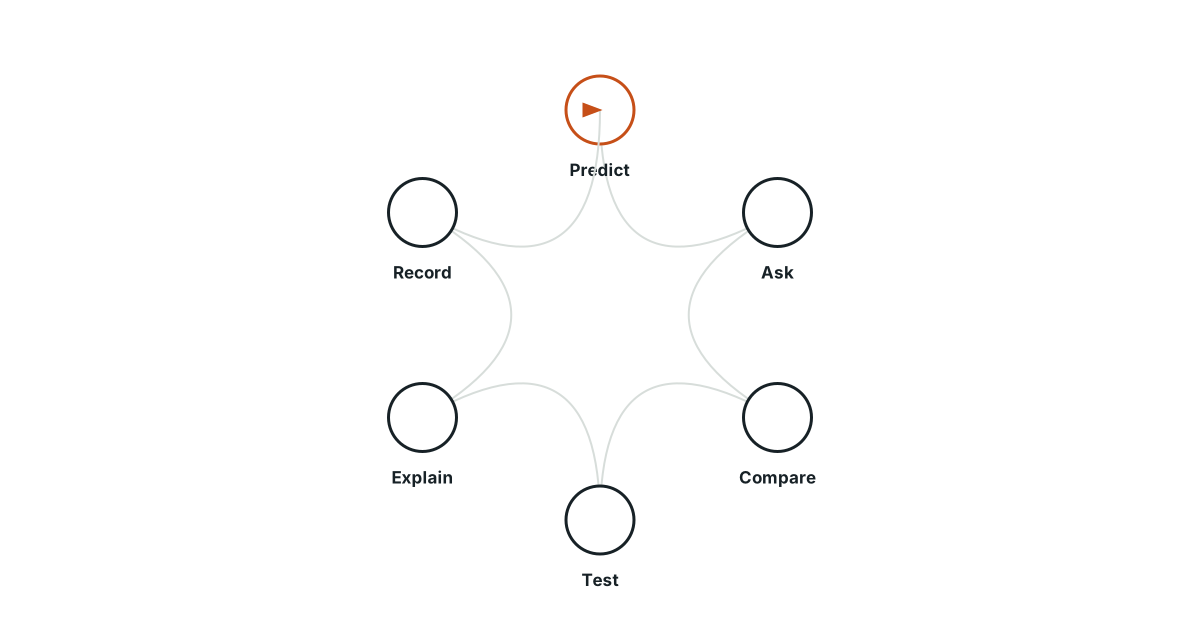
Put the learner in the decision seat
This workflow is for early-career developers who use AI during study or production work and want to build independent judgment. It addresses the learning loop, not company rules for proprietary data or code-review approval.
Why asking for the answer weakens calibration
AI makes the finished artifact arrive before the learner has formed a model of the problem. The code may work, yet the developer has not predicted a failure, chosen a boundary, inspected an API contract, or practiced recovery. Completion and learning separate.
Avoiding AI entirely also wastes a useful feedback surface. A model can generate contrasting cases, ask questions, challenge assumptions, and explain an error at several levels. The key is assigning it a role that does not remove the cognitive step being practiced.
Diagnosing an intermittent timeout
The developer predicts a connection-pool bottleneck and names a confirming metric before asking AI for competing hypotheses. AI proposes DNS and downstream queueing; the developer chooses tests, runs them, and writes why the original guess changed.
Assign AI a role for each stage
After an AI-assisted task, close the transcript and answer:
- What did you predict before running the code?
- Which requirement or invariant determined the design?
- Which alternative did you reject and why?
- What failure did you reproduce?
- Which external documentation confirms the API behavior?
- Can you change one constraint and adapt the solution without copying?
- Can you explain the result to a reviewer with no appeal to “the AI said so”?
Difficulty answering indicates that assistance occupied the driver’s seat rather than a tutoring or review seat.
Practice prediction, challenge, and review
Begin each task with a short prediction: expected behavior, risks, and test. Ask the AI for questions or a hint before requesting a solution. When it proposes code, require a line-by-line behavioral explanation, counterexample, and test plan. Verify claims against official documentation and execution.
Use three passes. In the tutor pass, the AI asks and explains. In the critic pass, it searches for edge cases, security issues, and alternative designs. In the reviewer pass, it compares the code to an explicit rubric. The developer owns the design record, runs the tests, and decides what to accept.
Schedule unassisted transfer tasks. Change the language, API, failure condition, or scale so memorized output is insufficient. Review errors with a mentor or peer when stakes are meaningful.
AI seat-assignment checklist
Assign seats before a practice task:
| Stage | Developer owns | AI may do | AI must not replace | Evidence saved |
|---|---|---|---|---|
| Frame | Requirements, constraints, prediction | Ask clarifying questions | Choose the objective silently | Problem card |
| Design | Alternatives and decision | Challenge trade-offs | Declare one architecture correct | Decision note |
| Implement | Read and understand every change | Suggest bounded patches | Apply unexplained bulk changes | Diff and explanation |
| Test | Define oracle and failure cases | Propose contrasts/fuzz cases | Grade its own output alone | Test results |
| Debug | Reproduce and form hypothesis | Suggest discriminating checks | Replace evidence with narrative | Hypothesis log |
| Review | Final acceptance and escalation | Review against rubric | Approve high-impact change | Review record |
| Transfer | Solve related case unaided | Stay unavailable until debrief | Feed the answer during assessment | Reflection |
Learning rituals that become disguised outsourcing
- Asking for the full answer before forming a prediction.
- Accepting an explanation because it sounds clear without running a discriminating test.
- Using AI to write both the solution and the only tests.
- Measuring productivity only by task completion time.
- Practicing one familiar pattern without unassisted transfer to a changed problem.
Evidence
AI code generation can improve immediate task performance for novices while learning and retention effects depend on how assistance is used.
The CHI 2023 study examines novice learners using an AI code generator on introductory Python tasks, including performance and learning-related measures.
Primary source · paper · checked Aug 26, 2026
Limit: Participants, tasks, duration, and the model were bounded; results do not establish a universal workflow for professional junior developers.
Different modes of AI assistance can produce different coding-skill outcomes even when assisted task completion looks similar.
Anthropic's research report studies how forms of AI assistance relate to immediate performance and subsequent coding-skill assessment in its experiment.
Primary source · paper · checked Aug 26, 2026
Limit: This is company research with a specific experimental design and should not be generalized to all learners, models, or workplaces.
Separating AI roles and requiring prediction, explanation, and independent tests can preserve more opportunities for deliberate reasoning.
The seat-assignment checklist below makes the learner's responsibilities explicit for each practice task.
Signal Studio author framework · reviewed Aug 26, 2026
Limit: The method is a learning design, not clinical or educational advice, and needs adaptation to experience and accessibility needs.
Limitations
Learning varies by prior knowledge, task, feedback, motivation, model, and workplace. AI output can be incorrect or insecure, and self-testing can overestimate transfer. Use mentors, documentation, executable tests, and unassisted assessments as independent checks.
FAQ
- Should a junior developer avoid AI-generated code?
- No blanket rule is needed. Use generation when speed is part of the task, but require yourself to predict behavior, inspect dependencies, run tests, explain trade-offs, and later solve a related task without the generated solution.
- Can AI replace a human code reviewer?
- It can find issues and generate useful questions, but it lacks local accountability and may miss context. Keep human review where policy, architecture, security, or high-impact changes require it.
Related guides
Continue within Engineering judgment with AI, or use one of these adjacent diagnostics:
Editorial QA: automated native-English, structure, source-presence, and link checks completed . This record is not an independent expert endorsement. Review boundary.