
Question-led guide · planning
What does a 12-week plan for building engineering judgment with AI look like?
A progressive practice program using predictions, retrieval, failure drills, design reviews, transfer tasks, and bounded AI roles.
Direct answer
Build engineering judgment over twelve weeks by repeating a weekly loop: predict, implement, inject a failure, gather evidence, explain the mechanism, review a decision, and solve a changed task without assistance. Progress from local code behavior to APIs, state, retries, architecture, incidents, and release decisions. Use AI as tutor and critic, then remove it during transfer checks and keep an evidence-backed judgment journal.
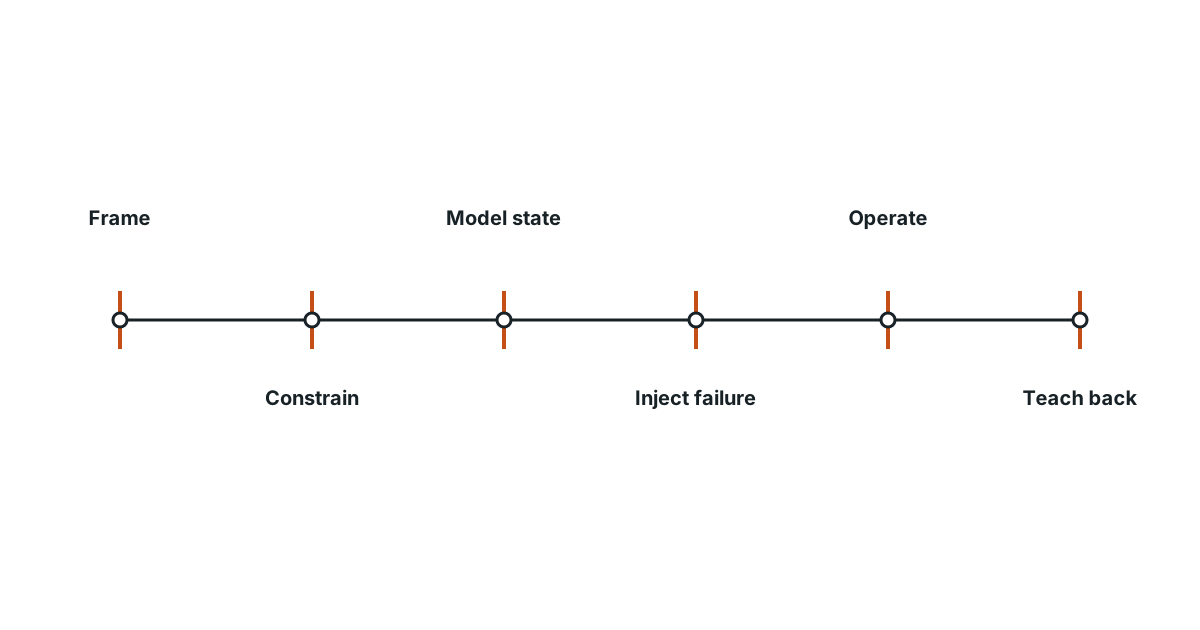
The curriculum follows increasing consequence
This plan is for a developer who can build and test small programs and wants structured practice in engineering decisions. Use a sandbox repository and disposable environment. A mentor can improve feedback, but every week still produces artifacts that make self-review possible.
Why random coding practice does not compound
Unstructured practice follows available tickets. The developer sees many tasks but may never isolate one judgment: interpreting an outcome, designing an invariant, choosing a retry boundary, or evaluating a risky release. AI increases throughput and can further reduce time spent predicting and debugging.
A curriculum should vary the object of judgment while repeating the learning loop. It should also test transfer, because performing a rehearsed example with AI present can overstate independent capability.
One queue revisited four ways
A learner first models queue states, then injects duplicate delivery, adds observability, and finally reviews a rollback. Reusing the domain makes the changing quality of decisions visible instead of hiding it behind new syntax each week.
Design a weekly evidence loop
Before week one, run a baseline task: integrate a small API with delayed completion and one injected failure. Write predictions, design notes, tests, incident diagnosis, and a release decision. Score the artifacts for explicit constraints, evidence, alternatives, failure handling, and unsupported assumptions.
Keep the baseline. Repeat a structurally similar but unfamiliar task in week twelve without AI during the first pass. Improvement should appear in the reasoning and recovery artifacts, not only in faster coding.
Progress from local code to operated systems
Use four phases:
- Weeks 1–3, observe: predict code and API behavior, distinguish response from outcome, and retrieve official documentation from memory and search.
- Weeks 4–6, control: model state, idempotency, retries, deadlines, permissions, and failure recovery.
- Weeks 7–9, decide: compare architecture alternatives, write quality scenarios, analyze incidents, and review evidence under uncertainty.
- Weeks 10–12, transfer: run a small production-like release, critique an AI-generated design, and complete a changed capstone with reduced assistance.
Every session uses the same loop: prediction, implementation, fault, observation, mechanism, decision, feedback, and transfer question. Rotate AI among tutor, critic, and reviewer roles. At least one weekly check is unassisted.
Twelve-week question bank
Build a question bank with one row per week:
| Week | Decision focus | Failure drill | Required artifact | Transfer change |
|---|---|---|---|---|
| 1 | Predict runtime behavior | Boundary input | Prediction ledger | New language/runtime |
| 2 | Read an API contract | Ambiguous 2xx | Outcome state model | Async provider |
| 3 | Test an assumption | Stale read | Evidence map | Different consistency |
| 4 | Model state | Crash/restart | State machine | New persistence layer |
| 5 | Control retries | Post-commit timeout | Retry budget | Layered client |
| 6 | Bound authority | Expired approval | Permission matrix | Different target |
| 7 | Choose architecture | Dependency failure | Constraint matrix | Changed team/scale |
| 8 | Diagnose incident | Missing telemetry | Hypothesis ledger | Different symptom |
| 9 | Review AI code | Hidden invariant | Review rubric | Unfamiliar repository |
| 10 | Plan a release | Bad canary slice | Gate record | New risk tier |
| 11 | Operate and recover | Rollback residue | Incident packet | Partial compensation |
| 12 | Capstone transfer | Combined faults | Decision portfolio | No AI first pass |
Score prediction calibration, evidence quality, mechanism explanation, safe recovery, and transfer. Add one targeted practice item for the weakest dimension.
Practice plans that reward volume instead of transfer
- Treating the table as reading topics instead of executable practice.
- Letting AI reveal the failure before the learner predicts it.
- Repeating the same tool and context until performance becomes memorization.
- Scoring only whether the final code passes happy-path tests.
- Running failure drills against shared or production resources.
Evidence
Expert performance develops through sustained, goal-directed practice with feedback rather than undifferentiated experience alone.
Ericsson, Krampe, and Tesch-Römer develop the deliberate-practice account through studies of expertise in bounded domains.
Primary source · paper · checked Aug 26, 2026
Limit: The influential paper and its interpretation do not imply a fixed number of hours or guarantee expertise from this twelve-week plan.
Retrieval practice can improve later retention compared with additional study in the studied learning conditions.
Roediger and Karpicke report experiments comparing repeated study and testing for later retention of prose passages.
Primary source · paper · checked Aug 26, 2026
Limit: The experiments are not software-engineering field studies, and retrieval benefits depend on task, delay, and feedback.
Transfer should be tested by changing context, domain, or task dimensions rather than repeating the practiced example.
Barnett and Ceci propose a taxonomy for describing where and how far learning transfers across contextual and content dimensions.
Primary source · paper · checked Aug 26, 2026
Limit: The taxonomy organizes transfer claims; it does not validate this curriculum or prescribe software tasks.
Limitations
Twelve weeks is a planning frame, not an evidence-based threshold for expertise. Access to systems, mentors, feedback, and realistic incidents varies. Use safe sandboxes, adapt task difficulty, and do not perform destructive failure drills in production.
FAQ
- How many hours per week does the plan require?
- Choose a sustainable block—often three focused sessions plus one review—and preserve the loop's quality. The plan is defined by deliberate tasks and evidence, not a universal hour count.
- How do I know judgment improved?
- Track prediction accuracy, quality of hypotheses, independent transfer performance, review findings, recovery under faults, and ability to explain decisions with evidence. Do not rely on confidence alone.
Related guides
Continue within Engineering judgment with AI, or use one of these adjacent diagnostics:
Editorial QA: automated native-English, structure, source-presence, and link checks completed . This record is not an independent expert endorsement. Review boundary.