
Question-led guide · how-to
How should retrieval preserve provenance?
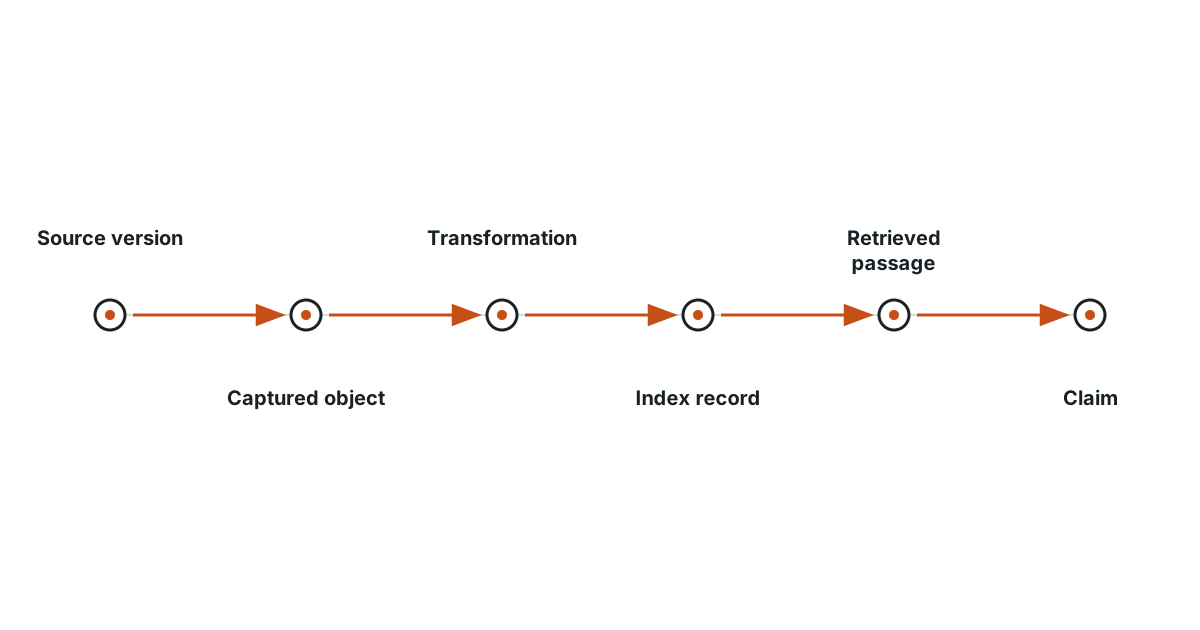
An evidence supply chain connecting source records, versions, chunks, retrieval runs, context placement, claims, citations, and downstream effects.
Direct answer
Preserve retrieval provenance by carrying stable identifiers and versions from the source record through parsing, chunking, indexing, retrieval, reranking, context assembly, claim generation, citation, and effect. Store both where a passage came from and why it entered this run. A URL alone is insufficient, and provenance proves lineage—not that the source is true, current, authorized, or relevant.
Retrieval begins before indexing
Use this schema for retrieval-augmented systems that ingest documents or records, transform them into an index, select evidence, and generate claims or actions. It supports debugging, citation, audit, correction, and deletion. It does not claim that a provenance graph is a truth graph.
How transformations sever source identity
RAG pipelines commonly retain a URL and chunk text. That loses the source version, parser, page or field, neighboring context, embedding model, filters, ranking scores, query rewrite, and exact excerpt placed in the prompt. When an answer is challenged, the team cannot tell whether the source changed, the parser dropped a qualifier, the retriever selected the wrong version, or the model exceeded the passage.
Provenance also has two directions. “Where” identifies the origin of a statement. “Why” records why this source and chunk contributed to this run: query, filters, ranker, score, policy, and selection decision.
A corrected runbook still cited from cache
A runbook paragraph is chunked, embedded, and cached; the source is corrected after an incident. Version and transformation lineage locate stale index and cache entries so the old passage can be withdrawn and affected answers reviewed.
Audit one passage back to origin
Take one generated claim and attempt a reverse trace:
claim -> context evidence unit -> retrieval candidate -> index record -> chunk -> parsed artifact -> captured source.
At each edge, verify stable ID, version, timestamp, transformation, actor or service, and integrity reference. Then replay forward using the saved query, filters, index snapshot, and ranker. If the same evidence set cannot be approximated or the system cannot explain divergence, mark the run non-reproducible.
Check whether citations support the exact claim, including qualifiers. A citation that merely shares the topic is a provenance link without evidentiary support.
Build an evidence supply chain
Assign immutable IDs at capture and every material transformation. Keep content hashes where lawful. A chunk record should point to its source artifact and exact structural location; an index record should point to the chunk and embedding configuration; a retrieval run should retain query versions, scope filters, candidates, scores, reranking, and exclusions.
When compiling context, create evidence units containing the exact text, source identity, version, location, authority and freshness labels, and limitations. The generator should map each material claim to one or more evidence-unit IDs. Store the citation actually shown to the user and any downstream decision or effect that relied on the claim.
Provenance record schema
A minimal evidence-supply-chain record:
source: {id: src-42, version: sha256:..., url: ..., captured_at: ...}
transform: {parser: parser-3.2, artifact_id: art-91, location: "section-4/table-2"}
chunk: {id: chunk-188, strategy: semantic-v5, parent: art-91}
index: {id: idx-12, embedding: embed-model@version, indexed_at: ...}
retrieval: {run: ret-731, query_version: q-8, scope: tenant-a, candidates: [...], selected: [...]}
context_unit: {id: ev-17, exact_text_hash: ..., placement: 6, limitations: [...]}
claim: {id: claim-9, text_hash: ..., supported_by: [ev-17], reviewer: ...}
effect: {id: effect-3, authorized_by: ..., based_on: [claim-9]}
Keep sensitive query and tenant fields under the same access and retention policy as the underlying content.
Relevant chunks that cannot support a claim
- Storing a mutable URL with no capture or content version.
- Recording selected chunks but not excluded high-ranking candidates or scope filters.
- Citing a whole document when a transformed excerpt omitted its qualifier.
- Assuming content hashes establish authority or truth.
- Building lineage that cannot propagate correction, quarantine, or deletion.
Evidence
PROV-O provides a vocabulary for representing entities, activities, agents, and derivation relationships.
The W3C Recommendation defines an OWL ontology for interoperable provenance descriptions and relations among entities, activities, and agents.
Primary source · standard · checked Aug 26, 2026
Limit: PROV-O supplies modeling primitives; it does not decide document trust, chunk quality, retrieval relevance, or application authorization.
Data provenance can distinguish where output data originated from and why source records contributed to a result.
Buneman, Khanna, and Tan characterize why- and where-provenance in a formal data setting.
Primary source · paper · checked Aug 26, 2026
Limit: The relational formalism predates RAG and does not cover semantic ranking, model synthesis, permissions, or temporal validity.
A production RAG system should keep source and transformation lineage adjacent to every evidence unit used by a generated claim.
The evidence-supply-chain schema below makes retrieval and citation decisions reproducible and reviewable.
Signal Studio author framework · reviewed Aug 26, 2026
Limit: Complete lineage adds storage and operational cost and still depends on accurate instrumentation and immutable identifiers.
Limitations
Lineage can be incomplete when external APIs do not expose versions, parsers are nondeterministic, or models combine evidence opaquely. Provenance records can themselves be corrupted and may contain sensitive metadata, so protect and validate the supply chain.
FAQ
- Is the document URL enough provenance?
- No. The content at a URL can change. Retain source identity, capture or content version, exact location, transformations, retrieval-run details, and the evidence unit supplied to the model.
- Does provenance make a generated answer trustworthy?
- It makes the lineage inspectable. Reviewers must still evaluate source authority, freshness, support, contradiction, retrieval coverage, and whether the claim exceeds the evidence.
Related guides
Continue within Context engineering, memory, and state, or use one of these adjacent diagnostics:
Editorial QA: automated native-English, structure, source-presence, and link checks completed . This record is not an independent expert endorsement. Review boundary.