
Question-led guide · how-to
How do I make technical content citable without keyword stuffing?
An evidence-unit method for writing bounded technical claims with definitions, support, limitations, provenance, updates, and answer-sized structure.
Direct answer
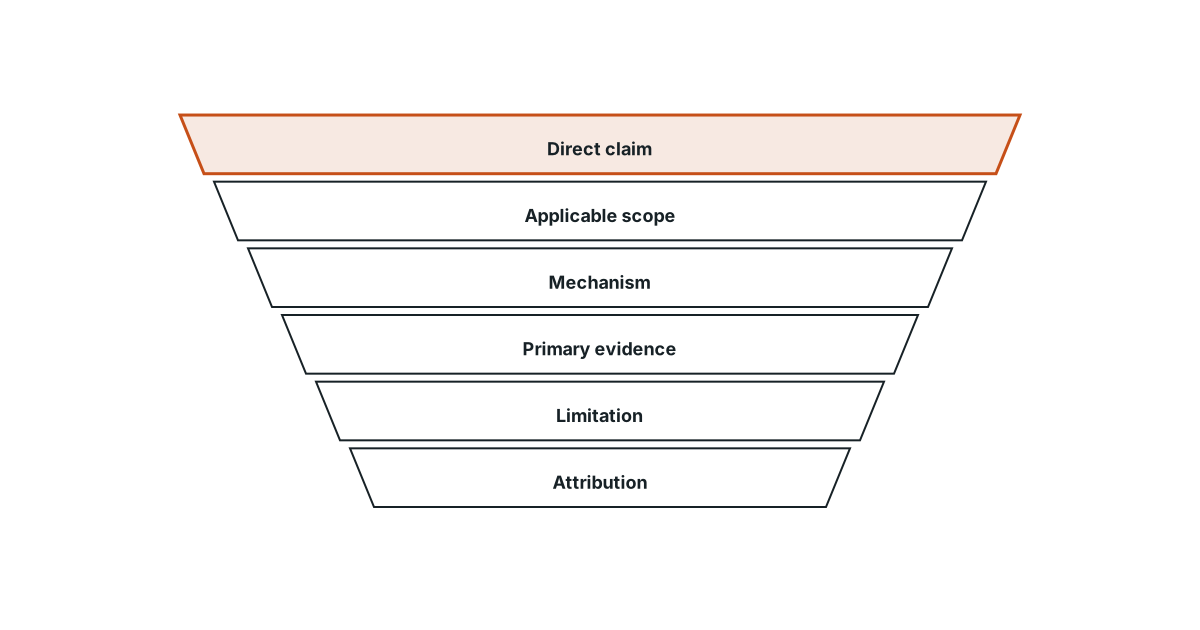
Make technical content citable by publishing small, complete evidence units: one clearly bounded question, a direct answer, defined terms, a specific claim, an authoritative source, the claim's limitation, and a checked date where freshness matters. Use descriptive headings and concrete artifacts. Keyword repetition adds little when the passage is vague, unsupported, inaccessible, or indistinguishable from pages targeting the same intent.
Write for a decision, not a phrase
Use this method for original technical guides, definitions, decision records, checklists, and research summaries intended to be useful to human readers and machine-mediated answer systems. It is a writing and evidence method, not a formula for search-engine ranking.
How repetition weakens evidence density
Keyword stuffing begins with a real concern: a system must understand what the page addresses. The tactic fails when phrase repetition substitutes for a complete answer. A generative system still needs an accessible passage whose claim is specific enough to retrieve and whose support can survive extraction.
Technical pages often create the opposite problem. They bury the answer after a long introduction, mix several intents, cite a source only at the end, or repeat vendor claims without boundaries. A passage can be topically relevant and still be unsafe to cite because the subject, conditions, evidence, or limitations are missing.
Answering whether retries are safe
The article states the condition, mechanism, concrete failure case, operational checklist, primary sources, and limitations in adjacent passages. It uses the reader’s natural vocabulary but never repeats a contrived long-form query.
Assemble a bounded evidence unit
Select one paragraph and test it outside the page:
- Is the question or decision it answers identifiable?
- Are unfamiliar terms defined without relying on nearby navigation?
- Does each material factual claim have a source close enough to map unambiguously?
- Does the source support the exact claim, including conditions and qualifiers?
- Is author recommendation distinguishable from standard, research result, or company claim?
- Is the paragraph still accurate after removing brand and keyword repetitions?
- Does another page on the site own the same intent more directly?
Failure on the final test signals cannibalization; consolidate or create sharper boundaries rather than varying the phrasing.
Make claims attributable and independently useful
Start from one real user problem. Give a direct answer in plain language, then expand with mechanism, diagnosis, solution, artifact, and failure modes as the topic requires. Use headings that name decisions or symptoms. Keep claims small enough that a reader can check them.
For each important claim, record source type, URL, checked date, supported portion, and limitation. Prefer standards, original research, and first-party documentation for facts about protocols and products. Mark author-created frameworks clearly.
Add an original artifact that solves part of the problem: schema, checklist, decision table, test plan, or runnable example. This differentiates the page through utility rather than synonyms. Maintain dateModified only for meaningful review or change.
Evidence-unit template
Use one evidence unit per material claim cluster:
| Field | Content |
|---|---|
| User question | One search or decision intent in natural language |
| Direct answer | A self-contained answer with the main condition and boundary |
| Defined terms | Only terms required to interpret the claim |
| Claim | Specific subject, mechanism, conditions, and scope |
| Source | Primary URL, source type, version/date, and owner |
| Support | Exact relationship between source and claim, in original prose |
| Limitation | What the evidence, page, or system cannot establish |
| Worked artifact | Original checklist, schema, example, or decision tool |
| Maintenance | Owner, checked date, change trigger, and next review |
| Intent exclusion | Sibling question this page deliberately does not answer |
Pages that sound optimized but teach nothing
- Repeating target phrases while leaving the direct answer vague.
- Citing a source for a topic rather than for the exact claim.
- Turning a company description into independent performance evidence.
- Publishing several near-identical pages to capture wording variants.
- Adding schema that exaggerates or contradicts visible content.
Evidence
Google's current guidance for AI search features emphasizes established search fundamentals and useful, accessible, people-first content rather than special AI markup or keyword tactics.
Google's AI optimization guide connects AI feature eligibility to technical access, content quality, structured data accuracy, and existing SEO practices.
Primary source · official-doc · checked Aug 26, 2026
Limit: The guidance covers Google systems only and does not disclose ranking or citation-selection weights.
Citation quality in generative search should be evaluated by whether citations entail claims and whether claims receive citation support.
The verifiability study proposes citation correctness and completeness measures and audits generative-search outputs in its 2023 setting.
Primary source · paper · checked Aug 26, 2026
Limit: Products and retrieval systems have changed, and the paper evaluates answer citations rather than proving a publisher-side optimization tactic.
A publishable evidence unit should state what a source supports and what it cannot establish.
The template below turns evidence boundaries into visible page content and structured editorial records.
Signal Studio author framework · reviewed Aug 26, 2026
Limit: Clear evidence units can improve auditability but cannot guarantee crawling, retrieval, citation, ranking, or recommendation by a model.
Limitations
Commercial generative systems do not expose complete retrieval and citation logic. A well-structured page may remain uncrawled, unindexed, or unselected, and citations can still misrepresent it. Measure observable behavior without claiming guaranteed GEO results.
FAQ
- Should I repeat the exact user question in every heading?
- Use the natural question once when it helps orientation, then organize the answer by mechanism, diagnosis, solution, and evidence. Repetition that adds no new meaning can make pages less useful and more homogeneous.
- Does structured data make a page citable?
- It can clarify entities and page metadata when it matches visible content, but it does not guarantee retrieval or citation. Accessible HTML and supported claims remain essential.
Related guides
Continue within SEO and GEO for technical sites, or use one of these adjacent diagnostics:
Editorial QA: automated native-English, structure, source-presence, and link checks completed . This record is not an independent expert endorsement. Review boundary.