
Question-led guide · how-to
How can traces, metrics, logs, changes, and services share stable identity?
A cross-signal identity contract using canonical IDs, aliases, source mappings, versions, valid time, and confidence without confusing correlation and identity.
Direct answer
Share identity by defining canonical entity IDs and explicit source mappings, not by copying one display name across signals. Separate immutable identity from mutable attributes; record entity type, tenant and namespace, source-native key, canonical ID, alias, version, valid time, mapping method, confidence, and lifecycle. Trace IDs correlate request execution, while service, deployment, resource, and change IDs identify different things.
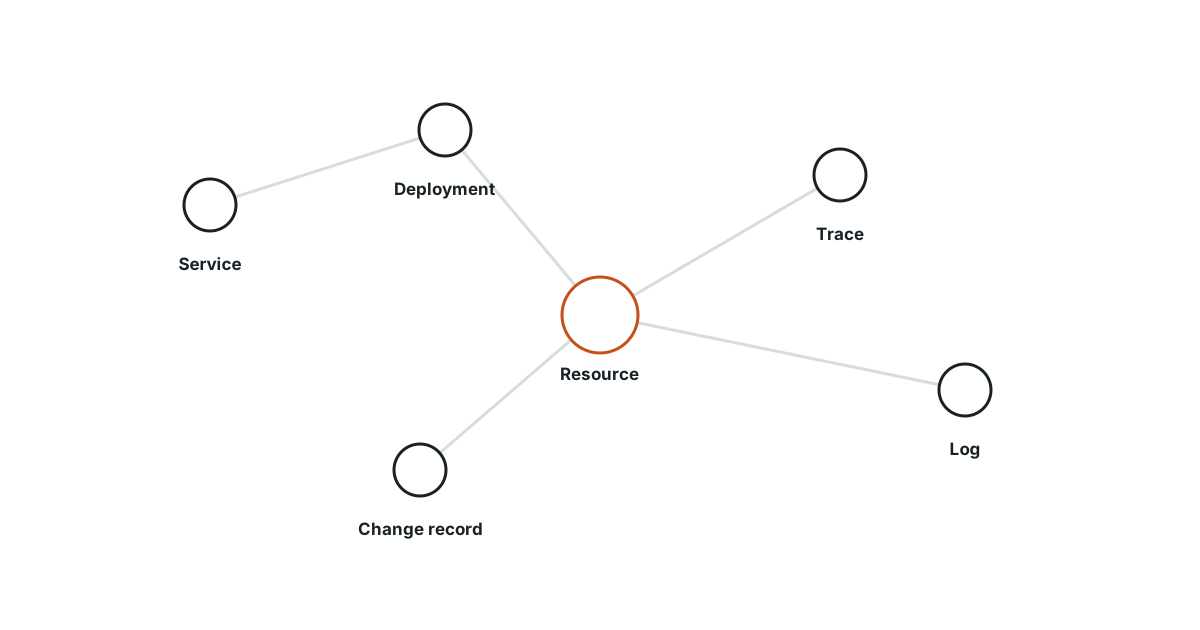
Identity is scoped, sourced, and temporal
Use this contract when joining observability signals with catalogs, CMDB records, deployments, changes, incidents, owners, and cloud inventory. It establishes shared identity pivots. It does not require one physical database or one ontology technology.
How shared names manufacture equivalence
Operational systems identify objects for their own purpose. Tracing knows resource attributes, a metrics backend has label sets, logs contain free-form service names, CI has repository and deployment IDs, and the CMDB has configuration-item records. A join on payments looks obvious until several environments, regions, clusters, or generations use that label.
Teams then promote a correlation key into identity. A trace ID correlates operations; an IP address can be reused; a pod UID identifies an ephemeral instance; a display name can change. Each can help a query while denoting a different kind of thing.
payments-api names three things
The label refers to a logical service, two Kubernetes deployments, and a repository. Scoped identifiers and mapping intervals let telemetry and change records join to the right runtime revision without declaring all three entities identical.
Trace one entity across systems
Select one service and follow it through a rename, deployment, scale event, and incident. Inventory every source-native key and its scope. Ask:
- Does the key identify a logical service, deployment, instance, process, request, or record?
- Is it unique within tenant, namespace, region, and environment?
- Can it be reused after deletion?
- Is it immutable, or merely observed as stable?
- Which authority created it and for what lifecycle?
- How are aliases, splits, merges, and uncertain mappings represented?
A join that cannot answer these questions needs an explicit mapping record rather than a hidden string-normalization rule.
Publish mapping records instead of magic joins
Define canonical entity types first: logical service, deployable, deployment, runtime instance, resource, change, incident, and request. Assign or adopt stable IDs within declared scopes. Keep source-native IDs and create mapping entities with method, evidence, valid time, confidence/status, and reviewer.
Separate immutable identifying fields from mutable description such as owner, version, region, and health. Never overwrite history when an entity changes. Correlation events—trace participation, log emission, metric observation, deployment, and incident involvement—connect identities without merging them.
Validate mappings continuously. Conflicting strong sources should create a review case, not last-write-wins truth.
Cross-signal identity contract
The cross-signal identity contract contains:
| Field | Meaning |
|---|---|
| Canonical entity type/ID | Governed subject and stable identifier |
| Identity scope | Tenant, namespace, environment, provider, and lifecycle |
| Source system/record | Authority, native type, native key, and record version |
| Mapping relation | Exact, alias, derived, candidate, supersedes, split, or merge |
| Mapping evidence | Rule, provenance, reviewer, confidence/status, and limitation |
| Valid/record time | When relation held and when it was recorded |
| Mutable attributes | Owner, version, region, state, and their source/time |
| Correlation IDs | Trace, request, session, deployment run, change, and incident—not identity aliases |
| Lifecycle | Created, active, renamed, replaced, merged, retired, and deleted |
| Conflict/repair | Competing mappings, decision owner, correction, and downstream invalidation |
Identifiers that survive only inside one dashboard
- Joining by display name without tenant, environment, or time.
- Treating a request correlation ID as an entity identifier.
- Overwriting a renamed or replaced entity and losing history.
- Discarding source-native keys after canonical mapping.
- Hiding probabilistic identity resolution behind a Boolean match.
Evidence
OpenTelemetry's entity data model separates entity type and identifying attributes from descriptive attributes and lifecycle concepts.
The OpenTelemetry specification defines Entity, Entity Type, identifying attributes, descriptive attributes, and entity relationships.
Primary source · standard · checked Aug 26, 2026
Limit: The model does not assign an organization's canonical IDs or guarantee source data is complete and consistent.
PROV-O provides standard relations for entities, activities, agents, derivation, attribution, generation, and invalidation.
The W3C Recommendation defines an ontology for interoperable provenance records.
Primary source · standard · checked Aug 26, 2026
Limit: Provenance relations do not perform identity resolution or prove two source records denote the same real-world entity.
Operational source records should map to a governed canonical identity with time and evidence, while retaining source-native IDs.
The contract below distinguishes canonical identity, correlation, alias, version, and observed relationship.
Signal Studio author framework · reviewed Aug 26, 2026
Limit: Some entities lack stable natural identity, and mapping may remain probabilistic or contested.
Limitations
Identity resolution can merge distinct entities or split one entity, especially during renames, ephemeral resources, acquisitions, and incomplete data. The contract makes decisions reviewable but cannot eliminate ambiguity. Preserve source records and support correction.
FAQ
- Can service.name be the canonical service ID?
- Only if governance makes it unique, stable, scoped, and lifecycle-managed. In many systems a name collides across tenants, namespaces, environments, or time and should remain one source attribute.
- Does a trace ID identify the service?
- No. It identifies a trace context for related execution. Many entities participate in a trace, and one service participates in many traces. Use resource/entity identity for the service.
Related guides
Continue within Ontology and operational semantics, or use one of these adjacent diagnostics:
Editorial QA: automated native-English, structure, source-presence, and link checks completed . This record is not an independent expert endorsement. Review boundary.