
Question-led guide · diagnostic
Why should an agent platform limit admission before scaling workers?
Use downstream headroom, deadline feasibility, queue age, and explicit rejection rules to prevent worker autoscaling from overloading an agent service.
Direct answer
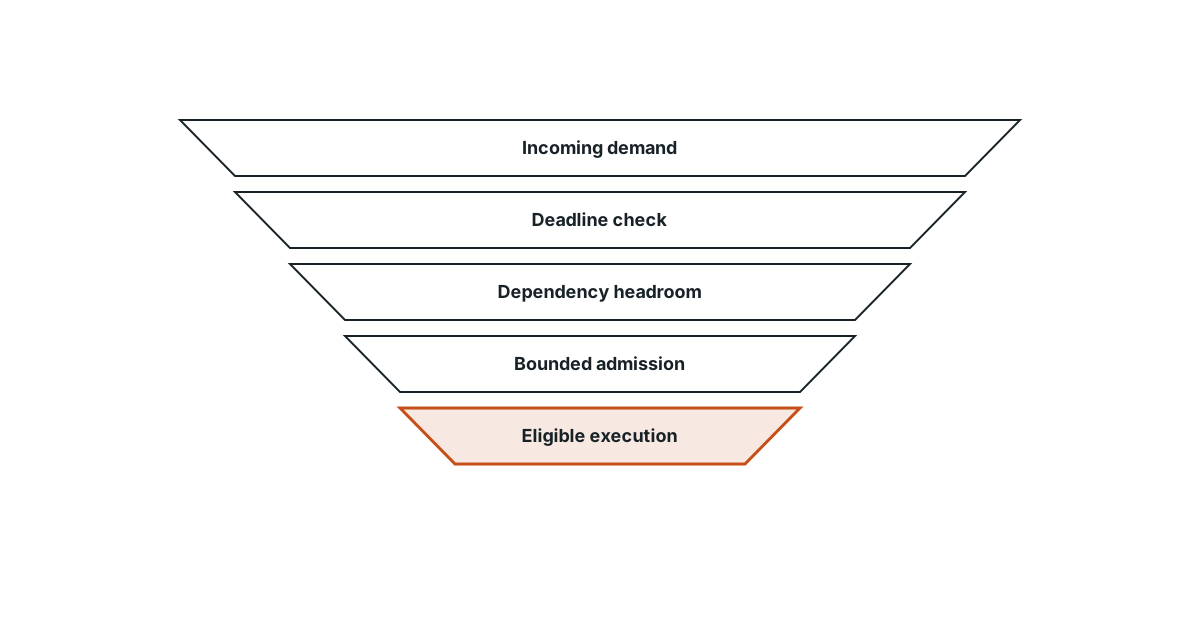
Admission decides whether the platform can take responsibility for more work under its current bottlenecks; autoscaling adds workers after demand becomes visible. If model quota, a tool service, or reviewer capacity is already exhausted, more replicas can increase contention without increasing completed outcomes. Check downstream headroom and deadline feasibility before acceptance, bound queued work, and scale execution only when the limiting resource can support it.
A worker is not a unit of downstream capacity
An agent worker often spends much of its time waiting for model inference, a search service, or a tool response. Low CPU can coexist with a saturated dependency. Increasing replicas increases the number of callers; it does not increase the number of requests that dependency can complete.
Admission asks whether accepting another task is compatible with the service promise. Scheduling asks when accepted work may run. Autoscaling asks how many executors should be available. These decisions should share capacity evidence, but they do not have interchangeable meanings.
Find the binding resource in the next task
Estimate demand separately for model calls, input and output tokens, tool operations, storage, and human review where relevant. Protect a measured reserve for already accepted obligations and incident recovery. A single global “active tasks” limit is useful only if task sizes are sufficiently comparable or it is deliberately conservative.
Kubernetes HPA reacts periodically to metrics. Metric delay, scheduling, and worker startup all occur after the load signal. A bounded admission policy must already exist during that interval.
Twenty replicas behind a sixty-call limit
Take a deliberately simplified hypothetical workload: every task needs four model calls, the usable provider allowance is 60 calls per minute, and other constraints are absent. Its arithmetic ceiling is 15 tasks per minute. Raising workers from five to twenty does not change that ceiling.
If requests arrive at 25 tasks per minute for ten minutes, the excess is 100 tasks before accounting for variability. A five-minute completion promise is already in jeopardy. The arithmetic does not model token quotas or tails; it is enough to show why replica count cannot solve this particular bottleneck.
Fill the admission headroom worksheet
Record one interval and task class at a time. Use observed conservative demand ranges when task costs vary.
| Resource | Usable budget per minute | Demand per task | Approximate task ceiling | Admission implication |
|---|---|---|---|---|
| Model calls | 60 | 4 | 15 | Binding in this constructed workload |
| Tool reads | 240 | 8 | 30 | Does not justify accepting above model limit |
| Evidence writes | 600 | 12 | 50 | Monitor storage latency separately |
| Review completions | Not required | 0 | Not applicable | Reassess if review becomes mandatory |
The smallest applicable ceiling is a starting bound, not a safe target. Subtract uncertainty and protected work, then validate the resulting policy under burst and impairment tests. Add token budgets when they bind independently of call count.
Give each rejected or waiting task a precise meaning
Before acceptance, return a clear capacity decision and the offered service level. After acceptance, preserve the task identity and a bounded waiting state with a deadline and wake condition. Avoid returning success merely because a request entered an unbounded queue.
Use separate outcomes for rejected demand, accepted work waiting for capacity, expired work, and completed tasks. This prevents a dashboard from reporting improved availability while users accumulate work that can no longer finish on time.
Increase workers only when they can convert waiting into progress
Scale the eligible runnable population, not every task that is waiting for approval or an external event. Verify that additional workers increase completed work without excessive throttling, queue-age growth, or downstream latency. If the provider is constrained, hold concurrency and consider an explicitly supported lower-cost task mode or refusal.
Google’s overload guidance supplies the general principle of bounded degradation and rejection. An agent-specific degradation still needs a usefulness decision. Omitting decisive evidence to fit capacity may violate the task promise even if it makes the request faster.
Revisit the bound when task shape changes
A prompt or tool revision can double the average number of calls without changing request volume. Version the demand assumptions with the release and compare predicted versus observed consumption. Provider purchasing belongs in on-demand versus provisioned capacity; repeated attempt amplification belongs in why retries worsen an incident. The full operating context is in AI Agent Platform Engineering.
Evidence
Horizontal Pod Autoscaling runs as an intermittent feedback loop using observed metrics rather than instantaneous demand admission.
Kubernetes documents the periodic HPA control loop and its resource, custom, and external metric inputs.
Primary source · official-doc · checked Sep 8, 2026
Limit: The mechanism does not establish usable capacity at an external model or tool provider.
A reliable serving system needs deliberate overload behavior, including reduced work or rejection when available capacity is insufficient.
Google's SRE chapter describes overload handling, degraded responses, and limiting work under capacity pressure.
Primary source · official-doc · checked Sep 8, 2026
Limit: Generic serving patterns do not establish which degradation preserves a particular agent task's usefulness or authority.
Limitations
The worksheet uses approximate service demand to expose bottlenecks, not to predict tail latency. Workload variation, token shape, parallel calls, provider scheduling, and changing quotas require measured headroom and load tests. Illustrative values are not production recommendations.
FAQ
- Is queue depth enough to autoscale agent workers?
- Not by itself. Similar queue depths can represent very different token demand, tool calls, and wait deadlines. Combine eligible work with downstream capacity and age by workload class.
- Should the service always queue instead of rejecting?
- No. Accepting a task creates an obligation. Reject or offer an explicit deferred service when the predicted wait cannot meet the promised deadline or bounded queue policy.
Related guides
Continue within AI agent platform engineering, or use one of these adjacent diagnostics:
Editorial QA: automated native-English, structure, source-presence, and link checks completed . This record is not an independent expert endorsement. Review boundary.