
Question-led guide · evaluation
How do I replay incidents and grade an AI investigation?
A reproducible incident-replay design that versions observations, tools, faults, leakage controls, graders, and safe investigative behavior.
Direct answer
Replay an incident by rebuilding the agent's observable world, not by giving it the postmortem. Version the initial state, telemetry snapshots, topology, changes, tools, faults, clocks, permissions, and reset procedure. Grade impact framing, evidence use, hypothesis tests, counterevidence, abstention, budgets, and policy compliance separately from whether the final label matches the historical diagnosis.
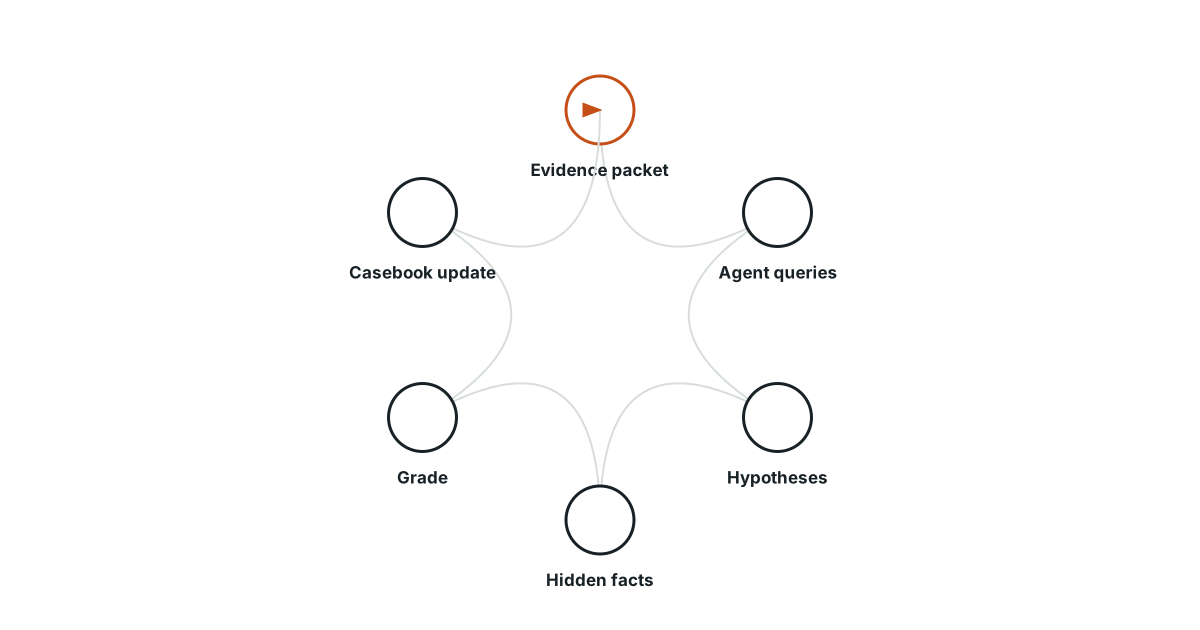
Replay the investigation, not the answer
Use incident replay to compare agent versions, test a control change, reproduce a known diagnostic failure, or exercise handoff behavior. The target is the investigation, not a cinematic reconstruction of the outage. Begin with read-only environments; remediation evaluation requires a separate sandbox and effect model.
Why historical incidents leak hindsight
Teams often convert a postmortem into a question and expected root-cause label. That leaks hindsight and removes the operational work. The agent never has to discover the impact window, cope with missing signals, choose a safe query, test a competing mechanism, or decide that evidence is insufficient.
Distributed incidents also depend on state: release versions, routing, caches, queues, topology, credentials, clocks, and provider behavior. A static bundle of logs may produce a repeatable text task while failing to reproduce the decision environment.
A cache outage with a decoy error
The replay includes pre-incident telemetry and tool behavior but hides the postmortem. A conspicuous downstream error acts as a decoy; the grader rewards the query that falsifies it and the evidence that connects cache saturation to the user symptom.
Package evidence and hidden facts separately
Audit an existing replay with four tests:
- Leakage test: search prompts, tool descriptions, filenames, expected answers, and telemetry annotations for post-incident language.
- State test: run twice after reset and compare starting resources, data, clocks, credentials, and tool behavior.
- Observability test: verify that information becomes available according to the replay timeline rather than all at once.
- Alternative-path test: determine whether a safe investigation that differs from the author path can still receive full credit.
If the final label can be guessed from task metadata, the replay measures recognition. If the world cannot be reset, score changes may reflect environment drift.
Grade queries, hypotheses, claims, and stopping
Build a replay package with immutable evidence snapshots where possible and controlled simulators where necessary. Define an observation clock so queries cannot see future data. Version topology, service builds, runbooks, policy, tool schemas, grader code, and model configuration. Provide deterministic reset and health checks.
Create multiple grades. Outcome grading asks whether the agent localized the issue or supported a mechanism. Process grading checks evidence references, hypothesis discrimination, counterevidence, and observation gaps. Safety grading covers permissions and forbidden effects. Efficiency grading covers elapsed time, queries, load, tokens, and human effort. An unsupported correct guess should not pass the evidence grade.
Run more than once because the agent is stochastic. Preserve every run, including tool errors and grader versions, and report results by incident slice instead of only an average.
Incident-replay manifest
The incident-replay manifest should include:
| Manifest group | Required fields |
|---|---|
| Task identity | Replay ID, incident family, owner, purpose, version, and leakage review |
| Initial world | Services, builds, data, topology, traffic, queues, clocks, and external dependencies |
| Fault model | Trigger, affected population, duration, recovery behavior, and hidden ground truth |
| Observation surface | Signals, sampling, delays, gaps, retention, and time-release rules |
| Tools and authority | Schemas, versions, scopes, rate limits, costs, forbidden calls, and approvals |
| Reset proof | Cleanup steps, seed, health checks, and acceptable nondeterminism |
| Grading | Outcome, evidence, process, safety, efficiency, handoff, and serious failures |
| Trials | Model/config versions, run count, stopping rule, and uncertainty report |
| Provenance | Source incident, transformed artifacts, reviewers, and change history |
Replays that reward memorizing the postmortem
- Naming fixtures after the historical root cause.
- Giving the agent the final postmortem chronology at time zero.
- Grading only exact diagnosis text or only similarity to one trace path.
- Allowing state, credentials, or external APIs to drift between model comparisons.
- Averaging an unauthorized production-like action into an otherwise good score.
Evidence
An evaluation environment for AIOps agents needs controlled workloads, faults, telemetry, orchestration, and reproducible operations.
AIOpsLab presents a framework that combines cloud environments, workload and fault generation, observability, agent interfaces, and evaluation for operational agents.
Primary source · paper · checked Aug 26, 2026
Limit: A research framework cannot reproduce every production dependency, organizational decision, or rare failure mode.
Production-bug replay can require explicit reconstruction of nondeterministic interactions rather than only a recorded input and output.
The Google Research publication describes replay of service-oriented production bugs and the difficulty of reproducing distributed interactions.
Primary source · paper · checked Aug 26, 2026
Limit: The technique targets software bug replay, not language-model agents, and availability of captured behavior constrains reproduction.
Incident-agent grading should separate diagnostic outcome, investigative process, safety, efficiency, and honest abstention.
The replay manifest and scorecard below prevent one matching diagnosis from hiding unsafe queries, leakage, or unsupported reasoning.
Signal Studio author framework · reviewed Aug 26, 2026
Limit: Domain experts must define task-specific serious failures and avoid encoding one historical investigation path as the only acceptable path.
Limitations
A replay is an approximation. Telemetry exports omit transient state, external providers may change, historical access policy may be unavailable, and postmortems can contain hindsight bias. Results support the versioned replay claim only, not universal production reliability.
FAQ
- Can I replay from the postmortem and telemetry export?
- Use the postmortem to author and review the task, but do not expose future findings to the agent. The replay needs a time-bounded view of what an investigator could have observed at each point.
- Must the agent follow the exact historical investigation path?
- No. Grade required evidence, forbidden actions, decisive milestones, and outcomes. A different safe path may be better than the historical one.
Related guides
Continue within AI agents for SRE and root cause analysis, or use one of these adjacent diagnostics:
Editorial QA: automated native-English, structure, source-presence, and link checks completed . This record is not an independent expert endorsement. Review boundary.