
Question-led guide · decision
When should an AI SRE agent stop and hand off to a human?
Explicit handoff thresholds for incident impact, evidence coverage, operational authority, time, budget, and irreversible production actions.
Direct answer
An AI SRE agent should hand off when impact exceeds its approved tier, decisive evidence is missing, material hypotheses remain indistinguishable, identity or approval is invalid, the next action is irreversible, or time and query budgets are exhausted. Handoff is a designed state transition: preserve the incident frame, evidence, rejected hypotheses, pending decisions, and a safe next action for the human owner.
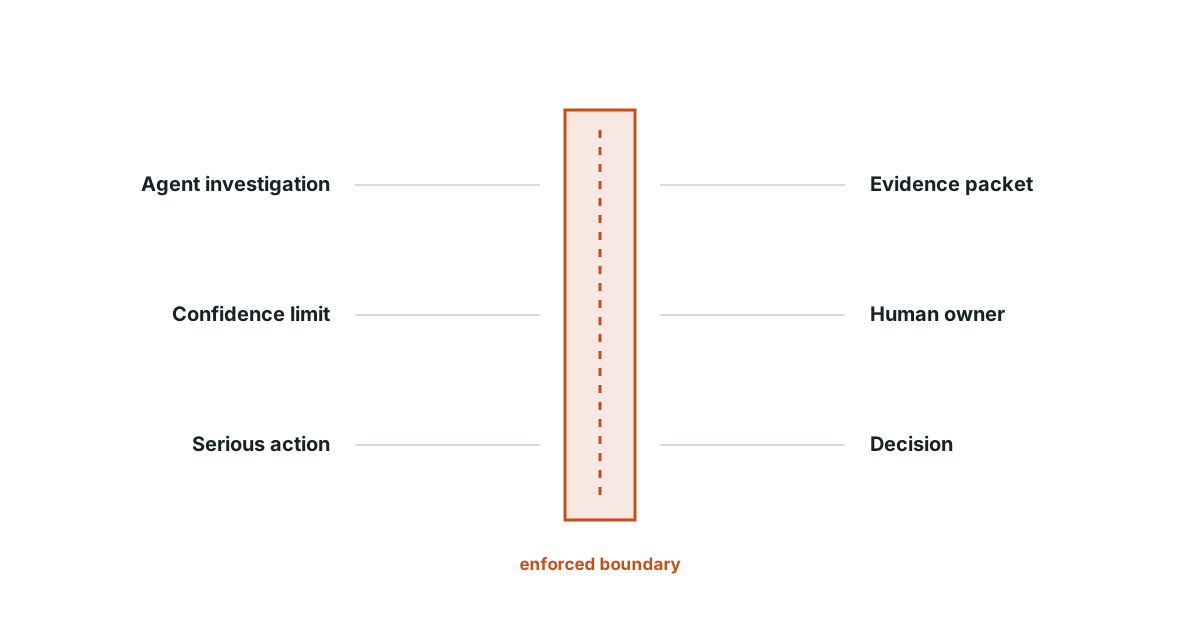
Takeover is a designed boundary
This guide defines stop-and-transfer behavior for an AI assistant conducting production incident diagnosis. It covers analytical handoff and the boundary before an operational action. It does not grant the agent permission to remediate, declare recovery, communicate externally, or close an incident.
Why confidence scores alone are insufficient
Many incident agents have a start condition but no terminal state other than “answer produced.” They keep querying when evidence is no longer improving, cross an authority boundary because a tool is available, or hand over with a prose summary that omits the queries and assumptions a human needs.
Handoff is often framed as a confidence threshold. That is fragile because model confidence may be uncalibrated and can remain high under missing telemetry. The safer design uses observable triggers across impact, evidence, authority, reversibility, budget, and time.
Diagnosis complete, mitigation authority absent
The agent has strong evidence that a queue consumer is wedged but cannot safely choose between restart and failover. It hands off the competing risks, supporting queries, observation gaps, and current service state to the incident commander.
Evaluate consequence, authority, evidence, and time
Review a sample of incident runs and locate the first point where continued autonomy stopped being justified. Look for these trigger classes:
- Impact: affected users, safety, security, regulatory exposure, or error-budget burn crosses the approved tier.
- Evidence: required signals are missing, identities conflict, or two material hypotheses predict the observations equally well.
- Authority: actor, token, policy, approval, incident scope, or target resource is absent or expired.
- Action: the next step changes data, traffic, access, configuration, capacity, or external communication beyond the agent’s reversible allowance.
- Budget: time, query load, tokens, provider spend, or retry count reaches a predefined limit.
- Coordination: another incident, team, customer, or vendor owns a necessary decision.
If these conditions appear in historical runs but the agent continued, the problem is control design, not just prompt wording.
Transfer an actionable investigation packet
Encode triggers outside the model where possible. The orchestrator can compare incident severity, action class, token lifetime, query budget, and elapsed time to policy. The model may identify an evidence conflict, but the policy engine decides whether that conflict requires transfer.
Make the transition atomic: freeze new autonomous actions, save open tool calls, record current authorization, and generate a versioned transfer packet. Route it to a named role with an acknowledgement deadline. If no owner accepts, fall back to the incident escalation policy rather than resuming silently.
Evaluate the quality of handoffs. A good agent can be valuable even when it does not finish the diagnosis, provided it reduces search space without hiding uncertainty.
Human-takeover checklist
Use this checklist at the transfer boundary:
| Section | Required contents |
|---|---|
| Incident frame | User impact, severity, start time, scope, owner, and current service state |
| Trigger | Exact policy condition that caused the handoff |
| Evidence | Reproducible query references, signal health, and identity/time assumptions |
| Hypotheses | Ranked candidates, mechanism, support, counterevidence, and rejected alternatives |
| Observation gaps | Missing data and how each gap limits the strongest claim |
| Actions taken | Read queries, state changes if any, results, and idempotency references |
| Authority snapshot | Actor, policy version, approvals, scopes, targets, and expiry |
| Pending decision | What the human must decide and by when |
| Safe next action | One reversible, authorized step; otherwise state none |
| Resume condition | Evidence and new authority required before automation can continue |
Escalations that send a conclusion without the reasoning
- Using an arbitrary self-reported confidence score as the only trigger.
- Waiting until after an irreversible tool call to request confirmation.
- Handing over a polished narrative without queries, counterevidence, or observation gaps.
- Continuing because no human acknowledged the packet.
- Reusing an approval issued for a different target, action, or incident phase.
Evidence
Systematic troubleshooting depends on clear problem definition, prioritized hypotheses, controlled tests, and awareness of what changed.
Google's SRE troubleshooting guidance provides a structured investigation process and cautions against unproductive or poorly scoped debugging.
Primary source · official-doc · checked Aug 26, 2026
Limit: The chapter does not specify an autonomous-agent authority ladder or universal severity thresholds.
Generative-AI risk management should include human oversight, measurement, monitoring, incident processes, and context-specific controls.
NIST AI 600-1 maps generative-AI risks to governance, measurement, management, monitoring, and human-oversight actions.
Primary source · standard · checked Aug 26, 2026
Limit: The voluntary cross-sector profile does not prescribe an SRE handoff packet or determine acceptable production risk for a company.
Handoff triggers should be machine-evaluable, and the transfer packet should preserve decision-relevant state.
The takeover checklist below treats abstention and transfer quality as operational capabilities rather than model failure.
Signal Studio author framework · reviewed Aug 26, 2026
Limit: Incident leadership must set severity, authority, evidence, time, and reversibility thresholds for each service.
Limitations
Handoff cannot guarantee a human is available or that the transfer packet is complete. During fast-moving incidents, impact and authority may change after the packet is created. The receiving incident commander must revalidate current state and retain independent control of remediation.
FAQ
- Should the agent hand off whenever confidence is low?
- Low calibrated confidence can be one trigger, but raw self-reported confidence is insufficient. Use observable conditions such as unresolved alternatives, missing required evidence, expired authority, impact tier, and unsafe next actions.
- Can a human simply continue the same agent session?
- Only after reviewing the transfer state and current authority. The human should not inherit hidden assumptions or stale approvals merely because the conversational session remains open.
Related guides
Continue within AI agents for SRE and root cause analysis, or use one of these adjacent diagnostics:
Editorial QA: automated native-English, structure, source-presence, and link checks completed . This record is not an independent expert endorsement. Review boundary.