
Question-led guide · how-to
What belongs in an agent release besides the container image?
Create a resolvable agent release manifest that binds code, instructions, model configuration, tools, policy, retrieval, and compatibility evidence to deployed tasks.
Direct answer
Package an agent release as an immutable manifest covering every controlled asset that changes its behavior: executable code, instructions, model configuration, tool revisions, policy, retrieval configuration, and state compatibility. Resolve those references before admission and attach the release identity to each task. Record external assets that cannot be frozen honestly. A reproducible configuration makes a result attributable; it does not guarantee identical model output.
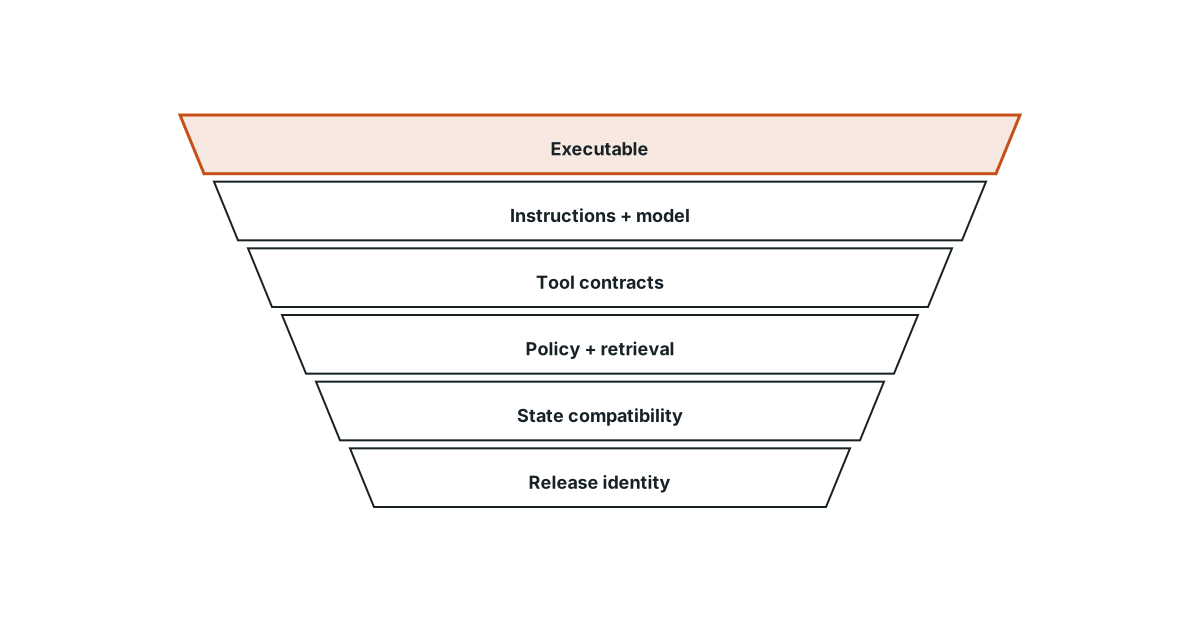
A healthy rollout can leave behavior unidentified
The deploy system knows an image digest. The application also loads a prompt from a configuration service, selects a model through a mutable route, and asks a registry which tools are available. A task’s behavior depends on all of them. Reverting the image cannot reconstruct the earlier behavior if those other inputs changed without retained revisions.
Kubernetes Deployments track changes to the Pod template. That mechanism does not automatically turn externally edited prompts or retrieval settings into an application release. The platform must define and enforce its own release boundary.
Resolve a manifest into usable assets
A list of version names is useful only when a worker can retrieve the corresponding bytes or establish the relevant service contract. Before accepting work, resolve the manifest against the asset registry, verify digests where available, check access, and determine whether the worker supports its state schema.
Distinguish three outcomes: fully resolved, explicitly dynamic, and invalid. An intentionally dynamic evidence source may be acceptable with a captured query and observation time. A missing prompt revision is invalid. Treating both as “use latest” destroys the distinction the manifest was meant to preserve.
One image, two ticket-writing behaviors
In a hypothetical deployment, build 42 runs for a week. On Tuesday, an administrator changes a tool description from “prepare a ticket draft” to “submit the ticket.” On Wednesday, an incident review finds different outcomes from tasks that report the same image.
A complete release record assigns Tuesday’s change a new identity, retains the prior tool definition, and shows which tasks received each revision. It does not imply that a description alone may authorize submission. The tool’s actual effect contract and permission enforcement must still agree with the published revision.
Copy the release resolution ledger
Use this ledger in a release review; values below describe fields to fill, not a provider-neutral executable schema.
| Asset | Required identity | Resolution check | Dynamic limit to disclose |
|---|---|---|---|
| Worker executable | Image digest and source revision | Registry object exists; provenance verifies | Runtime or host dependencies |
| Instructions | Content digest and template revision | Rendered template inputs accounted for | User input remains variable |
| Model configuration | Provider, model reference, route, parameters | Route resolves to intended deployment | Provider may change an alias |
| Tool contract | Server revision and schema/behavior record | Expected implementation available | Unversioned downstream behavior |
| Policy | Bundle revision and decision interface | Enforcement service accepts bundle | Authority still checked when required |
| Retrieval | Index build and retrieval configuration | Index and transformations identifiable | Live sources and freshness |
| State and evidence | Reader/writer compatibility and gate record | Candidate supports active state versions | Environment cannot always be replayed |
Assign one release identifier to the completed ledger and record it at task acceptance. Sensitive credentials should be referenced through their governed identity, never copied into this artifact.
Make resolution failure visible before admission
Introduce an admission check that reports missing or mismatched assets with a stable reason. Keep known-good capacity available while a candidate cannot resolve its inputs. A worker becoming ready proves only its configured readiness check; include release resolution in that check when it is a prerequisite for serving work.
Record the resolved manifest in a durable location. Later incident analysis should not depend on the current registry still mapping a name to its earlier contents. SLSA provenance helps trace artifact origin; the broader behavior ledger here is an author-created extension for application attribution.
Connect the manifest to evidence without inventing a score
Attach the evaluation evidence identifier and its evaluated manifest. Reject a candidate whose evidence describes different controlled assets unless the difference has an explicit reviewed disposition. This article does not select task portfolios or pass thresholds: the evaluation release gate owns that decision.
For environment-level reproducibility, record fixtures and dependency behavior using the reproducible agent test environment. Release packaging and experiment reconstruction are connected but distinct tasks.
Attribution survives where exact replay does not
An external model revision may disappear, or a live search result may no longer exist. Preserve the observed revision metadata and authorized evidence available at execution, then state the gap. A manifest is valuable when it shows the limits precisely. Continue with active-task revision rollout or the full deployment method in AI Agent Platform Engineering.
Evidence
A Kubernetes Deployment rollout is triggered by a change to its Pod template, not every external behavior change an application may consume.
The Deployment documentation identifies changes to spec.template as the trigger for a rollout.
Primary source · official-doc · checked Sep 8, 2026
Limit: Application configuration delivery and admission checks remain outside this controller-level guarantee.
Build provenance records where and how an artifact was produced, providing a basis for tracing a deployable artifact to its origin.
SLSA defines provenance as verifiable artifact-origin information and distinguishes build and source provenance.
Primary source · standard · checked Sep 8, 2026
Limit: A provenance attestation does not prove model behavior, semantic quality, or the correctness of this guide's release manifest.
Limitations
The resolution ledger is an integration proposal rather than an industry schema. Providers may not expose immutable model revisions, retrieval data may change, and third-party tools may lack versioned behavior. Record those gaps and validate runtime observations; do not label the entire environment frozen.
FAQ
- Can a model alias count as a pinned model version?
- Only if the provider's contract makes that alias immutable for the required period. Otherwise record the alias, observed version information, and the unresolved reproducibility limit.
- Does a matching manifest guarantee the same answer?
- No. Nondeterminism, external state, unavailable historical provider revisions, and changing data can alter the result. The manifest identifies controlled inputs and exposes the remaining uncertainty.
Related guides
Continue within AI agent platform engineering, or use one of these adjacent diagnostics:
Editorial QA: automated native-English, structure, source-presence, and link checks completed . This record is not an independent expert endorsement. Review boundary.