
Question-led guide · governance
How do you version an agent skill when a tiny edit changes behavior?
Define a skill's behavioral API, classify compatibility by observable promises, and pin package plus host dependencies before claiming a safe upgrade.
Direct answer
Version an agent skill against its public behavior: supported requests, output meaning, side effects, dependencies, and stopping rules. Classify a change by the promises it alters, not the number of edited lines. Bind the readable version to immutable package bytes and a tested host profile. A model or tool update can require compatibility review even when SKILL.md has not changed.
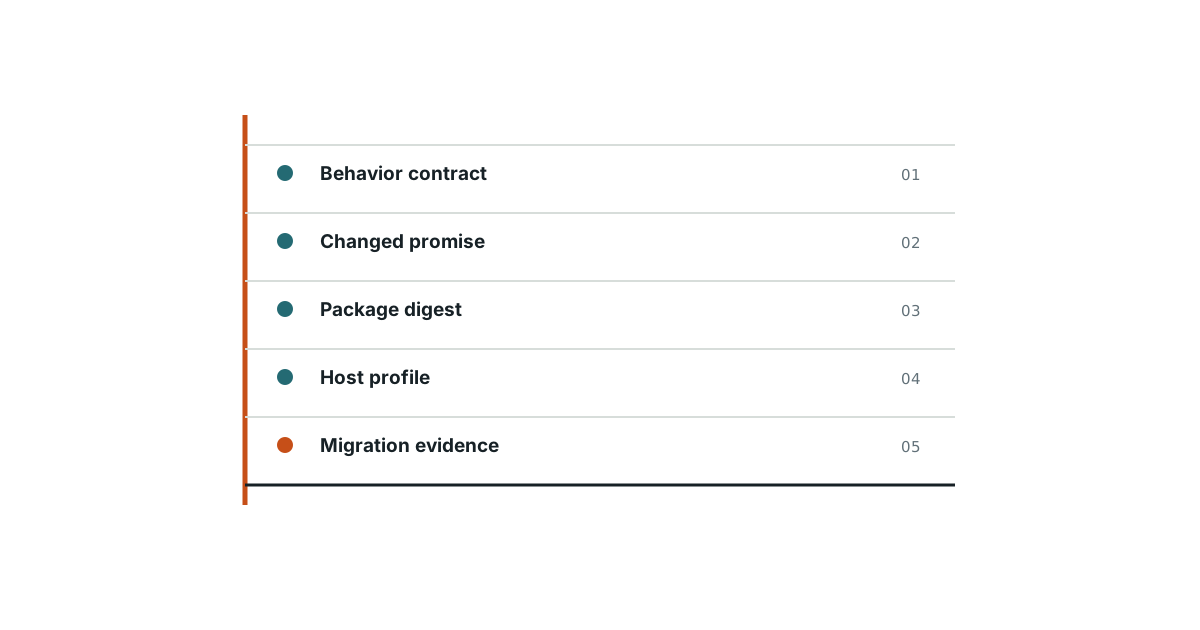
Line count cannot classify compatibility
Changing one sentence can alter a skill’s trigger, remove a required caveat, or introduce an external write. Reformatting twenty pages may preserve every observable promise. A useful version policy therefore starts with the behavior callers depend on, then evaluates how the proposed edit affects it.
Semantic Versioning supplies compatibility vocabulary for a declared public API. Applying that vocabulary to a skill requires the author to define the API; the version format does not make that definition automatically.
Write down the behavior consumers can rely on
Include supported request families, accepted input assumptions, output fields and their meanings, allowed side effects, missing-data behavior, and the conditions that stop execution. Discovery is part of the contract because a newly broad trigger can change work that previously belonged to another capability.
Distinguish promises from incidental prose. A consumer may require a field containing unresolved questions, but not a particular introductory sentence. Testing every word creates false breakages, while testing only a JSON shape may miss that a confidence label has changed meaning.
An invoice assistant adds one dangerous verb
Consider a fictional skill that classifies invoice exceptions and prepares review notes. Version 1.6 returns a draft without updating the finance system. A proposed “cleanup” adds the instruction to close any exception that appears resolved.
The output schema has not changed, but the side-effect contract has. Existing callers may have granted read access and expected every closure to go through a separate review workflow. Under a locally declared SemVer policy, the author should classify this as incompatible or split closure into a separate capability. Calling it 1.6.1 because only one line changed misrepresents the consumer impact.
Review the behavioral change record
The following record is a proposed review object, not a provider manifest. Fill it before approving a version label.
| Review field | Required decision or evidence |
|---|---|
| Prior contract | Named request, output, side-effect, and stop promises |
| Changed promise | Exact invariant added, removed, or reinterpreted |
| Compatibility class | Compatible fix, compatible addition, or migration required |
| Artifact identity | Immutable digest covering all influential package files |
| Tested profile | Host, model selection, tools, references, and policy versions |
| Comparative evidence | Baseline and candidate results for affected and protected cases |
| Consumer action | No change, opt-in, adapter update, or explicit migration |
| Recovery condition | Prior release remains eligible; external effects are reconciled |
An additive output field is compatible only if consumers tolerate it. A stricter refusal can improve a safety boundary while still breaking callers who depended on the prior scope. Name both consequences rather than forcing every beneficial change into the patch category.
Pin the package and describe the operating profile
A digest answers which bytes were selected. A readable version communicates intended compatibility. A host deployment identifier tells operators which uploaded object ran. Preserve their relationship so the same display version cannot silently map to different content.
The Claude Skills API documentation describes specific version selection. That facility does not freeze the full agent. Model settings, external reference data, tool schemas, or host behavior can change independently and invalidate prior compatibility evidence.
Compare migrations before moving the default
Run the candidate and baseline against affected tasks and protected neighbor tasks using the same prepared conditions. Inspect semantic invariants, not just an aggregate quality score. If a dependency change is intentional, record it as a separate comparison so reviewers can identify which difference plausibly caused a regression.
Move the default only after consumers have the required migration path. Retain the earlier artifact and its admission status, but do not call rollback complete merely because a version selector moved back. Any writes from the newer behavior still require reconciliation.
Keep labels narrower than the evidence
No finite suite proves that probabilistic behavior is compatible for every future request. State the tested request families and uncontrolled dependencies. The record should help a consumer decide whether the remaining uncertainty fits its use.
Continue with verification of release provenance and testing the installed skill collection. Skills in Production extends these decisions to fleet operations. This article’s invoice scenario and change record are independently written explanatory material.
Evidence
Semantic Versioning requires a declared public API and bases major, minor, and patch increments on compatibility.
SemVer 2.0.0 defines version changes in terms of incompatible API changes, compatible additions, and compatible fixes.
Primary source · standard · checked Sep 8, 2026
Limit: SemVer does not define a behavioral compatibility algorithm for probabilistic instruction packages.
The Claude Skills API allows a selected skill version instead of always resolving the latest version.
The API documentation describes skill version selection and recommends specific versions for production use.
Primary source · official-doc · checked Sep 8, 2026
Limit: A provider's version identifier is surface-specific and does not pin the model, external tools, or an organization's complete behavior profile.
A skill release needs distinct package identity, compatibility evidence, and activation identity.
The behavioral change record connects intended compatibility with artifact digest, runtime profile, evaluation, and rollback eligibility.
Signal Studio author framework · reviewed Sep 8, 2026
Limit: The record is a proposed production profile and is not an official Agent Skills or SemVer extension.
Limitations
Behavioral compatibility is a bounded empirical claim, not a guarantee of identical model output. Hosted model drift and changing external services may prevent complete pinning; those limits must remain visible in release evidence.
FAQ
- Is a wording-only change always a patch release?
- No. Wording can change activation, uncertainty handling, or external effects. Treat a patch classification as a compatibility claim that needs evidence against the declared behavior contract.
- Is pinning the skill version enough to reproduce a run?
- No. It identifies one package selection. Record the host, model, tool contracts, relevant policy, and reference dependencies as well, with any provider-controlled uncertainty clearly stated.
Related guides
Continue within Agent skills in production, or use one of these adjacent diagnostics:
Editorial QA: automated native-English, structure, source-presence, and link checks completed . This record is not an independent expert endorsement. Review boundary.